Category Archives: Math
 There are many tutorials and teachers, online and off, that can teach you how to work with matrices. This post is a quick reference for the basics. Matrix operations are important in quantum mechanics, so I thought a Sideband might have some value.
I’ll mention the technique I use when doing matrix multiplication by hand. It’s a simple way of writing it out that I find helps me keep things straight. It also makes it obvious if two matrices are compatible for multiplying (not all are).
One thing to keep in mind: It’s all just adding and multiplying!
Continue reading
7 Comments | tags: matrix math, matrix multiplication | posted in Math, Sideband
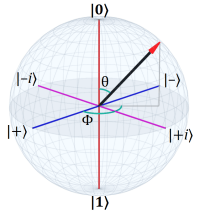 Last time I set the stage, the mathematical location for quantum mechanics, a complex vector space (Hilbert space) where the vectors represent quantum states. (A wave-function defines where the vector is in the space, but that’s a future topic.)
The next mile marker in the journey is the idea of a transformation of that space using operators. The topic is big enough to take two posts to cover in reasonable detail.
This first post introduces the idea of (linear) transformations.
Continue reading
13 Comments | tags: linear algebra, matrix transform, QM101, quantum mechanics, vector space, vectors | posted in Math, Physics
Whether it’s to meet for dinner, attend a lecture, or play baseball, one of the first questions is “where?” Everything that takes place, takes place some place (and some time, but that’s another question).
Where quantum mechanics takes place is a challenging ontological issue, but the way we compute it is another matter. The math takes place in a complex vector space known as Hilbert space (“complex” here refers to the complex numbers, although the traditional sense does also apply a little bit).
Mathematically, a quantum state is a vector in Hilbert space.
Continue reading
9 Comments | tags: coordinate system, inner product, QM101, quantum mechanics, vector space, vectors | posted in Math, Physics

Converging…
Back in October I published two posts involving the ubiquitous exponential function. [see: Circular Math and Fourier Geometry] The posts were primarily about Fourier transforms, but the exponential function is a key aspect of how they work.
We write it as ex or as exp(x) — those are equivalent forms. The latter has a formal definition that allows for the complex numbers necessary in physics. That definition is of a series that converges on an answer of increasing accuracy.
As a sidebar, I thought I’d illustrate that convergence. There’s an interesting non-linear aspect to it.
Continue reading
9 Comments | tags: exponential function, transcendental numbers | posted in Math, Sideband

And the total is…?
Oh the irony of it all. Two days ago I post about two math books, at least one of which (if not both) I think everyone should read. This morning, reading my newsfeed, I see one of those “People Are Confused By This Math Problem” articles that pop up from time to time.
Often those are expressions without parentheses, so they require knowledge of operator precedence. (I think such “problems” are dumb. Precedence isn’t set in stone; always use parentheses.)
Some math problems do have a legitimately confusing aspect, but my mind is bit blown that anyone gets this one wrong.
Continue reading
10 Comments | tags: fun with numbers, math phobia, mathematics | posted in Math, Rant, Society
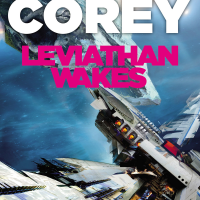
 There are many science-minded authors and working physicists who write popular science books. While there aren’t as many math-minded authors or working mathematicians writing popular math books, it’s not a null set. I’ve explored two such authors recently: mathematician Steven Strogatz and author David Berlinski.
Strogatz wrote The Joy of X (2012), which was based on his New York Times columns popularizing mathematics. I would call that a must-read for anyone with a general interest in mathematics. I just finished his most recent, Infinite Powers (2019), and liked it even more.
Berlinski, on the other hand, I wouldn’t grant space on my bookshelf.
Continue reading
11 Comments | tags: calculus, David Berlinski, derivatives, fun with numbers, integrals, numbers, Steven Strogatz, The Joy of X | posted in Books, Math
 Last time I opened with basic exponentiation and raised it to the idea of complex exponents (which may, or may not, have been surprising to you). I also began exploring the ubiquitous exp function, which enables the complex math needed to deal with such exponents.
The exp(x) function, which is the same as ex, appears widely throughout physics. The complex version, exp(ix), is especially common in wave-based physics (such as optics, sound, and quantum mechanics). It’s instrumental in the Fourier transform.
Which in turn is as instrumental to mathematicians and physicists as a hammer is to carpenters and pianos.
Continue reading
8 Comments | tags: complex numbers, complex plane, exponential function, exponentiation, Fourier transform, Heisenberg Uncertainty | posted in Math, Physics
Five years ago today I posted, Beautiful Math, which is about Euler’s Identity. In the first part of that post I explored why the Identity is so exquisitely beautiful (to mathematicians, anyway). In the second part, I showed that the Identity is a special case of Euler’s Formula, which relates trigonometry to the complex plane.
Since then I’ve learned how naïve that post was! It wasn’t wrong, but the relationship expressed in Euler’s Formula is fundamental and ubiquitous in science and engineering. It’s particularly important in quantum physics with regard to the infamous Schrödinger equation, but it shows up in many wave-based contexts.
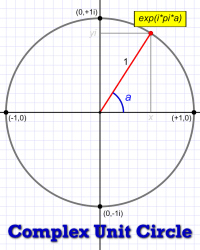
It all hinges on the complex unit circle and the exp(i×π×a) function.
Continue reading
14 Comments | tags: 3Blue1Brown, complex numbers, complex plane, Euler's Formula, Euler's Identity, exponential function, Fourier transform | posted in Math
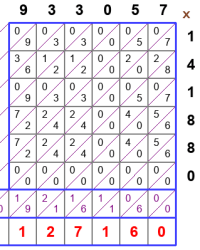 At the beginning of the month I posted about a neat Japanese visual method for multiplying smallish numbers. Besides its sheer visual attractiveness, it’s interesting in allowing one to multiply numbers without reference to multiplication tables (which, let’s face it, typically require rote memorization).
As I mentioned last time, my interest in multiplication is linked to my interest in generating Mandelbrot plots, which is a multiplication-intensive process. But for those learning math, digging into basic multiplication has some instructive value.
With that in mind, here are some other multiplication tricks.
Continue reading
14 Comments | tags: Cartesian product, multiplication | posted in Math

123 × 321 = 39,483
My interest in number multiplication goes back to exploring algorithms for generating Mandelbrot plots, which can require billions of multiplication operations on arbitrary precision numbers (numbers with lots and lots of digits).
Multiplying two numbers — calculating their product — is computationally intense because of the intermediate Cartesian product. Multiplying two 12-digit numbers creates a 24-digit result (12+12), but it also has an intermediate stage involving 144 (12×12) single digit multiplications.
Recently I learned an intriguing Japanese visual multiplication method.
Continue reading
23 Comments | tags: Cartesian product, Japanese multiplication method, Mandelbrot, multiplication | posted in Math






 Logos con carne