Category Archives: Sci-Fi Saturday
 My last post was about my disappointment in the science fiction novel series, The Expanse, starting with book four. As it turns out, for me, that’s just the start of my disengagement — it goes seriously downhill from there. To be clear I’m speaking strictly in terms of my personal taste. As the saying goes, ‘One person’s mead is another person’s poison’ (not that I’m a fan of mead).
Given the steep downward trend, book four seems better in comparison. While I like it much less than the first three, I like it much more than what follows. It has some good protomolecule bits, and frontier colony stories are pretty standard science fiction fare.
But I’m particularly struck by what the TV version changed and added.
Continue reading
25 Comments | tags: adaptations, Babylon 5, science fiction, science fiction books, science fiction TV, SF, SF Books, The Expanse (TV series) | posted in Sci-Fi Saturday, TV
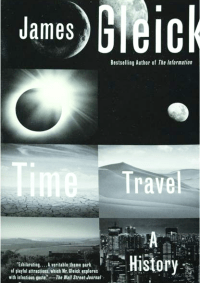 I just finished Time Travel: A History (2016) by science historian and author James Gleick. The New York Times Book Review, Anthony Doerr described it as, “A fascinating mash-up of philosophy, literary criticism, physics and cultural observation.” I agree with that description minus the word fascinating. I would have said tedious.
This is not the book’s fault. I’m not saying it’s bad. There was nothing I disagreed with. There were even a few parts I got into. The problem is I found it ambling, rambling, and meandering. It wasn’t incoherent, but it seemed disconnected to me.
Overall, I found it easy to put down and hard to pick back up.
Continue reading
16 Comments | tags: Doctor Who, Edith Nesbit, H.G. Wells, James Gleick, Robert Heinlein, The Time Machine, time, time travel | posted in Books, Sci-Fi Saturday
 If you know me at all, you know I was already a science fiction fan when Star Trek began. (It’s a rare occasion I get in on the ground floor of something.) I adored Kirk and crew. It took some episodes, but I came to love Picard and crew even more. The Trek story still unfolds, but I left that fold around the fifty-year mark. (Or rather, Trek left me.)
More recently (the rebooted) Doctor Who became my favorite SF TV series, but it’s starting to look like it won’t have the staying power that Trek did. I haven’t been as engaged the last many seasons, and the shift to the 13th Doctor hasn’t worked for me.
Currently I’d have to say my favorite SF TV series is The Expanse.
Continue reading
6 Comments | tags: Boston Legal, Captain Kirk, Chris Chibnall, Dark Matter (TV series), David Tennant, Denny Crane, Doctor Who, Jessi Combs, Jodie Whittaker, Matt Smith, Peter Capaldi, science fiction, science fiction TV, Star Trek, The Doctor, The Expanse (TV series), William Shatner | posted in Sci-Fi Saturday
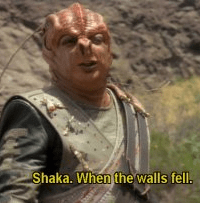 Okay, here’s one that’s been sitting in my Drafts folder since 2012. The last time I even edited it was back in 2016. (Wow. Four years already?) The problem has been turning it into a post. At this point it’s like a lazy twenty-year-old who won’t move outta the house.
If you were a serious fan of Star Trek: The Next Generation, the post’s title might ring a bell. It involves an episode with a very interesting idea about a communication problem between different species despite a “universal translator” that makes the words clear.
It isn’t a matter of language, but of metaphor.
Continue reading
9 Comments | tags: Darmok, metaphor, Picard, relationships, Star Trek | posted in Sci-Fi Saturday, Writing
 One of the older notes on my board just reads: “Armageddon (1998) vs Deep Impact (1998)”. On weirdness points, the note could just as easily have read: “Antz (1998) vs A Bug’s Life (1998)”.
The coincidence that both coincidences take place in 1998 (ah, the good old days) does makes it a bit weirder, but weird coincidences aren’t the point of my note or this post. The point is how audiences reacted to the films.
For this Sci-Fi Saturday, I thought I’d ramble about some SF Yin-Yang pairs that have struck me over the years.
Continue reading
9 Comments | tags: Frank Miller, George Lucas, Michael Bay, Mimi Leder, Peter Jackson, Robert Heinlein, science fiction movies, SF, SF Movies | posted in Movies, Sci-Fi Saturday
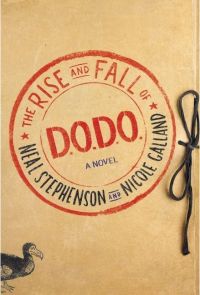 Neal Stephenson, like Greg Egan, is a hard science fiction author who never fails to delight me with something new and tasty. Both Stephenson and Egan seem able to leave footprints in otherwise well-trodden ground. Stephenson, in particular, often makes me LOL.
That’s not an acronym I use very often, but it seems especially appropriate here given this post is about The Rise and Fall of D.O.D.O., by Neal Stephenson and Nicole Galland. The book has so many tongue-in-cheek military acronyms (DODO, DTAP, DEDE, MUON, etc) that it has a glossary at the back.
The story concerns parallel worlds, wave-function collapse, and witches.
Continue reading
7 Comments | tags: hard SF, Neal Stephenson, Nicole Galland, science fiction, science fiction books, SF, SF Books, The Rise and Fall of D.O.D.O., witches | posted in Books, Sci-Fi Saturday
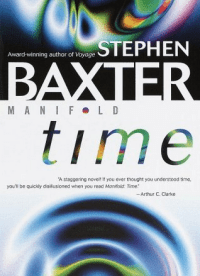 Recently I posted about Manifold: Time, the first book in a trilogy by Stephen Baxter, a writer new to me. As I wrote, I wasn’t very whelmed, but a bad meal at a new restaurant can be a fluke — it’s only fair to give the chef at least one more chance. (A single data point doesn’t mean much.) And I did find the overall themes a little intriguing.
As it turned out, I rather enjoyed the second one, Manifold: Space. The story stayed grounded and engaged me throughout, plus there were several cool science fiction ideas I’d never encountered before (which is kinda the point of reading hard SF). So a definite thumbs up on book number two.
Unfortunately, the third book, Manifold: Origin, didn’t do much for me.
Continue reading
9 Comments | tags: Fermi Paradox, Stephen Baxter | posted in Books, Sci-Fi Saturday
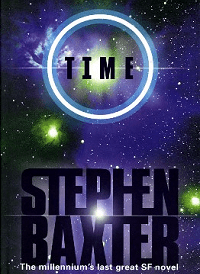 Yesterday, courtesy of Cloud Library, I finished Manifold: Time (1999), by Stephen Baxter. It’s my first exposure to Baxter, who has written 60 science fiction novels — none of which I’ve read. Per his Wiki bibliography, he’s written only a half-dozen short stories, also none of which I’ve read. (There are SF authors I’ve only met in short story collections. He isn’t one of them.)
Time is the first of the Manifold trilogy (which has a fourth book, Phase Space); the second and third books are Space (2000) and Origin (2001). Each of the books tells a separate story in a separate universe.
I enjoyed the first book, but I can’t say I was hugely whelmed.
Continue reading
24 Comments | tags: hard SF, science fiction, science fiction books, SF, SF Books, Stephen Baxter | posted in Books, Sci-Fi Saturday
 Here’s yet another unplanned post, mostly because there was something important I forgot to mention yesterday, but also because I started watching three different Netflix shows (or maybe call it two-and-a-half), and all three are fit for a Sci-Fi Saturday post, so here I am again.
I dither about three because one of them wasn’t new, it was season two I started of Siempre Bruja. But I hadn’t yet seen any of Lost in Space or the new Chilling Adventures of Sabrina. I’ve been suspicious of the former, and the latter isn’t quite my cup of tea on several counts.
But first you should know about (Your) CloudLibrary!
Continue reading
32 Comments | tags: Always a Witch, Angely Gaviria, cloudlibrary, science fiction, science fiction TV, SF, Siempre Bruja | posted in Books, Sci-Fi Saturday
 I’ll get to the delightful alien eyes later, but I want to start this Sci-Fi Saturday post with a different delight: A Trick of Light, a novel by Stan Lee. Yeah, that Stan Lee. Along with Kat Rosenfield. And no, there are no pictures, comic or otherwise.
What is there is a fast, breezy, comic-book-like story about a guy and a gal and some interesting stuff that happens to them. I read the whole thing in one long afternoon, night, and into the AM, because it was hard to put down. “Just one more chapter” grew to reading the whole thing. It was a lot of fun.
There is also an interesting but somewhat less delightful book (a trilogy, actually) to tell you about. I have some definite mixed feeling about the author and his books.
Continue reading
9 Comments | tags: A Trick of Light, Electric Dreams (TV series), Jack L. Chalker, Kat Rosenfield, Philip K. Dick, science fiction, science fiction books, science fiction TV, Stan Lee, Well World | posted in Sci-Fi Saturday








 Logos con carne