About Wyrd Smythe
The canonical fool on the hill watching the sunset and the rotation of the planet and thinking what he imagines are large thoughts.
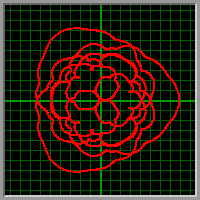
Fourier Curve 1
Don’t let the title put you off — this is one of the coolest things I’ve seen in a while. It’s because of math, but there’s no need to get all mathy to enjoy this, you just need to think about clocks. Or even wheels that spin ’round and ’round.
The fun thing is what happens when we connect one wheel to another in a chain of wheels of different sizes and turn rates. If we use the last wheel to trace out a pattern, we get something that resembles the Spirograph toy of old (which worked on a similar principle of turning wheels).
And if we pick the wheel sizes and spin rates just right, we can draw just about any picture we want.
Continue reading
4 Comments | tags: 3Blue1Brown, JPEG, sine wave | posted in Math, Wednesday Wow
 I’ve said before that I’m kind of bored with the high-calorie low-nutrition CGI spectacles Hollywood cranks out. Some of that is on me; I was into movies long before all that started, so very much a case of ‘been there, seen that, bought the DVDs.’
I’m just weary of the same old thing, which is all many bigger movies are. They cost so much to make and have to earn that back, so producers stay with formulas and formats they know. It tends to turn movies into commodities, like burgers or pizzas.
Which is fine, but I find I really prefer the smaller, non-mainstream, artisan-oriented movies. Today, for Sci-Fi Saturday, I want to tell you about two very tasty treats.
Continue reading
4 Comments | tags: Frank Langella, James Marsden, robots, Susan Sarandon | posted in Movies, Sci-Fi Saturday
We all have our personal milestones, those marker days that tick off the passing years. July 4th has become a big one for me over the years. I’ve always liked fireworks (and thunder), so the day was always something of a joy. Various personal events over the years give it a bullet list of associations.
At the top of that list, today is my blog anniversary, so I’ve spent all month working on a little something to celebrate:

Continue reading
25 Comments | tags: 2011, 3D images, Anniversary, blog, blogger, blogging, July 4, POV-Ray, ray tracing | posted in Life
 I’ve always meant to try it, and it was on sale at the grocery store the other day, so I grabbed a couple cans (and one of the cream soda). Before even tasting it, I was amused by the prominent label declaring the brew both gluten- and caffeine-free. (I’m expecting a similar warning on my bottled spring water any day now.)
I suppose root beer could have caffeine, but its whole gestalt is mellow childhood. No one puts caffeine in! (Do they?) As for gluten, real beer has it, and I suppose it’s possible someone might link beer with root beer. (As I’ve said before, I find myself bemused by the necessity of treating consumers like stupid children.)
It’s got a cool name, though. Ya gotta give it that!
Continue reading
9 Comments | tags: caramel, Harmon Killebrew, Minnesota Twins, root beer, Target Field | posted in Baseball

I have a proposition for all of us on the left. Starting now, let’s not support any Democratic candidate who slams another Democratic candidate (for any reason). Let’s make them focus on the Pumpkin Goblin and the Republican party.
Let’s make them allow us, the voters, to decide between their proposed solutions. Don’t make us take sides, one against each other, for that way we will surely all lose.
Continue reading
9 Comments | tags: Anyone But Trump, Democratic Party, election 2020, Never Trump, Trump is a loser, Trump is a monster | posted in Politics
 I’ve long been fascinated by stories about octopuses. I confess I’ve eaten a few, too, and it’s obviously a worse than eating dog, which I could never. (OTOH, properly done calamari is really yummy!)
It’s not just that octopuses (and it is octopuses, by the way; the root is Greek, not Latin) are jaw-dropping smart. It’s that their intelligence operates in a completely different brain than ours — an evolutionary branch that considerably predates the dinosaurs. It isn’t just the top brain and eight satellite brains; it’s that their entire body, in some sense, and especially their skin, is their brain.
Check out this 13-minute TED Talk by marine biologist Roger Hanlon:
Continue reading
46 Comments | tags: brain, intelligence, mind, octopus | posted in Science
 Happy Tau Day! It’s funny. I feels like I’ve written a lot of posts about pi plus few about it’s bigger sibling, tau. Yet the reality is that I’ve only ever written one Tau Day post, and that was back in 2014. (As far as celebrating Pi Day, I’ve only written three posts in eight years: 2015, 2016, & 2019.)
What I’m probably remembering is mentioning pi a lot here (which is vaguely ironic in that I won’t eat pie — mostly I don’t like cooked fruit, but there’s always been something about pie that didn’t appeal — something about baking blackbirds in a crust or something).
It’s true that I am fascinated by the number.
Continue reading
3 Comments | tags: Andrey Kolmogorov, Champernowne constant, Gregory Chaitin, Kolmogorov complexity, normal number, normal sequence, omega constant, pi, tau, tau day | posted in Math
 This is what I imagined as my final post discussing A Computational Foundation for the Study of Cognition, a 1993 paper by philosopher and cognitive scientist David Chalmers (republished in 2012). The reader is assumed to have read the paper and the previous two posts.
This post’s title is a bit gratuitous because the post isn’t actually about intentional states. It’s about system states (and states of the system). Intention exists in all design, certainly in software design, but it doesn’t otherwise factor in. I just really like the title and have been wanting to use it. (I can’t believe no one has made a book or movie with the name).
What I want to do here is look closely at the CSA states from Chalmers’ paper.
Continue reading
65 Comments | tags: algorithm, brain, brain mind problem, computation, computationalism, computer model, computer program, David Chalmers, finite state machine, human brain, human mind, mind, positronic brain, state diagram, state table, theory of mind | posted in Computers
This continues my discussion of A Computational Foundation for the Study of Cognition, a 1993 paper by philosopher and cognitive scientist David Chalmers (republished in 2012). The reader is assumed to have read the paper and the previous post.
I left off talking about the differences between the causality of the (human) brain versus having that “causal topology” abstractly encoded in an algorithm implementing a Mind CSA (Combinatorial-State Automata). The contention is that executing this abstract causal topology has the same result as the physical system’s causal topology.
As always, it boils down to whether process matters.
Continue reading
54 Comments | tags: algorithm, brain, brain mind problem, Church-Turing thesis, computation, computationalism, computer model, computer program, David Chalmers, human brain, human mind, mind, positronic brain, theory of mind | posted in Computers
I’ve always liked (philosopher and cognitive scientist) David Chalmers. Of those working on a Theory of Mind, I often find myself aligned with how he sees things. Even when I don’t, I still find his views rational and well-constructed. I also like how he conditions his views and acknowledges controversy without disdain. A guy I’d love to have a beer with!
Back during the May Mind Marathon, I followed someone’s link to a paper Chalmers wrote. I looked at it briefly, found it interesting, and shelved it for later. Recently it popped up again on my friend Mike’s blog, plus my name was mentioned in connection with it, so I took a closer look and thought about it…
Then I thought about it some more…
Continue reading
11 Comments | tags: algorithm, brain, brain mind problem, computation, computationalism, computer model, computer program, David Chalmers, human brain, human mind, mind, positronic brain, theory of mind | posted in Computers, Philosophy




 Logos con carne