Tag Archives: quantum mechanics
 An article in a recent issue of New Scientist caught my attention on two counts: firstly, in what it said about my old friend wavefunction collapse and the measurement problem; and secondly, in mentioning Boltzmann Brains. Both set off my “Yeah, but!” reaction.
I’ll touch (as briefly as possible) on the first point, but this little Bubble is mainly about the second one.
Boltzmann Brains bug me.
Continue reading
3 Comments | tags: measurement problem, quantum mechanics, wave-function | posted in Brain Bubble, Physics
 It’s been a while, but the two previous posts in this series (this one and this one) explored the mechanism behind partial differential equations that equate the time derivative (the rate of change), with the second spatial derivative (the field curvature). The result pulls exceptions to the average back to the average in proportion to how exceptional they are.
Such equalities appear in many classical physics equations where they have clear physical meaning. Heat diffusion (explored in the previous posts) is a good example.
In quantum mechanics, they also appear in the Schrödinger Equation.
Continue reading
6 Comments | tags: QM101, quantum mechanics, Schrödinger Equation, wave-function | posted in Math, Physics
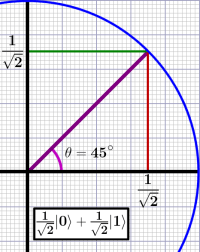 It’s actually obvious and might fall under the “Duh!” heading for some, but it only recently sunk in on me that the Born Rule is really just another case of the Pythagorean theorem. The connection is in the way the coefficients of a quantum superposition, when squared, must sum to unity (one).
For that matter, Special Relativity, which is entirely geometric, is yet another example of the Pythagorean theorem, but that’s another story. (One I’ve already told. See: SR #X6: Moving at Light Speed)
The obvious connection is the geometry behind how a quantum state projects onto the basis eigenvectors axes.
Continue reading
9 Comments | tags: geometry, Pythagoras, QM101, quantum mechanics, trigonometry | posted in Brain Bubble, Math, Physics
A single line from a blog post I read got me wondering if maybe (just maybe) the answer to a key quantum question has been figuratively lurking under our noses all along.
Put as simply as possible, the question is this: Why is the realm of the very tiny so different from the larger world? (There’s a cosmological question on the other end involving gravity and the realm of the very vast, but that’s another post.)
Here, the answer just might involve the wavelength of matter.
Continue reading
9 Comments | tags: de Broglie wavelength, QM101, quantum computing, quantum mechanics, qubits | posted in Opinion, Physics
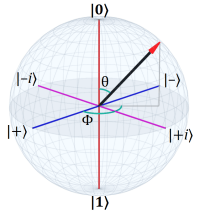
I’ve been working my way through The Principles of Quantum Mechanics (1930), by Paul Dirac. (It’s available as a Kindle eBook for only 6.49 USD.) It’s perhaps best known for being where he defines and describes his 〈bra|ket〉 notation (which I posted about in QM 101: Bra-Ket Notation). More significantly, Dirac shows how to build a mathematical quantum theory from the ground up.
This is not a pop-science book. Common wisdom is that including even a single equation in a science book greatly reduces reader interest. Dirac’s book, in its 82 chapters, has 785 equations! (And no diagrams, which is a pity. I like diagrams.)
What I wanted to post about is something he mentioned about qubits.
Continue reading
14 Comments | tags: Bloch sphere, bra-ket notation, Paul Dirac, QM101, quantum computing, quantum mechanics, qubits | posted in Physics
In the last four posts (Quantum Measurement, Wavefunction Collapse, Quantum Decoherence, and Measurement Specifics), I’ve explored the conundrum of measurement in quantum mechanics. As always, you should read those before you read this.
Those posts covered a lot of ground, so here I want to summarize and wrap things up. The bottom line is that we use objects with classical properties to observe objects with quantum properties. Our (classical) detectors are like mousetraps with hair-triggers, using stored energy to amplify a quantum interaction to classical levels.
Also, I never got around to objective collapse. Or spin experiments.
Continue reading
23 Comments | tags: measurement problem, QM101, quantum mechanics, quantum physics, wave-function | posted in Opinion, Physics
In the last three posts (Quantum Measurement, Wavefunction Collapse, and Quantum Decoherence), I’ve explored one of the key conundrums of quantum mechanics, the problem of measurement. If you haven’t read those posts, I recommend doing so now.
I’ve found that, when trying to understand something, it’s very useful to think about concrete real-world examples. Much of my puzzling over measurement involves trying to figure out specific situations and here I’d like to explore some of those.
Starting with Mr. Schrödinger’s infamous cat.
Continue reading
8 Comments | tags: measurement problem, QM101, quantum mechanics, quantum physics, Schrödinger's Cat | posted in Opinion, Physics
In the last two posts (Quantum Measurement and Wavefunction Collapse), I’ve been exploring the notorious problem of measurement in quantum mechanics. This post picks up where I left off, so if you missed those first two, you should go read them now.
Here I’m going to venture into what we mean by quantum coherence and the Yin to its Yang, quantum decoherence. I’ll start by trying to explain what they are and then what the latter has to do with the measurement problem.
The punchline: Not very much. (But not exactly nothing, either.)
Continue reading
52 Comments | tags: measurement problem, QM101, quantum mechanics, quantum physics | posted in Opinion, Physics
The previous post began an exploration of a key conundrum in quantum physics, the question of measurement and the deeper mystery of the divide between quantum and classical mechanics. This post continues the journey, so if you missed that post, you should go read it now.
Last time, I introduced the notion that “measurement” of a quantum system causes “wavefunction collapse”. In this post I’ll dig more deeply into what that is and why it’s perceived as so disturbing to the theory.
Caveat lector: This post contains a tiny bit of simple geometry.
Continue reading
13 Comments | tags: measurement problem, QM101, quantum mechanics, quantum physics, Schrödinger Equation | posted in Opinion, Physics
Over the last handful of years, fueled by many dozens of books, lectures, videos, and papers, I’ve been pondering one of the biggest conundrums in quantum physics: What is measurement? It’s the keystone of an even deeper quantum mystery: Why is quantum mechanics so strangely different from classical mechanics?
I’ll say up front that I don’t have an answer. No one does. The greatest minds in science have chewed on the problem for almost 100 years, and all they’ve come up with are guesses — some of them pretty wild.
This post begins an exploration of the conundrum of measurement and the deeper mystery of quantum versus classical mechanics.
Continue reading
24 Comments | tags: measurement problem, QM101, quantum mechanics, quantum physics | posted in Opinion, Physics





 Logos con carne