Tag Archives: Albert Einstein
 This is an eXtra post in the Special Relativity series. It explores a sub-topic in detail that may not be of interest to most readers — either the detail or the sub-topic itself. The purpose of the post is to pre-answer, or serve as a reference for, obvious questions that the technically astute might ask (often questions I once asked).
This article is about the acceleration and deceleration that seems required in the Twins Paradox illustration. Some even refuse to accept the illustration as valid under the belief that changing speed significantly alters the picture.
Here I try to show how we can completely ignore it.
Continue reading
2 Comments | tags: Albert Einstein, Emmy Noether, Special Relativity, time dilation, Twins Paradox | posted in Physics
 Last time we watched friend Em make a six light-year trip to planet Noether while friend Al stays home on Earth working on Theories. It turns out that Al ages 27 years while Em ages only 23 (point 8). This is not due to special diet, but to Special Relativity slowing Em’s clock on account of her fast motion through space.
We also saw that once Em stops at Noether, this breaks the symmetry of the two valid points of view regarding their motion (Em and ship are moving vs Al, Earth, and space, are moving).
Today we examine the trip before that point, while it is symmetrical.
Continue reading
5 Comments | tags: Albert Einstein, Emmy Noether, length contraction, light, light speed, light year, space-time, Special Relativity, time, time dilation, time-space diagram, Twins Paradox | posted in Physics
 We’ve covered a great deal of ground in the last four weeks. (Writing a series of posts this long is a new experience for me! I hope you’re getting something out of it, too.) We’ve learned that motion, velocity, simultaneity, and length, are all relative to your frame of reference — motion changes your perception of these things. This week we’ll see that time is also relative — motion changes that, too!
So far, we only needed a (very imaginary) train to demonstrate the effects of Special Relativity. An Earthly frame of reference was enough to illustrate how motion affects velocity, simultaneity, and length.
But when it comes to time, we’re gonna need spaceships!
Continue reading
51 Comments | tags: Albert Einstein, cosmic rays, Emmy Noether, length contraction, light speed, light year, muon, space-time, Special Relativity, time, time dilation, time-space diagram, Twins Paradox | posted in Physics
 The main topic this week was how simultaneity is relative to your frame of reference. How there are (virtual) lines of simultaneity where all points on some line — at all distances from you — share the same moment in time. For any instant you pick, that instant — that snapshot — includes all points in your space.
A line of simultaneity freezes the relative positions of objects at a given moment — which enables distance measurements. Simple example: When their watches both read 12 noon, Al and Em were 30 miles apart. A more mathematical example uses x, y, & z (& t), but it amounts to the same thing: a coordinate system.
The gotcha is that simultaneity and coordinate systems are relative when motion is involved!
Continue reading
5 Comments | tags: 1D, 2D, 3D, Albert Einstein, Emmy Noether, frame of reference, Galilean invariance, light, light clock, light cone, light speed, line of simultaneity, simultaneity, simultaneous events, space-time, Special Relativity, surface of simultaneity, time-space | posted in Physics
 It’s Friday, and I’m sure you’re thinking about the weekend, so today will be just a review and some more details about the speed of light.
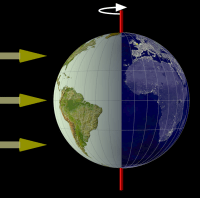
And speaking of light, today is the Vernal Equinox. For the next six months (for those of us in the northern hemisphere), our days will be longer than our nights. No doubt the combination of spring, the Equinox, and the weekend, have you wondering what you’re doing at your computer reading about Special Relativity.
I’ll try to be very brief…
Continue reading
8 Comments | tags: Albert Einstein, equinox, Galilean invariance, Galileo Galilei, light, light speed, light year, moon, Special Relativity, spring equinox, Sun, vernal equinox | posted in Physics

Throwing like a girl!
I’ve introduced the idea of an inertial frame of reference. This is when we, and objects in our frame, are either standing still or moving with constant (straight-line) motion. In this situation, we can’t tell if we’re really moving or standing still relative to some other frame of reference. In fact, the question is meaningless.
I’ve also introduced the idea that objects moving within our frame — moving (or standing still) along with us, but also moving from our perspective — move differently from the perspective of other frames. Specifically, the speed appears different.
Now I’ll dig deeper into that and introduce a crucial exception.
Continue reading
11 Comments | tags: Albert Einstein, Emmy Noether, Galilean invariance, Galileo Galilei, Mo'ne Davis, motion, scalars, Special Relativity, speed, vectors, velocity | posted in Physics
 In the last two posts I’ve explained how Special Relativity concerns relative motion between two frames of reference, and that the motion involved is constant, straight-line motion that allows us to view either frame as the “moving” one or the “standing still” one.
Today I’m going to dig a little bit deeper into the idea of relative motion and what that involves for actions within a constantly moving frame of reference versus what observers in a different frame perceive. In other words: trains, planes, and automobiles.
(Warning: this gets a little math-y, but you can ignore those bits.)
Continue reading
25 Comments | tags: Albert Einstein, bowling ball, Emmy Noether, frame of reference, Galileo Galilei, James Maxwell, motion, relative motion, relativity, Special Relativity | posted in Physics

A fun way to feel acceleration!
Last time I introduced some of the foundation concepts required for our exploration of Special Relativity. In particular, that the word “special” in this case refers to a specific kind of motion: constant motion in a straight line.
Which may have caused some of you to wonder: Okay, what about motion that isn’t constant (and what’s that business about “in a straight line” — why keep mentioning that)? As it turns out, when motion involves speeding up, or slowing down, or going along a curve (or even just changing direction), that changes the situation in very significant ways!
That’s what I’m going to discuss today.
Continue reading
3 Comments | tags: acceleration, Albert Einstein, constant motion, cubit, deceleration, fortnight, furlong, General Relativity, jiffy, motion, slowing down, Special Relativity, speeding up | posted in Physics
 Okay, if you’ll all take your seats and quiet down, we can begin. I’ll keep this very short today because I know it’s Spring and many of you are eager to get out there and walk Frisbees and throw dogs… I mean — well you know what I mean.
The point is, that in keeping with spring, I’m aiming to keep these posts light and breezy. Unfortunately, I have terrible aim, so we’ll see how that goes. I never met a paragraph I couldn’t make longer!
Ready? Let’s go…
Continue reading
24 Comments | tags: Albert Einstein, constant motion, frame of reference, motion, Special Relativity | posted in Physics
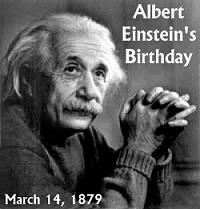 Okay. I’ve been teasing doubly special Saturday and (especially this year) since last Monday (and planting hints along the way). If you haven’t figured it out by now, today is Albert Einstein’s birthday. It’s also pi day, and how cool is it that a guy like Al was born on pi day?
So: Happy Birthday Albert! The (especially this year) part is because it’s extra-special pi day (3/14/15) and because this year I’m finally going to do what I’ve been wanting to do here to commemorate Einstein’s birthday since I started this blog back in ought-eleven.
I’m going to write — at length — about Special Relativity!
Continue reading
8 Comments | tags: Albert Einstein, Emmy Noether, faster than light, FTL, Happy Birthday, light speed, pi day, Special Relativity | posted in Math, Physics








 Logos con carne