Category Archives: Books
 Recently I posted about Manifold: Time, the first book in a trilogy by Stephen Baxter, a writer new to me. As I wrote, I wasn’t very whelmed, but a bad meal at a new restaurant can be a fluke — it’s only fair to give the chef at least one more chance. (A single data point doesn’t mean much.) And I did find the overall themes a little intriguing.
As it turned out, I rather enjoyed the second one, Manifold: Space. The story stayed grounded and engaged me throughout, plus there were several cool science fiction ideas I’d never encountered before (which is kinda the point of reading hard SF). So a definite thumbs up on book number two.
Unfortunately, the third book, Manifold: Origin, didn’t do much for me.
Continue reading
9 Comments | tags: Fermi Paradox, Stephen Baxter | posted in Books, Sci-Fi Saturday
 My voracious reading habit has deep roots in libraries. The love of reading comes from my parents, but libraries provided a vast smörgåsbord to browse and consume. Each week I’d check out as many books as I could carry. I discovered science fiction in a library (the Lucky Starr series, with Isaac Asimov writing as Paul French, is the first I remember).
Modern adult life, I got out of the habit of libraries (and into book stores and now online books). But now the Cloud Library has reinvigorated my love of all those free books, especially the ones I missed along the way.
For instance, Farewell to Reality: How Modern Physics Has Betrayed the Search for Scientific Truth (2014), by Jim Baggott.
Continue reading
13 Comments | tags: Farewell to Reality, Jim Baggott, library, Many Worlds Interpretation, MWI, theoretical physics | posted in Books, Philosophy, Physics
 Yá’át’ééh! Fans of the Hillerman books will immediately recognize the three names in the title as Joe Leaphorn, Jim Chee, and Bernadette Manuelito (a relatively new addition who doesn’t yet have her own Wiki page). All three are (fictional) police officers working for the (real) Navajo Tribal Police in the American southwest.
I have to call them just “the Hillerman books” now, because after father Tony Hillerman died, daughter Anne Hillerman took up the series and has so far contributed five very worthy stories of her own. (Her vision of the series puts Bernie Manuelito front and center and thus adds fresh air to the 18 books her father wrote.)
I’m a fan of detective novels, especially murder mystery detective novels, and these are without question my second favorite mystery books of all time.
Continue reading
26 Comments | tags: Anne Hillerman, Bernadette Manuelito, Jim Chee, Joe Leaphorn, Navajo Nation, Tony Hillerman | posted in Books, Mystery Monday
 Yesterday, courtesy of Cloud Library, I finished Manifold: Time (1999), by Stephen Baxter. It’s my first exposure to Baxter, who has written 60 science fiction novels — none of which I’ve read. Per his Wiki bibliography, he’s written only a half-dozen short stories, also none of which I’ve read. (There are SF authors I’ve only met in short story collections. He isn’t one of them.)
Time is the first of the Manifold trilogy (which has a fourth book, Phase Space); the second and third books are Space (2000) and Origin (2001). Each of the books tells a separate story in a separate universe.
I enjoyed the first book, but I can’t say I was hugely whelmed.
Continue reading
24 Comments | tags: hard SF, science fiction, science fiction books, SF, SF Books, Stephen Baxter | posted in Books, Sci-Fi Saturday
 Here’s yet another unplanned post, mostly because there was something important I forgot to mention yesterday, but also because I started watching three different Netflix shows (or maybe call it two-and-a-half), and all three are fit for a Sci-Fi Saturday post, so here I am again.
I dither about three because one of them wasn’t new, it was season two I started of Siempre Bruja. But I hadn’t yet seen any of Lost in Space or the new Chilling Adventures of Sabrina. I’ve been suspicious of the former, and the latter isn’t quite my cup of tea on several counts.
But first you should know about (Your) CloudLibrary!
Continue reading
32 Comments | tags: Always a Witch, Angely Gaviria, cloudlibrary, science fiction, science fiction TV, SF, Siempre Bruja | posted in Books, Sci-Fi Saturday
 The internet has always been a place of raging controversy, from the profound to the trivial. I’m not the first to observe that people, at least in our culture, tend to divide fairly equally over many issues. Be it about important issues (like guns or abortion), or about the trivial (like computer games or actors), we rarely agree on anything.
It starts when someone says something, and people react. Then more people react to the people reacting (and new people get on board with reacting to what the first person said, starting new waves of reaction). More and more people react to reactions, and the epidemic spreads.
This mind virus was about hurting books, so lots of people had opinions.
Continue reading
13 Comments | tags: Alex Christofi, book harm, book love, book lust, book murder, bookmark, page dogear | posted in Books
 How real is Sherlock Holmes, and what is the nature of his reality? On the one hand, Holmes is a fictional character from writer Sir Arthur Conan Doyle, but on the other there is a Canon of 56 short stories and four novels defining that character. It’s hard to deny at least some reality to something so well defined.
Others have extended the concept of Holmes far beyond the original in books, movies, TV shows, and more. The original texts are in the public domain, so there is considerable freedom to explore the idea of a crime-solving duo comprised of a brainy detective plus a faithful sidekick.
As a result, Holmes has a well-defined center and very fuzzy boundaries!
Continue reading
21 Comments | tags: A Christmas Carol, Dorothy L. Sayers, Dr. Greg House, House M.D., John Watson, Lord Peter Wimsey, ontological anti-realism, ontology, reality, Rex Stout, Sherlock Holmes | posted in Books, Mystery Monday
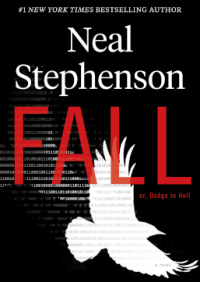 I finished Fall: or, Dodge in Hell, the latest novel from Neal Stephenson, and I’m conflicted between parts I found fascinating and thoughtful and parts I found tedious and unsatisfying. This division almost exactly follows the division of the story itself into real and virtual worlds. I liked the former, but the latter not so much.
Unfortunately, at least the last third of the book involves a Medieval fantasy quest that takes place in the virtual reality. The early parts of the story in the VR are fairly interesting, but the quest really left me cold, and I found myself skimming pages.
I give it a positive rating, but it’s my least-liked Stephenson novel.
Continue reading
17 Comments | tags: Fall; or Dodge in Hell, fantasy, hard SF, Neal Stephenson, science fiction, science fiction books, SF, SF Books, soft SF | posted in Books, Sci-Fi Saturday
I’ve been a fan of Neal Stephenson since Snow Crash (1992), his third novel. I’ve read much of his work — the big exception being The Baroque Cycle, descriptions of which haven’t captured my interest yet. I like his writing enough that I’ll probably enjoy them if I ever take the plunge.
Stephenson writes pretty hard SF, which I love, and he explores such interesting ideas that I’m generally quite enthralled by what some see as fictionalized physics books. The thing is, I’d enjoy reading those physics books, so having it come coated in any kind of frosting is a win in my (pardon the pun) book.
I’ve just gotten started on his most recent novel, Fall; or, Dodge in Hell.
Continue reading
16 Comments | tags: Fall; or Dodge in Hell, hard SF, Neal Stephenson, science fiction, science fiction books, SF, SF Books, Snow Crash | posted in Books, Sci-Fi Saturday
 Science fiction has been a deep part of my life since I was a child. I discovered it early and have been reading it ever since I started picking my own reading material. As a consequence, I’ve written a lot of posts on various SF topics, but somehow I’ve never gotten around to writing much about my other favorite genre: detective stories.
As with the SF, I discovered Sherlock Holmes early, along with the Agatha Christie detectives, Miss Marple and Hercule Poirot. I fell in love with the idea of the puzzle-solving detective. (I also had a crush on Nancy Drew, but that was a whole other kind of interest.)
Then my dad, who also loved mysteries, introduced me to Rex Stout…
Continue reading
28 Comments | tags: Archie Goodwin, detective books, murder mysteries, mystery books, Nero Wolfe, Rex Stout | posted in Books, Mystery Monday








 Logos con carne