Tag Archives: quantum mechanics
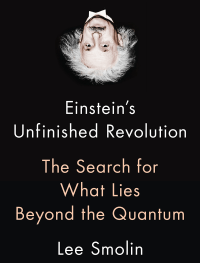 Earlier this month I posted about Quantum Reality (2020), Jim Baggott’s recent book about quantum realism. Now I’ve finished another book with a very similar focus, Einstein’s Unfinished Revolution: The Search for What Lies Beyond the Quantum (2019), by Lee Smolin.
One difference between the books is that Smolin is a working theorist, so he offers his own realist theory. As with his theory of cosmic selection via black holes (see his 1997 book, The Life of the Cosmos), I’m not terribly persuaded by his theory of “nads” (named after Leibniz’s monads). I do appreciate that Smolin himself sees the theory as a bit of a wild guess.
There were also some apparent errors that raised my eyebrows.
Continue reading
6 Comments | tags: Copenhagen Interpretation, Lee Smolin, ontological anti-realism, quantum mechanics, quantum physics, realism | posted in Books, Physics
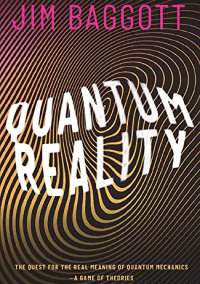 I recently read, and very much enjoyed, Quantum Reality (2020) by Jim Baggot, an author (and speaker) I’ve come to like a lot. I respect his grounded approach to physics, and we share that we’re both committed to metaphysical realism. Almost two years ago, I posted about his 2014 book Farewell to Reality: How Modern Physics Has Betrayed the Search for Scientific Truth, which I also very much enjoyed.
This book is one of a whole handful of related books I bought recently now that I’m biting one more bullet and buying Kindle books from Amazon (the price being a huge draw; science books tend to be pricy in physical form).
The thread that runs through them is that each author is committed to realism, and each is disturbed about where modern physics has gone. Me, too!
Continue reading
24 Comments | tags: Jim Baggott, Lee Smolin, ontological anti-realism, Peter Woit, quantum mechanics, quantum physics, realism, Roger Penrose, Sabine Hossenfelder | posted in Books, Physics
 Speaking of Bell tests, I’ve noticed that science writers often struggle to find a good metaphor that illustrates just what’s so weird about the correlation between entangled particles. Bell tests are complex, and because they squat in the middle of quantum weirdness, they’re hard to explain in any classical terms.
I thought I had the beginnings of a good metaphor, at least the classical part. But the quantum part is definitely a challenge. (All the more so because I’m still not entirely clear on the deep details of Bell’s theorem myself.)
Worse, I think my metaphor fails the ping-pong ball test.
Continue reading
35 Comments | tags: Bell's Theorem, particles, quantum mechanics | posted in Brain Bubble, Physics
 Last time I explored the quantum spin of photons, which manifests as the polarization of light. (Note that all forms of light can be polarized. That includes radio waves, microwaves, IR, UV, x-rays, and gamma rays. Spin — polarization — is a fundamental property of photons.)
I left off with some simple experiments that demonstrated the basic behavior of polarized light. They were simple enough to be done at home with pairs of sunglasses, yet they demonstrate the counter-intuitive nature of quantum mechanics.
Here I’ll dig more into those and other experiments.
Continue reading
10 Comments | tags: Bell's Theorem, photons, QM101, quantum mechanics | posted in Physics
 I finished The Quantum Labyrinth: How Richard Feynman and John Wheeler Revolutionized Time and Reality (2017), by Paul Halpern. As the title implies, the book revolves around the careers and lives of John A. Wheeler (1911–2008) and Richard Feynman (1918–1988). After Feynman graduated from MIT he became Wheeler’s teaching assistant at Princeton. The two men, despite very different personalities, became life-long friends and collaborators.
One of Wheeler’s many claims to fame is his promotion of Hugh Everett’s PhD thesis, The Theory of the Universal Wave Function. That paper, of course, is the seed from which grew the Many Worlds Interpretation of Quantum Mechanics.
The thing is, there are two major versions of the MWI.
Continue reading
3 Comments | tags: Many Worlds Interpretation, MWI, Paul Halpern, quantum mechanics, Sabine Hossenfelder | posted in Brain Bubble, Physics
I’m two-thirds through my second Paul Halpern book this month. Earlier I read his book about cosmology, Edge of the Universe: A Voyage to the Cosmic Horizon and Beyond (2012), which was okay. Now I’m reading The Quantum Labyrinth: How Richard Feynman and John Wheeler Revolutionized Time and Reality (2017), which I’m enjoying a bit more. In part because cosmology has changed more since 2012 than quantum physics has since 2017. (Arguably, the latter hasn’t changed much since the 1960s.)
I wrote about Halpern’s book, Einstein’s Dice and Schrödinger’s Cat (2015), last year. As the title implies, it focuses on two great names from physics. Quantum Labyrinth (as its title also implies) also focuses on two great physics names.
But today’s Brain Bubble (as the title implies) is about wavefunction collapse.
Continue reading
10 Comments | tags: Paul Halpern, quantum mechanics, Schrödinger Equation, wave-function | posted in Brain Bubble, Physics
When I was in high school, bras were of great interest to me — mostly in regards to trying to remove them from my girlfriends. That was my errant youth and it slightly tickles my sense of the absurd that they’ve once again become a topic of interest, although in this case it’s a whole other kind of bra.
These days it’s all about Paul Dirac’s useful Bra-Ket notation, which is used throughout quantum mechanics. I’ve used it a bit in this series, and I thought it was high time to dig into the details.
Understanding them is one of the many important steps to climb.
Continue reading
15 Comments | tags: bra-ket notation, inner product, matrix multiplication, outer product, QM101, quantum mechanics | posted in Math, Physics
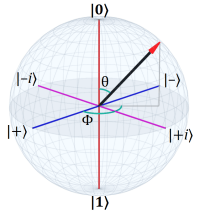
One small hill I had to climb involved the object I’ve been using as the header image in these posts. It’s called the Bloch sphere, and it depicts a two-level quantum system. It’s heavily used in quantum computing because qubits typically are two-level systems.
So is quantum spin, which I wrote about last time. The sphere idea dates back to 1892 when Henri Poincaré defined the Poincaré sphere to describe light polarization (which is the quantum spin of photons).
All in all, it’s a handy device for visualizing these quantum states.
Continue reading
16 Comments | tags: Bloch sphere, QM101, quantum computing, quantum mechanics, quantum spin | posted in Math, Physics
Popular treatments of quantum mechanics often treat quantum spin lightly. It reminds me of the weak force, which science writers often mention only in passing as ‘related to radioactive decay’ (true enough). There’s an implication it’s too complicated to explain.
With quantum spin, the handwave is that it is ‘similar to classical angular momentum’ (similar to actual physical spinning objects), but different in mysterious quantum ways too complicated to explain.
Ironically, it’s one of the simpler quantum systems, mathematically.
Continue reading
40 Comments | tags: QM101, quantum mechanics, quantum spin | posted in Math, Physics
Unless one has a strong mathematical background, one new and perhaps puzzling concept in quantum mechanics is all the talk of eigenvalues and eigenvectors.
Making it even more confusing is that physicists tend to call eigenvectors eigenstates or eigenfunctions, and sometimes even refer to an eigenbasis.
So the obvious first question is, “What (or who) is an eigen?” (It turns out to be a what. In this case there was no famous physicist named Eigen.)
Continue reading
14 Comments | tags: eigenstate, eigenvalue, eigenvector, matrix transform, QM101, quantum mechanics | posted in Math, Physics








 Logos con carne