Tag Archives: numbers
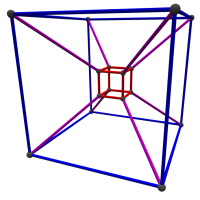
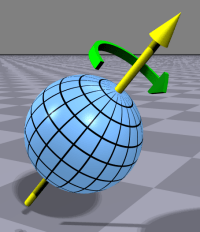 Folded into the mixed baklava of my 2018, was a special mathematical bit of honey. With the help of some excellent YouTube videos, the light bulb finally went on for me, and I could see quaternions. Judging by online comments I’ve read, I wasn’t alone in the dark.
There does seem a conceptual stumbling block (I tripped, anyway), but once that’s cleared up, quaternions turn out to be pretty easy to use. Which is cool, because they are very useful if you want to rotate some points in 3D space (a need I’m sure many of have experienced over the years).
The stumbling block has to do with quaternions having not one, not two, but three distinct “imaginary” numbers.
Continue reading
19 Comments | tags: complex numbers, math theory, mathematics, natural numbers, number systems, numbers, octonion, quaternion, real numbers | posted in Math, Sideband

But my brain is full!
You may have noticed that, in a number of recent posts, the topic has been math. The good-bad news is that there’s more to come (sorry, but I love this stuff). The good-good news is that I’m done with math foundations. For now.
To wrap up the discussion of math’s universality and inevitability — and also of its fascination and beauty — today I just have some YouTube videos you can watch this Sunday afternoon. (Assuming you’re a geek like me.)
So get a coffee and get comfortable!
Continue reading
6 Comments | tags: algebraic numbers, math and sex, math ontology, mathematics, numbers, Philosophy of Math, Theory of Mathematics, transcendental numbers | posted in Math, Opinion
Oh, no! Not math again!
Among those who try to imagine alien first contact, many believe that mathematics will be the basis of initial communication. This is based on the perceived universality and inevitability of mathematics. They see math as so fundamental any intelligence must not only discover it but must discover the same things we’ve discovered.
There is even a belief that math is more real than the physical universe, that it may be the actual basis of reality. The other end of that spectrum is a belief that mathematics is an invented game of symbol manipulation with no deep meaning.
So today: the idea that math is universal and inevitable.
Continue reading
44 Comments | tags: alien math, cardinal numbers, cardinality, counting, counting numbers, first contact, Leopold Kronecker, math origins, math theory, mathematics, natural numbers, numbers, Philosophy of Math, rational numbers, real numbers, Theory of Mathematics | posted in Math, Opinion
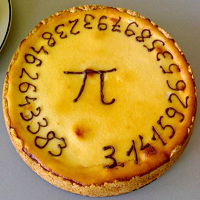
It’s pi day! Be irrational!
Earlier this week I mentioned that “this coming Saturday is a doubly special date (especially this year).” One of the things that makes it special is that it is Pi Day — 3/14 (at least for those who put the month before the day). What makes it extra-special this year is that it’s 3/14/15— a pi day that comes around only once per century. (Super-duper extra-special pi day, which happens only once in a given calendar, happened way back on 3/14/1529.)
I’ve written before about the magical pi, and I’m not going to get into it, as such, today. I’m more of a tau-ist, anyway; pi is only half as interesting. (Unfortunately, extra-special Tau Day isn’t until 6/28/31, and the super-duper extra-special day isn’t until 6/28/3185!)
What I do want to talk about is a fascinating property of pi.
Continue reading
148 Comments | tags: cake, Carl Sagan, Contact (book), Ellie Arroway, irrational numbers, Magnum Pi, normal sequence, numbers, pi, pi day, pie, real numbers, tau, tau day, transcendental numbers | posted in Math
 We’re still motoring through numeric waters but hang in there; the shore is just ahead. This is the last math theory post… for now. I do have one more up my sleeve, but that one is more of an overly long (and very technical) comment in reply to a post I read years ago. If I do write that one, it’ll be mainly to record the effort of trying to figure out the right answer.
This post picks up where I left off last time and talks more about the difference between numeric values and how we represent those values. Some of the groundwork for this discussion I’ve already written about in the L26 post and its follow-up L27 Details post. I’ll skip fairly lightly over that ground here.
Essentially, this post is about how we “spell” numbers.
Continue reading
3 Comments | tags: base 10, base 2, base 8, Frederik Pohl, Heechee, irrational numbers, Leopold Kronecker, natural numbers, number bases, number names, numbers, pi, prime numbers, rational numbers | posted in Math, Sideband
In this post I’ll show how Set Theory allows us to define the natural numbers using sets. It’s admittedly a very abstract topic, but it’s about something very common in our experience: counting things. Seeing how numbers are defined also demonstrates (contrary to some false notions) that there is a huge difference between a number and how that number is “spelled” or represented.
Note: I am not a mathematician! This topic is right on the edge of my mathematical frontier. I wanted this addendum to the previous post but be aware I may misstep. I welcome any feedback from Real Mathematicians!
But go on anyway… keep reading… I dare ya!
Continue reading
8 Comments | tags: counting, counting numbers, natural numbers, numbers, set theory, successor function | posted in Math, Sideband
Be warned: these next Sideband posts are about Mathematics! Worse, they’re about the Theory of Mathematics!! But consider sticking around, at least for this one. It fulfills a promise I made in the Infinity is Funny post about how Georg Cantor proved there are (at least) two kinds of infinity: countable and uncountable. It also connects with the Smooth or Bumpy post, which considered differences between the discrete and the continuous.
This first one is pretty easy. The actual math involved is trivial, and I think it’s fascinating how the Yin/Yang of separate units versus a smooth continuum seems a fundamental aspect of reality. We can look around to see many places characterized by “bumpy” or “smooth” (including Star Trek). (The division lies at the heart of the conflict between Einstein’s Relativity and quantum physics.)
So, let’s consider Cantor.
Continue reading
10 Comments | tags: Cantor, Cantor's Diagonal, finite, Georg Cantor, infinity, integers, irrational numbers, natural numbers, numbers, rational numbers, real numbers | posted in Math, Sideband
This one’s mine!
So I was conversing with a fellow I know, and the right side of my brain asked the left side, “So just how much square footage per person is there these days?” We both agreed that seemed like an interesting question (given all the people running around these days), so we looked around for a body to help us research the answer.
We just happened to find one handy, so off we all went to the virtual library and math lab. Unfortunately our math consultant was a Communications Arts major and made a small error thinking square kilometers to square miles was the same as kilometers to miles. Fortunately everyone involved obsessively double-checks their work, so we caught the error in time.
Pity, though. The original answer would have been fun to write about.
Continue reading
15 Comments | tags: big numbers, Earth, Earth population, numbers, square feet per person | posted in Life, Math
 Yesterday I introduced you to the idea of words as numbers. There are many ways to create a map between words and numbers. For example, we could assign them the number that represents their position in the dictionary. That would make words that start with “A” have smaller numbers while words that start with “Z” would have the largest numbers.
There are also ways to treat the words themselves as numbers. We can interpret the letters the same way we do digits. Each letter has an assigned numeric value, and then a string of letters—just like string of digits—forms a number. The scheme I showed you yesterday allows us to treat (only!) single words as numbers.
Now let’s extend this so that entire sentences—or even entire books—become numbers!
Continue reading
2 Comments | tags: big numbers, number systems, numbers, positional notation, Rudy Rucker, words, zero | posted in Basics, Math






 Logos con carne