Tag Archives: light
 The main topic this week was how simultaneity is relative to your frame of reference. How there are (virtual) lines of simultaneity where all points on some line — at all distances from you — share the same moment in time. For any instant you pick, that instant — that snapshot — includes all points in your space.
A line of simultaneity freezes the relative positions of objects at a given moment — which enables distance measurements. Simple example: When their watches both read 12 noon, Al and Em were 30 miles apart. A more mathematical example uses x, y, & z (& t), but it amounts to the same thing: a coordinate system.
The gotcha is that simultaneity and coordinate systems are relative when motion is involved!
Continue reading
5 Comments | tags: 1D, 2D, 3D, Albert Einstein, Emmy Noether, frame of reference, Galilean invariance, light, light clock, light cone, light speed, line of simultaneity, simultaneity, simultaneous events, space-time, Special Relativity, surface of simultaneity, time-space | posted in Physics
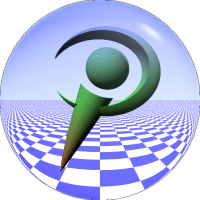 A couple of readers have asked about the diagrams in this series of Special Relativity posts. I created them with the freeware 3D ray tracing application, POV-Ray. The diagrams are actually three-dimensional “scenes” designed to be viewed as flat pieces. If some of the “dots” look more like little spheres, that’s because they are!
I wrote some introductory posts a while ago (here, here, and here). You can read those if you want more details about the application.
For a little (optional!) Friday fun, I thought I’d share some POV-Ray images that have a bit more “dimension” to them.
Continue reading
7 Comments | tags: 1D, 2D, 3D, 3D images, Emmy Noether, light, light speed, POV-Ray, ray tracing, space-time, Special Relativity, time, time-space diagram | posted in Physics
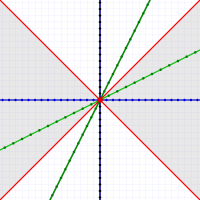
My Special Relativity “icon”!
This week I’ve introduced you to time-space diagrams. They’re the foundation of everything that follows in this series, so I hope you’re feeling very comfortable with them.
I also introduced you to space-time events, and I apologize for any confusion in calling the diagrams “time-space” and the events “space-time.” Six of one, half-dozen of the other. I wanted to stress the time component of the diagrams, whereas space-time is the more usual general term.
Today we wrap up the week with some important diagram details.
Continue reading
8 Comments | tags: distance, light, light speed, space, space-time, Special Relativity, time, time-space, time-space diagram | posted in Physics
 Last time I introduced you to the idea of a space-time event. In physics, an “event” has the same meaning as when Hollywood blares out about a “major motion picture event” — that is to say, nothing at all special — just something that happens at a specified location and time.
If you attend a social event, it has a location and a time. When we talk about space-time events, all we mean is a specific location and a specific time (hence the name, space-time event).
Today we’ll explore some interesting aspects of such events.
Continue reading
8 Comments | tags: light, light speed, space, space-time, space-time event, Special Relativity, time, time-space, time-space diagram | posted in Physics
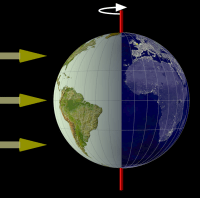 It’s Friday, and I’m sure you’re thinking about the weekend, so today will be just a review and some more details about the speed of light.
And speaking of light, today is the Vernal Equinox. For the next six months (for those of us in the northern hemisphere), our days will be longer than our nights. No doubt the combination of spring, the Equinox, and the weekend, have you wondering what you’re doing at your computer reading about Special Relativity.
I’ll try to be very brief…
Continue reading
8 Comments | tags: Albert Einstein, equinox, Galilean invariance, Galileo Galilei, light, light speed, light year, moon, Special Relativity, spring equinox, Sun, vernal equinox | posted in Physics
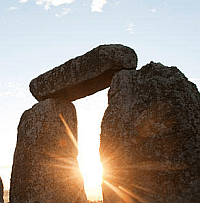 I didn’t realize it at the time, but by staying up reading until 5 AM this morning, I was awake for the ironically named “Beginning of Summer.” I say “ironically” because the Summer Solstice is the point when the days start to get shorter again. The beginning of summer is also the beginning of the darkness.
Which means that my pagan side mourns the Summer Solstice as much as it celebrates the Winter one. These days, it’s hard not to see a larger parallel in society. Many of us feel and fear society is sliding into darkness — inexorably spinning along a path towards a Winter of Disaster.
This Solstice, as food for thought, I want to introduce The Five E’s…
Continue reading
10 Comments | tags: darkness, economics, education, entertainment, environment, light, media, punching, rock bottom, social issues, social media, Solstice, summer, Summer Solstice, Sun, Supreme Court, W.G. Sebald | posted in Rant
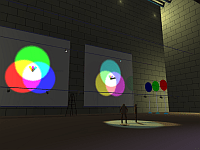 In Monday’s post I started writing about light and color. I described how white light can be created by adding three primary colors (red, green, blue), and how mixing any two result in secondary colors (yellow, cyan, magenta).
I went on to describe how subtracting two of the secondaries gives you the primary color they have in common, and how subtracting all three filters out all color, giving you black. The secondary combinations are the negative of the primary ones (e.g. blue is “anti-yellow”). I also touched on how color is the “pitch” (frequency) of light and that X-rays, radio waves, microwaves and gamma rays are all forms of light.
Today I continue the topic by exploring some details and nuances.
Continue reading
5 Comments | tags: blue, cyan, green, ink, light, magenta, primary colors, red, secondary colors, yellow | posted in Basics, Science
This is a post I began quite some time ago thinking it would be a quick and easy one, since it concerns a topic I know very well.
But — perhaps due to my own inability to be brief — it turned out to be more involved than expected. Maybe I just have a hard time leaving out all the details. In any event, I set it aside until I had more time.
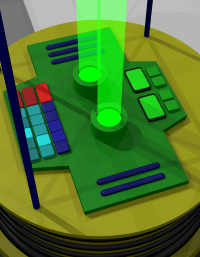
Then I had an idea for making this post a bit more fun (at least for me). The problem was: I needed to build a theatre! You see, this post is about color and light.
Continue reading
10 Comments | tags: blue, cyan, green, light, magenta, primary colors, red, secondary colors, yellow | posted in Basics, Science






 Logos con carne