 Last time on TV Tuesday, I ran out of time to write about a collection of sitcoms I’ve been watching that are all produced by, sometimes written or directed by, and in one case even starring: Kenya Barris.
His first creation, the family sitcom Black-ish, is probably the most well-known. That show has a spin-off, Grown-ish, as well as a prequel, Mixed-ish. He also has a family sitcom on Netflix, #blackAF, in which he stars as a fictional version of himself.
I really like these shows, in part because they’re pretty good — fun and funny with good characters — but also because I think it’s so important for us white folks to sometimes just STFU and listen to Black voices. Most of these shows make deliberate attempts to reach out and share something important.
Continue reading
10 Comments | tags: comedy, Deon Cole, Kenya Barris | posted in TV, TV Tuesday
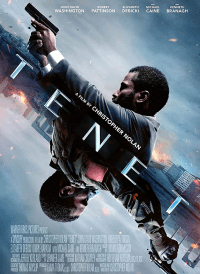 This has the potential to be short since it doesn’t feel that I have that much to say, but I did want to record a few thoughts. I have neither rant nor rave — just some heavy disappointment in one case. In the other case, for me, it’s more a sense of, “Well, what did you expect from a time-travel movie? Time travel is utterly absurd and inherently contradictory.”
The post’s title may have clued you in. This post is about Tenet (2020), the most recent Christopher Nolan movie, plus the most recent effort by his brother, Jonathan Nolan (and wife Lisa Joy), Westworld, season three (also 2020). I’m a little late to the party seeing both of these, but I was so disappointed in season two of Westworld, that I didn’t much care about season three (and nothing I heard encouraged me).
Last night (and into this morning) I binged on all that Nolan.
Continue reading
14 Comments | tags: Christopher Nolan, Jonathan Nolan, Lisa Joy, science fiction, science fiction movies, science fiction TV, Summer Solstice, Tenet (movie), Westworld (TV series) | posted in Movies, TV
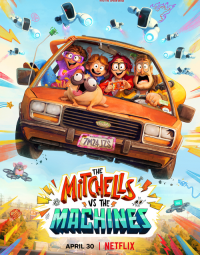 This post is a follow up to the one yesterday about TV shows I’ve been watching recently, but this one is about recent movies. Actually, there’s a dessert dish I snuck in to make it a four-course meal — I haven’t seen Hardcore Henry in a while, but it’s so unique and tasty I had to include it.
I have two entrées today, one an Amazon Prime original modeled after the great (but as it turned out not inimitable) Groundhog Day. The other, which I also saw on Prime, is an interesting and wry murder mystery with a great cast and an interesting twist on the whodunnit murder mystery.
The side dish is a Netflix animated comedy about the robot apocalypse.
Continue reading
14 Comments | tags: Amazon Prime, Hardcore Henry, Knives Out, Netflix, science fiction movies, SF Movies, The Map of Tiny Perfect Things, The Mitchells vs the Machines | posted in Movies
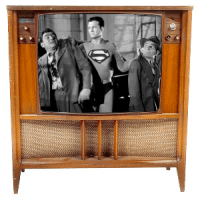 For me, one of the challenges of writing a blog post is coming up with a title. A scan of my Index shows I like short and punchy (with a dash of clever if I can manage it), and I’m not above using puns (in fact, quite love them). I wanted to call this Channel Surfing, but I’ve already used that title. (In retrospect, I should have called that one TV Triple. If only I’d known.)
Earlier this year I read a lot (see: this, this, this, or this). Lately I’m watching more TV, trying to whittle away at various watch lists. (For a retired guy, I have a lot of TODO lists. Lists on multiple ebook platforms, lists on multiple video streaming sites, household lists, personal lists,… I even have a list of local breweries to try.)
Here’s a list of what I’ve been watching lately. And a cutaway about cutaways.
Continue reading
20 Comments | tags: anime, Death & Robots, Fairy Tail, Invincible, Japanese anime, Marvel comics, MODOK, superheroes | posted in TV, TV Tuesday
 Last Saturday, on Netflix, I watched Stowaway (2021) an engaging and compelling hard science fiction film by a new filmmaker, Joe Penna. The story, which has only four characters, is reminiscent of Gravity (2013) or Apollo 13 (1995), not only in how it involves a disaster aboard a small spacecraft, but in how it tries to respect physics as much as possible. (Apollo 13, of course, was a real story which made it a lot easier.)
It is, on both counts, also similar to The Martian (2015), in which it bears a third similarity — a connection to Mars. They differ, however, in that The Martian is about a guy trying to get away from Mars whereas Stowaway is about three people trying to get to Mars.
The disaster for them is the fourth person, the stowaway.
Continue reading
16 Comments | tags: hard SF, science fiction, science fiction movies, SF, SF Movies | posted in Movies, Sci-Fi Saturday
 Lately I’ve been playing a little game of What’s the Wavelength? The question is certainly a bit evocative. Wavelength could refer to many things: a favorite radio station or, metaphorically extended, a favorite anything. It might even evoke an old news meme, although the supposed question posed that time was about frequency (which is just the inverse of wavelength).
Wavelength might even apply to one’s political, social, sexual, musical, or whatever, alignment, but in this case I mean it literally and physically. Under quantum mechanics — our best description of small-scale physical reality — everything manifests as a wave. That means everything has a wavelength — the de Broglie wavelength.
I’ve been curious about it for a couple of reasons.
Continue reading
11 Comments | tags: de Broglie wavelength, matter wave, wave-particle duality | posted in Physics, Wednesday Wow
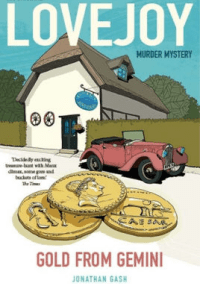 Lately, for my mystery reading, I’ve returned to another old friend from my past: the Lovejoy series by British author Jonathan Gash. It’s a murder mystery series — the sort where the star, who is not a detective of any kind, in each book is confronted with a murder to solve. Usually against their will; they’d rather be doing anything else.
The Lovejoy series has the added attraction that each book spends a fair fraction of the text talking about antiques. The main character, known only as Lovejoy, is an antiques dealer struggling to make a living. He’s also an antiques “divvie” — he has a definite, if somewhat mystical, connection with genuine antiques. He can always tell the difference between real and fake (as he describes it, a bell goes off in his chest).
I just started reading them last week, and I was immediately struck by something.
Continue reading
14 Comments | tags: detective books, Libby, Lovejoy, murder mysteries, Sherlock Holmes | posted in Books, Mystery Monday
 The notion of emergence — because it is so fundamental — pops up in a lot of physics related discussions. (Emergence itself emerges!) A couple of years ago I posted about it explicitly (see: What Emerges?), but I’ve also invoked it many times in other posts. It’s the very basic idea that combining parts in a certain way creates something not found in the parts themselves. A canonical example is how a color image emerges from red, green, and blue, pixels.
Also often discussed is reductionism, the Yin to the Yang of emergence. One is the opposite of the other. The color image can be reduced to its red, green, and blue, pixels. (The camera in your phone does exactly that.)
Recently I’ve been thinking about the asymmetry of those two, particularly with regard to why (in my opinion) determinism must be false.
Continue reading
47 Comments | tags: emergence, emergent property, physical determinism, reductionism | posted in Physics
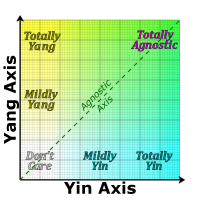 Exactly a year ago I wrote about metaphor as a tool for understanding the world around us. Our metaphors are part of the intuitive window through which we view reality. I think it’s good to have as many windows as possible, both in real life and in metaphor (intellectual rigor and creative insight are the metaphorical equivalent of Windex).
For a very long time, one of my key metaphorical windows has been the notion of Yin-Yang and its implicit notion of balance. One of my first posts was about it. Since then I’ve revisited it in myriad ways (see this, this, this, or this).
Here, among other things, I want to link Yin-Yang to another useful metaphor.
Continue reading
9 Comments | tags: parameter space, Science, scientism, Yin and Yang | posted in Sunday Sermons
 My serious effort lately to reduce my pile of notes has resulted in picking the low-hanging fruit and leaving the ones that demand more effort. (One reason those notes have been notes all this time is not feeling the effort needed to develop them into something.)
The good news is that I’ve dug through most of the new layer — the one that formed when I started blogging again after taking a break all through 2017 (being in shock from 2016). Now I’m tapping into the older much larger — and in many cases now outdated — pile from before 2017. (Notes about politics in 2016 I can now just toss.)
Three of today’s notes are from that old pile. Three obviously aren’t.
Continue reading
11 Comments | tags: Minnesota Twins, time, Twins 2021 | posted in Friday Notes




 Logos con carne