Category Archives: Math

Oh, no! Not math again!
Among those who try to imagine alien first contact, many believe that mathematics will be the basis of initial communication. This is based on the perceived universality and inevitability of mathematics. They see math as so fundamental any intelligence must not only discover it but must discover the same things we’ve discovered.
There is even a belief that math is more real than the physical universe, that it may be the actual basis of reality. The other end of that spectrum is a belief that mathematics is an invented game of symbol manipulation with no deep meaning.
So today: the idea that math is universal and inevitable.
Continue reading
44 Comments | tags: alien math, cardinal numbers, cardinality, counting, counting numbers, first contact, Leopold Kronecker, math origins, math theory, mathematics, natural numbers, numbers, Philosophy of Math, rational numbers, real numbers, Theory of Mathematics | posted in Math, Opinion
Put on your arithmetic caps, dear readers. Also your math mittens, geometry galoshes and cosine coats. Today we’re venturing after numeric prey that lurks down among the lines and angles.
There’s no danger, at least not to life or limb, but I can’t promise some ideas won’t take root in your brain. There’s a very real danger of learning something when you venture into dark territory such as this. Even the strongest sometimes succumb, so hang on to your hats (and galoshes and mittens and coats and brains).
Today we’re going after vectors and scalars (and some other game)!
Continue reading
16 Comments | tags: 2D, 3D, azimuth, coordinates, declination, dimensions, direction, elevation, location, scalars, speed, technology, vectors, velocity | posted in Math
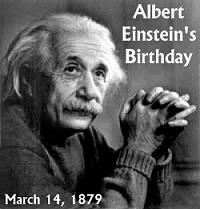 Okay. I’ve been teasing doubly special Saturday and (especially this year) since last Monday (and planting hints along the way). If you haven’t figured it out by now, today is Albert Einstein’s birthday. It’s also pi day, and how cool is it that a guy like Al was born on pi day?
So: Happy Birthday Albert! The (especially this year) part is because it’s extra-special pi day (3/14/15) and because this year I’m finally going to do what I’ve been wanting to do here to commemorate Einstein’s birthday since I started this blog back in ought-eleven.
I’m going to write — at length — about Special Relativity!
Continue reading
8 Comments | tags: Albert Einstein, Emmy Noether, faster than light, FTL, Happy Birthday, light speed, pi day, Special Relativity | posted in Math, Physics
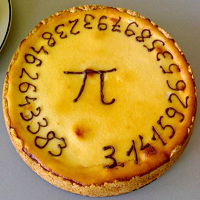
It’s pi day! Be irrational!
Earlier this week I mentioned that “this coming Saturday is a doubly special date (especially this year).” One of the things that makes it special is that it is Pi Day — 3/14 (at least for those who put the month before the day). What makes it extra-special this year is that it’s 3/14/15— a pi day that comes around only once per century. (Super-duper extra-special pi day, which happens only once in a given calendar, happened way back on 3/14/1529.)
I’ve written before about the magical pi, and I’m not going to get into it, as such, today. I’m more of a tau-ist, anyway; pi is only half as interesting. (Unfortunately, extra-special Tau Day isn’t until 6/28/31, and the super-duper extra-special day isn’t until 6/28/3185!)
What I do want to talk about is a fascinating property of pi.
Continue reading
148 Comments | tags: cake, Carl Sagan, Contact (book), Ellie Arroway, irrational numbers, Magnum Pi, normal sequence, numbers, pi, pi day, pie, real numbers, tau, tau day, transcendental numbers | posted in Math
Computing…
I’ve written here before about chaos theory and how it prevents us from calculating certain physical models effectively. It’s not that these models don’t accurately reflect the physics involved; it’s that any attempt to use actual numbers introduces tiny errors into the process. These cause the result to drift more and more as the calculation extends into the future.
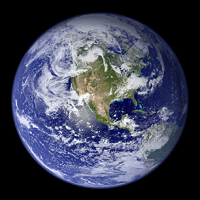
This is why tomorrow’s weather prediction is fairly accurate but a prediction for a year from now is entirely guesswork. (We could make a rough guess based on past seasons.) Yet the Earth itself is a computer — an analog computer — that tells us exactly what the weather is a year from now.
The thing is: it runs in real-time and takes a year to give us an answer!
Continue reading
3 Comments | tags: analog, analog computer, chaos theory, digital, Information Technology, mathematics, orbital mechanics, Pluto, Pluto is a planet, solar system, three-body problem, weather, weather prediction | posted in Math

Tick-Tock, goes the clock…
Last time, in the Determined Thoughts post, I talked about physical determinism, which is the idea that the universe is a machine — like a clock — that is ticking off the minutes of existence. The famous French mathematician, Pierre-Simon Laplace (the “French Newton”), was the first (in 1814) to articulate the idea of causal determinism.
We now know that quantum mechanics makes it impossible to know both the position and motion of particles, so Laplace’s Demon isn’t possible at the sub-atomic level. (It might be possible at the classical or macro level — that’s an open question.) Sometimes the issue of chaos theory is proposed as a counter-argument to determinism, so I thought I’d cover what chaos theory is and how it might apply.
If you want to skip to the punchline, the answer is it doesn’t apply at all.
Continue reading
8 Comments | tags: butterfly effect, chaos theory, Edward Lorenz, KAOS, Lorenz attractor, Mandelbrot, Mandelbrot fractal, Pierre-Simon Laplace, strange attractor, weather, weather prediction | posted in Math
 This might seem like another math post… but it’s not! It’s a geometry post! And geometry is fun, beautiful and easy. After all, it’s just circles and lines and angles. Well, mostly. Like anything, if you really want to get into it, then things can get complex (math pun; sorry). But considering it was invented thousands of years ago, can it really be that much harder than, say, the latest smart phone?
Even the dreaded trigonometry is fairly simple once you grasp the basic idea that the angles of a triangle are directly related to the length of its sides. (Okay, admittedly, that’s a bit of a simplification. The (other two) angles of a right-angle triangle are directly related to the ratios of the length of its sides, but still.)
However, this isn’t about trig; this is about tau!
Continue reading
10 Comments | tags: circle, circumference, geometry, pi, pi day, pie, pizza, radius, tau, tau day, trigonometry | posted in Math
 We’re still motoring through numeric waters but hang in there; the shore is just ahead. This is the last math theory post… for now. I do have one more up my sleeve, but that one is more of an overly long (and very technical) comment in reply to a post I read years ago. If I do write that one, it’ll be mainly to record the effort of trying to figure out the right answer.
This post picks up where I left off last time and talks more about the difference between numeric values and how we represent those values. Some of the groundwork for this discussion I’ve already written about in the L26 post and its follow-up L27 Details post. I’ll skip fairly lightly over that ground here.
Essentially, this post is about how we “spell” numbers.
Continue reading
3 Comments | tags: base 10, base 2, base 8, Frederik Pohl, Heechee, irrational numbers, Leopold Kronecker, natural numbers, number bases, number names, numbers, pi, prime numbers, rational numbers | posted in Math, Sideband
In this post I’ll show how Set Theory allows us to define the natural numbers using sets. It’s admittedly a very abstract topic, but it’s about something very common in our experience: counting things. Seeing how numbers are defined also demonstrates (contrary to some false notions) that there is a huge difference between a number and how that number is “spelled” or represented.
Note: I am not a mathematician! This topic is right on the edge of my mathematical frontier. I wanted this addendum to the previous post but be aware I may misstep. I welcome any feedback from Real Mathematicians!
But go on anyway… keep reading… I dare ya!
Continue reading
8 Comments | tags: counting, counting numbers, natural numbers, numbers, set theory, successor function | posted in Math, Sideband
Be warned: these next Sideband posts are about Mathematics! Worse, they’re about the Theory of Mathematics!! But consider sticking around, at least for this one. It fulfills a promise I made in the Infinity is Funny post about how Georg Cantor proved there are (at least) two kinds of infinity: countable and uncountable. It also connects with the Smooth or Bumpy post, which considered differences between the discrete and the continuous.
This first one is pretty easy. The actual math involved is trivial, and I think it’s fascinating how the Yin/Yang of separate units versus a smooth continuum seems a fundamental aspect of reality. We can look around to see many places characterized by “bumpy” or “smooth” (including Star Trek). (The division lies at the heart of the conflict between Einstein’s Relativity and quantum physics.)
So, let’s consider Cantor.
Continue reading
10 Comments | tags: Cantor, Cantor's Diagonal, finite, Georg Cantor, infinity, integers, irrational numbers, natural numbers, numbers, rational numbers, real numbers | posted in Math, Sideband






 Logos con carne