Category Archives: Sci-Fi Saturday
 You may know about the Drake Equation, which is an attempt to quantify the number of intelligent species that evolve in a galaxy. Depending on how you set the parameters, the answer varies from “lots!” to “almost none.” The first answer leads to Fermi’s Paradox: Okay, if there are lots of aliens… where are they? So far we’ve seen no signs (pardon the reference).
If you read science fiction you may also be familiar with the idea of Ancient Alien Ancestors (AAA) who are now long gone leaving only a legend. Sometimes there are The Ancients (now long absent), the current Elder Races (powerful, not always wise, not always kind), and the Younger Races (which Earthlings invariably belong to).
But what if we are those Ancient Ancestors?
Continue reading
30 Comments | tags: alien contact, alien races, alien vistors, aliens, ancient alien races, ancient aliens, Drake Equation, Fermi Paradox, Rare Earth Hypothesis, science fiction | posted in Brain Bubble, Sci-Fi Saturday
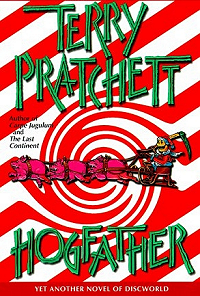 As a memorial to the loss of my favorite voice in fiction, I’ve been doing a Sir Terry Pratchett Discworld memorial read. I’d been planning to read the Witches novels again anyway, so I did that and then went on to read the Rincewind novels. Now I’m working my way through the rest in chronological order. I just finished Hogfather.
This time, as I go, I’m leaving tape flags behind to mark bits I especially liked and plan to share (and record) here. Part of what is so engaging about the Discworld novels is how intelligent and perceptive the writing is. Pratchett was a brilliant writer. After reading these books many times I’m still learning to appreciate his genius.
Today I thought I’d share some of those flagged bits with you.
Continue reading
7 Comments | tags: Death (Discworld character), Discworld, Discworld novel, Hogfather, Pterry, Pterry Psnippets, science fiction, science fiction books, Susan Sto Helit, Terry Pratchett | posted in Sci-Fi Saturday
 Movies, for a variety of reasons, are hard to make. They’re even harder to get right. Science fiction and fantasy are also hard to get right — in addition to all the other challenges of storytelling, they require much more imagination and invention than fiction based on reality or history. This, in large part, accounts for the truth of Sturgeon’s Law.
It’s not often that a science fiction movie gets all the notes exactly right. Many are lucky if they have just a few good ones that make the film worth seeing. A very rare few get enough right to make an SF film notable. (For my money, Elysium and Oblivion are recent good examples, and Ender’s Game and Edge of Tomorrow weren’t bad.)
And once in a blue moon a film gets it so right that the horse sings.
Continue reading
21 Comments | tags: Chris Pratt, Drax, Galaxy Quest, Gamora, Groot, Guardians of the Galaxy, I am Groot, James Gunn, LA Story, Marvel comics, Marvel movies, Peter Quill, Rocket Racoon, science fiction, science fiction film, Star Lord, The Fifth Element | posted in Movies, Sci-Fi Saturday
 For my money, Sir Terry Pratchett is the greatest fantasy author ever. That includes Tolkien, Verne, Wells, Burroughs, and Howard. (Martin isn’t even in this conversation to my mind, but then neither is Lucas.) Pratchett’s work has incredible social relevance. His keen sense of people, his deft hand with humor, and his ability to weave a rich, textured story as engaging as it is fantastic, gives his work a substance that sticks to the soul.
A recurring theme in Pratchett is the power — and the reality — of belief. Is Superman real? Or Sherlock Holmes? If millions believe in them, if so many stories are told about them, how can they not be real? One might say the same of all the gods we worship.
There’s also the bit about the frogs.
Continue reading
85 Comments | tags: Agnes Nutter, American Gods, bromeliad frogs, Diggers (novel), Good Omens, Johnny and the Bomb, Johnny and the Dead, Johnny Maxwell, Neil Gaiman, Only You Can Save Mankind, Terry Pratchett, The Bromeliad, Truckers (novel), Wings (novel), xkcd | posted in Sci-Fi Saturday
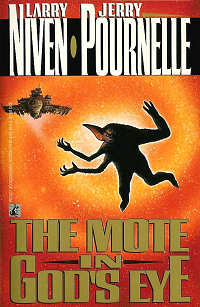 Science fiction authors Larry Niven and Jerry Pournelle collaborated on about a dozen SF novels, at least one of which is highly regarded as a classic in the genre (and an oft-named favorite). Ironically, that one — The Mote in God’s Eye — was the very first book the two of them wrote together.
Rereading it is a task I have queued for this summer (along with the sequel they wrote almost 20 years later: The Gripping Hand). But this past week or so my relaxation reading took me back to their second and third collaborations, the latter of which I just now finished.
Being that it’s Sci-Fi Saturday I thought I’d share those two with you (along with an entirely different series by an entirely different author).
Continue reading
8 Comments | tags: Idiocracy, Inferno (novel), Jerry Pournelle, Larry Niven, Oath of Fealty, omnivore, Piers Anthony, science fiction, The Gripping Hand, The Mote in God's Eye, Xanth | posted in Sci-Fi Saturday
 Bear with me; I have another get it off my chest rant about how something on the TV machine made me angry. In this case it concerns a show that’s risen quite high on the list of shows I watch: NBC’s Grimm.
I enjoy the show a lot, but I’m really annoyed about one particular aspect. It’s a glaring flaw in an otherwise very appealing show. I understand why the flaw exists, but it concerns something that’s generally bugged me in storytelling for a long time. In the case of Grimm it especially grates; I wish the writers had taken another tack.
The issue concerns keeping secrets from loved ones.
Continue reading
18 Comments | tags: Batman, Castle (TV series), Galaxy Quest, Ghost Rider, Grimm (TV series), mistaken identity, Nick Burkhardt, secret identity, secrets, Spiderman, Superman, The Man Who Knew Too Little, TNT, wesen, woge | posted in Rant, Sci-Fi Saturday, TV
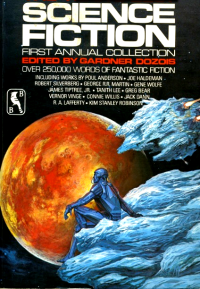 Science Fiction — or rather Speculative Fiction — has the general quality that it contains all other fiction genres. There is mystery and detective science fiction. There is romance (and sexual) science fiction. Action? Horror? Psychological thriller? Drama and pathos? Allegory? Westerns? Science fiction has them all and more.
In a sense, SF is just a property that fiction can have. I’ve tried to explain what I think that property is. I also took a stab at separating science fiction from fantasy. Now that thread resumes to explore the idea of SF hardness.
But first we return to and start with…
Continue reading
31 Comments | tags: Anne McCaffrey, David Brin, George O. Smith, Greg Egan, Hal Clement, hard SF, Isaac Asimov, James P. Hogan, Larry Niven, Orson Scott Card, Robert L. Forward, science fiction, soft SF | posted in Sci-Fi Saturday
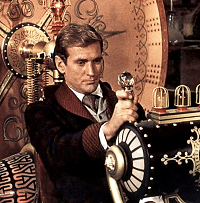 One of the great things about science fiction is how it allows an author to explore the human condition in contexts that ordinary fiction cannot. For example, it can explore the idea of immortality. Is boredom a problem? If you are immortal, but others aren’t, what is it like to see everyone you know age and die? Is it as desirable as it seems?
Some themes occur repeatedly in science fiction. Immortality is just one. A very common one is the idea of alien races — or even intelligent machines. Such stories view humanity through new eyes.
Another common one is time travel, and that is the subject of today’s Sci-Fi Saturday!
Continue reading
26 Comments | tags: H.G. Wells, Looper, Poul Anderson, Primer (film), Special Relativity, The Shield of Time, The Time Machine, Time Patrol, time travel, time tunnel | posted in Sci-Fi Saturday
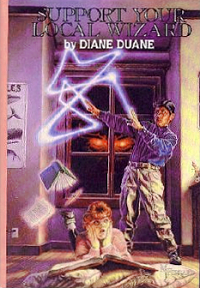 The punchline is that I was suddenly struck by how modern fiction seems to have conditioned me to expect an apparent White Hat to secretly be a Black Hat. The question I find myself asking now is whether fiction has actually changed (and if so why) or is it just me? The more I think about it, the more I’m inclined to think modern fiction has changed.
If so, does that reflect a modern sensibility about people today? Does the rise of the modern anti-hero bring with it the idea of the betrayer? Do we expect so little of people anymore that our heroes need to be dirty and double agents seem matter of course?
This all started with Diane Duane…
Continue reading
9 Comments | tags: anti-hero, Deep Wizardry, Diane Duane, Ghosts of Mars, High Wizardry, Judas, Manse Everard, Poul Anderson, So You Want to be a Wizard, Star Trek, Star Trek novels, story plots, storytelling, Time Patrol, Weeds, Young Wizards | posted in Books, Sci-Fi Saturday
 The Earth orbits our star, Sol, at a distance of roughly 93 million miles (150 million kilometers) — a distance we call an Astronomical Unit (AU). Our little rock is just under 8,000 miles wide (a bit over 12,000 km) and has a surface area (including oceans) of just under 200 million sq miles (510 million sq km). Depending on how you look at it, the Earth seems very large or very small.
What if, instead of a rock spinning around its star, it was a ring encircling it? Suppose the ring spun fast enough (770 miles per second) to create “gravity” on its inner surface? And suppose the ring was one-million miles wide and had walls 1000 miles high long both rims to keep air inside? Such a ring would have a surface area equal to about three-million Earths.
And what you’d have is Larry Niven’s Ringworld!
Continue reading
26 Comments | tags: Dyson sphere, Elysium (movie), Freeman Dyson, Larry Niven, Ringworld, Teela Brown, The Ringworld Engineers | posted in Sci-Fi Saturday






 Logos con carne