Category Archives: Brain Bubble
 The previous post, Our Memories, suggested that — in large part because they become faded self-imaginings— we might want to consider not clinging to our event memories as much as we sometimes do. We might want to focus on what we are more than where we’ve been.
Put it this way: What matters is what you are (and can do), not what facts or moments you can recall. Which is likely why I always resisted memorizing dates or formulas I can easily look up.
Which touches indirectly on a counterpoint to what I wrote yesterday…
Continue reading
2 Comments | tags: cameras, memories, smartphones | posted in Brain Bubble
In another place, someone wrote: “It is memories that make us who we are, that haunt us, that enrich and warm us, that remind us of how to be better.” The place and the someone can be anonymous here because the sentiment is a common one.
In this Brain Bubble, I’d like to push back on that, at least a little. I want to suggest as counterbalance the one memorable line from an unmemorable film trilogy:
“Let the past die. Kill it if you have to.”
Continue reading
1 Comment | tags: Kylo Ren, memories, the past | posted in Brain Bubble
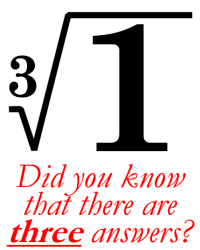 Thinking back on your math classes, you may recall that the square root of a number has two answers, one positive and one negative. For example, the square root of +9 is both +3 and -3 (the first one is known as the principal square root). Squaring +3 gives you +9, of course, but so does squaring -3.
Square roots aren’t the only roots of a number. For example, the (principal) cube root of +8 is +2 because +2³ = +2 × +2 × +2 = +8.
But just as square roots have two answers, cube roots have three (and fourth roots have four and so on and so on).
Continue reading
3 Comments | tags: complex numbers, complex plane, cube roots, Euler's Formula | posted in Brain Bubble, Math
 Today (3/14) is Pi Day. People everywhere (or at least math geeks everywhere) are baking decorated pies (or cakes or cookies) to celebrate. And while this is yet another math-y post, it’s not about pi. I’m more of a tau guy, anyway, so I celebrate Tau Day (6/28), because I get twice the (pizza) pie.
Today is also Albert Einstein’s birthday, which I’ve always thought was a cool coincidence. He’s 145 now (and still being widely misquoted).
But this post isn’t about him either.
Continue reading
10 Comments | tags: Albert Einstein, pi day, tau day, trigonometry, two slit experiment | posted in Brain Bubble, Math
The old saying “Spare the rod, spoil the child” has fallen into, shall we say, severe disfavor these days, even as just a metaphor for strict childrearing. And forget about actually spanking your kid — that’s child abuse by modern standards.
At the same time, we seem to be in the midst of a serious and growing mental health crisis among teens, especially in the USA (but also the UK and Australia).
A new book by Abigail Shrier suggests these may be connected.
Continue reading
24 Comments | tags: children, kids | posted in Brain Bubble, Society
 My final post in 2023 was about growth curves. It focused on the difference between geometric growth versus exponential growth — which turns out to be not much — and compared them to polynomial growth (see that post for the math-y details; this post isn’t a math post, so relax and read on).
A key characteristic of all these growth curves is that they grow without limit. If we treat the horizontal axis as time, then the longer the growth continues along the curve, the greater whatever growing grows.
The problem is that nothing in the real world can grow infinitely without limit. At some point, something has to give.
Continue reading
9 Comments | tags: Earth population, global warming | posted in Brain Bubble, Society
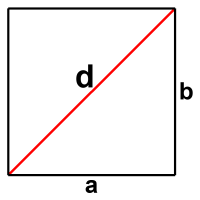 Consider the lowly square, a four-sided shape with sides of equal length meeting at right angles. The embodiment of what we’re referring to when we refer to square miles, square kilometers, square inches, or square whatevers. The two-dimensional version of any one-dimensional length.
A trivially easy shape to draw, all you need is a straight edge and a compass — the latter for ensuring your corners are right angles (see Plato’s Divided Line for more on using a straight edge and compass). The only simpler shape is the circle.
Yet the simple square threw early mathematicians into a serious tizzy!
Continue reading
12 Comments | tags: irrational numbers, Pythagoras, square | posted in Brain Bubble, Math
 An article in a recent issue of New Scientist caught my attention on two counts: firstly, in what it said about my old friend wavefunction collapse and the measurement problem; and secondly, in mentioning Boltzmann Brains. Both set off my “Yeah, but!” reaction.
I’ll touch (as briefly as possible) on the first point, but this little Bubble is mainly about the second one.
Boltzmann Brains bug me.
Continue reading
3 Comments | tags: measurement problem, quantum mechanics, wave-function | posted in Brain Bubble, Physics
You may have, at some point, seen one of those bits where a series of seemingly simple math operations somehow end up proving that 1=0 or something equally clearly wrong. Most of them accomplish their joke by sneaking in a hidden division by zero. From that point on, all bets are off (see Divide by Zero).
Recently, on a YouTube channel I follow, I saw a clever example that uses a much sneakier trick. It’s harder to spot because the operation it uses is legit in two of the three possible cases.
The gag, of course, uses the third one.
Continue reading
7 Comments | tags: fun with numbers, imaginary unit, numbers | posted in Brain Bubble, Math
 This is one of those geeky posts more a “Dear Diary” (or “Dear Lab Notebook”) entry than a post I expect anyone anywhere will get anything out of. This — in part — is about how we define numbers using set theory, so it’s pretty niche and rarified. Tuning out is understandable; this is extra-credit reading.
This is also about having a double-lightbulb moment. I finally get why what always seemed an overly complicated approach is actually perfect. A smaller lightbulb involves easily solving a programming problem that confounded me previously.
Fun for me, but your mileage may vary.
Continue reading
3 Comments | tags: computer code, math theory, natural numbers, set theory | posted in Brain Bubble, Math





 Logos con carne