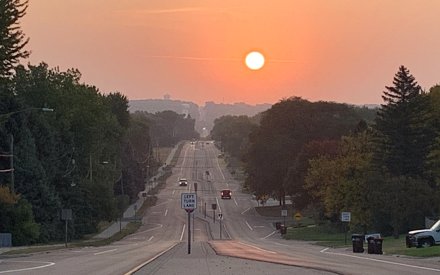
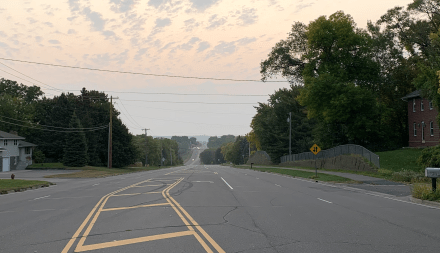
Sort of. It’s not quite the shot I’d hoped for, but it’s close-ish:
There actually is a cloud bank on the eastern horizon, so the Sun wasn’t too visible as it rose, but once it got a bit above the horizon, it was. And, a day later, it’s moved a bit south, too.
The line in question is, “The best-laid schemes o’ mice an’ men; Gang aft agley,” (go often astray), and — as you see — it applied to my plan to capture the last sunrise of summer this morning.
Ralph Emerson famously said, “A foolish consistency is the hobgoblin of little minds,” but I also like what Wilde Oscar said: “Consistency is the last refuge of the unimaginative.” The last two words in both sentences signify something important. Consistency is the enemy of creativity, art, and philosophy, although it’s generally welcomed in other places (one’s airline pilot, surgeon, or government, for instance).
Which is all by way of excusing the dreadful consistency of this so-called Monday Miscellany series. Episodes in 2012, 2014, and then not again until 2020, is barely a series. Another one so soon is definitely suspect.
These days, with digital music so easily streamed, albums seem not as central to music as they once were. Artists still make them; it’s even possible to buy vinyl versions of some new albums (there are those who still see vinyl as better than digital), but the industry no longer revolves around the idea.
In any event, a conversation topic I’ve enjoyed starting is the question of one’s perfect albums. Which is not to say one’s favorite albums — the two are not necessarily the same. A perfect album is one where you love — love, not just like — every single tune.
Lists differ, of course. The fun is seeing what people have in common.
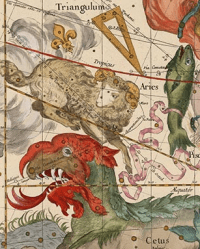
As someone with almost literally a life-long love of astronomy (my first word was “star”), I’ve always been vaguely intrigued by astrology. I’m fascinated by that which endures through many ages and cultures of humanity. At the very least, such things reflect an aspect of human consciousness. They’re also a shared idea, so they form community in the like-minded.
Is there magic in the stars? No, not in the astrological sense. Any “magic” is in us, in our consciousness, not in the stars. (Worldwide, on average, almost 12 million babies are born each month. That an astrological sign applies to them all is a bit of a stretch.)
And the thing is, most of us aren’t the sign we think we are!
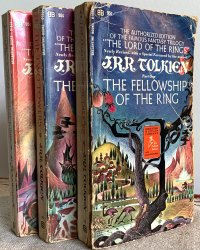
I mentioned in a post six years ago that I’d finally gotten around to unpacking a box of books that had been sitting in a closet since I moved into the place. The problem I always have when I move (aside from all the book packing) is shelf space. I prefer the kind of shelves mounted on the wall, so I have to recreate shelf space every time.
Not that my memory for what I mentioned in a post six years ago is sharp. Or even exists. I noticed the post had some views recently, so I re-read it. The line caught my eye because last week I opened the last unopened box of books.
If it isn’t one thing, it’s another. An article in Jalopnik, “You Idiots Are Going To Kill People”, talks about the increase in traffic fatalities and speeding tickets during the pandemic. Because, sure, that’s just what we need right now — people driving like maniacs.
Theories range from it being due to there being less traffic, to thinking the cops might be avoiding contact due to the virus, to just general frustration and unrest in these strange times. (I do have a sense of social unraveling sometimes.)
I have to say, driving around I’ve seen it. Lots of speeders!
My interest in number multiplication goes back to exploring algorithms for generating Mandelbrot plots, which can require billions of multiplication operations on arbitrary precision numbers (numbers with lots and lots of digits).
Multiplying two numbers — calculating their product — is computationally intense because of the intermediate Cartesian product. Multiplying two 12-digit numbers creates a 24-digit result (12+12), but it also has an intermediate stage involving 144 (12×12) single digit multiplications.
Recently I learned an intriguing Japanese visual multiplication method.
Sometimes it’s tricky figuring right from wrong, but maybe it’s a bit easier if we cast it in term of light and dark. Here’s a guy whose security camera kept alerting him because a neighbor kid on a bike looped through his driveway every evening. His response is awesome and humbling…
The lesson here goes beyond acceptance. He could have just ignored it, done nothing. Instead, he embraced it — turned it into something joyful and engaging. A bit of light in the darkness that surrounds us these days.

 Ralph Emerson famously said, “A foolish consistency is the hobgoblin of little minds,” but I also like what Wilde Oscar said: “Consistency is the last refuge of the unimaginative.” The last two words in both sentences signify something important. Consistency is the enemy of creativity, art, and philosophy, although it’s generally welcomed in other places (one’s airline pilot, surgeon, or government, for instance).
 These days, with digital music so easily streamed, albums seem not as central to music as they once were. Artists still make them; it’s even possible to buy vinyl versions of some new albums (there are those who still see vinyl as better than digital), but the industry no longer revolves around the idea.
 As someone with almost literally a life-long love of
 If it isn’t one thing, it’s another. An article in Jalopnik,





 Logos con carne