Tag Archives: science fiction

2001: A Space Trailer

This is too good not to share:

I was a big fan of 2001: A Space Odyssey when it came out in 1968 (I was in high school at the time). I was already a science fiction fan by then, so it was a dream movie for a guy like me. Later, in college, I majored in film and television, so came to appreciate the artistry of the film on a whole new level: as a visual tone poem by Stanley Kubrick.

It remains one of my favorite films, perhaps more for the memories and early exposure than for it being a great film that stands the test of time (although I rather think it is and does). I still see it as a very beautiful film; the visual poetry remains. The soundtrack also is quite extraordinary, I think.

But I’m still waiting for those commercial TWA flights to the Moon base!

Anyway, enjoy the video. It’s a trailer for 2001 as if it were cut today (making the film a Thriller … in space).

Funniest thing I’ve seen all week, and I’m indebted to the Bad Astronomer, Phil Plait, for posting it! If you like space or astronomy (or science or cool things), this is a blog site you want to visit daily. One of the best out there, as far as I’m concerned.
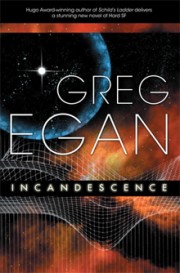

SF: Distress by Greg Egan

It’s official, I really like science fiction author Greg Egan! He’s among the modern science fiction authors; his first SF work, the short story Artifact, was published in 1983, so he’s been writing SF for about 28 years. Like many science fiction authors with a science or technical education, he writes non-fiction as well.
And here’s the thing: If you like your science fiction hard, you want to know about Greg Egan. He writes SF as hard as any I know. For instance, consider a novel (Incandescence) in which a key plot thread involves alien beings discovering (Einstein’s) General Relativity in a completely different way than Einstein did.

He reminds me of Hal Clement on several levels, particularly so in the novel I just cited, as part of it is told from the aliens’ point of view (a common device in Clement’s work).

Continue reading


Star Trek vs Star Wars

You may have heard about the recent meme battle between Princess Leia (played by the very interesting Carrie Fisher) and Captain Kirk (played by the equally interesting William Shatner).

The battle prize: which is “better,” Star Wars or Star Trek?

It began with a photon torpedo fired from the Enterprise. The warhead contained an anti-Wars payload of roughly one-quarter Mega-grin:

Continue reading


Why I Hated The Holodeck

This is a rant about an aspect of Star Trek that always bugged me: the deadly, dangerous, ridiculous Holodeck!

If it seems familiar, you may have encountered it before. I wrote it back when the show (Star Trek: The Next Generation) was still running (1987-1994) and published versions of it then and later in various online venues (FidoNet, USENET, some websites). Long-time friends will certainly recognize the rant if not the writing.

If you were on the net before the web, and you hung out in Star Trek places, you might have stumbled over this.

Continue reading


SciFi: Two Important Things

And then there was one.

Last time, I wrote that my definition of science fiction is fiction with science + imagination. And that the science is freely defined to include guesses and completely made up, if not downright illegitimate, physics. In fact, that’s the imagination part of the equation. The fiction part is also freely defined, but basic story telling rules should apply. The science part must also play by certain rules, even when it’s made-up science, even when it’s illegitimate

This article is about how I view the science and fiction in science fiction when it comes to playing by the rules. (Keep in mind that science fiction is art, and in art rules are made to be broken.)

Fantasy lovers take heart; in this case, my definition of science includes magic, the supernatural and the metaphysical. This uses the context of speculative fiction, which includes everything beyond current physics. The fiction canvas is framed by any physics, or metaphysics, the story requires. Warp drive is no more real science than vampires or Norse Gods; all of them are fiction.

Continue reading


What is Science Fiction?

I recently asked the question, “What is Art?” Answering that one is a real challenge, and the answer may be entirely subjective. This time I’m asking a question that is almost as difficult: “What is Science Fiction?” The answer may turn out to be just as subjective, and just as much of a challenge, but I’ve always thought the tough questions are the most interesting to explore.

I may, or may not, be an artist (but I know what I like!) and suffice to say I have only dabbled in art over the years. Science fiction, however, has filled my life as long as I’ve been picking my own reading material. I suspect that, overall, my fiction reading (and I read a lot of fiction) is at least 80% science fiction. It could be more. Most normal fiction leaves me disinterested, no matter how insightful it might be. I live in the real world; I want stories that take me far, far away, be it conceptually, spatially or temporally (if only temporarily).

Only authors that bring something newly invented to the table really hold my interest.

Continue reading