Tag Archives: math theory
 This is one of those geeky posts more a “Dear Diary” (or “Dear Lab Notebook”) entry than a post I expect anyone anywhere will get anything out of. This — in part — is about how we define numbers using set theory, so it’s pretty niche and rarified. Tuning out is understandable; this is extra-credit reading.
This is also about having a double-lightbulb moment. I finally get why what always seemed an overly complicated approach is actually perfect. A smaller lightbulb involves easily solving a programming problem that confounded me previously.
Fun for me, but your mileage may vary.
Continue reading
3 Comments | tags: computer code, math theory, natural numbers, set theory | posted in Brain Bubble, Math
 In the Rational vs Real post I mentioned that real numbers were each “an infinitely tiny island separated from direct contact with all other numbers.” The metaphor of each real number as an island comes from how, given any real number, it’s not possible to name the next (or previous) real number.
It’s easy enough to name a particular real number. For instance 1.0 and 3.14159… real numbers. There are infinitely many more we can name, but given any one of them, there is no way to get to any other number other than by explicitly naming it, too.
This applies to a variety of numeric spaces.
Continue reading
9 Comments | tags: complex numbers, continuum, integers, math theory, mathematics, natural numbers, numbers, rational numbers, real numbers, Theory of Mathematics | posted in Math
 One of the great philosophical conundrums involves the origin of numbers and mathematics. I first learned of it as Platonic vs Aristotelian views, but these days it’s generally called Platonism vs Nominalism. I usually think of it as the question of whether numbers are invented or discovered.
Whatever it’s called, there is something transcendental about numbers and math. It’s hard not to discover (or invent) the natural numbers. Even from a theory standpoint, the natural numbers are very simply defined. Yet they directly invoke infinity — which doesn’t exist in the physical world.
There is also the “unreasonable effectiveness” of numbers in describing our world.
Continue reading
8 Comments | tags: math theory, mathematics, natural numbers, nominalism, numbers, Plato, Platonic, Platonism, rational numbers, real numbers, Theory of Mathematics | posted in Math, Philosophy
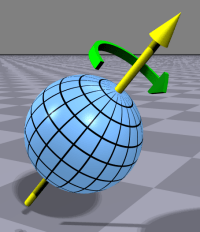 Folded into the mixed baklava of my 2018, was a special mathematical bit of honey. With the help of some excellent YouTube videos, the light bulb finally went on for me, and I could see quaternions. Judging by online comments I’ve read, I wasn’t alone in the dark.
There does seem a conceptual stumbling block (I tripped, anyway), but once that’s cleared up, quaternions turn out to be pretty easy to use. Which is cool, because they are very useful if you want to rotate some points in 3D space (a need I’m sure many of have experienced over the years).
The stumbling block has to do with quaternions having not one, not two, but three distinct “imaginary” numbers.
Continue reading
19 Comments | tags: complex numbers, math theory, mathematics, natural numbers, number systems, numbers, octonion, quaternion, real numbers | posted in Math, Sideband
I seem to be doing a lot of reblogging lately (a lot for me, anyway). But I’m on kind of a math kick right now, and this ties in nicely with all that.
 4 gravitons
You’ve probably seen it somewhere on your facebook feed, likely shared by a particularly wide-eyed friend: pi found hidden in the hydrogen atom!



From the headlines, this sounds like some sort of kabbalistic nonsense, like finding the golden ratio in random pictures.
Read the actual articles, and the story is a bit more reasonable. The last two I linked above seem to be decent takes on it, they’re just saddled with ridiculous headlines. As usual, I blame the editors. This time, they’ve obscured an interesting point about the link between physics and mathematics.
So what does “pi found hidden in the hydrogen atom” actually mean?
It doesn’t mean that there’s some deep importance to the number pi in nature, beyond its relevance in mathematics in general. The reason that pi is showing up here isn’t especially deep.
It isn’t trivial either, though. I’ve seen a few people…
View original post 546 more words
2 Comments | tags: math theory, mathematics, pi, quantum physics | posted in Math
 In the recent post Inevitable Math I explored the idea that mathematics was both universal and inevitable. The argument is that the foundations of mathematics are so woven into the fabric of reality (if not actually being the fabric of reality) that any intelligence must discover them.
Which is not to say they would think about or express their mathematics in ways immediately recognizable to us. There could be fundamental differences, not just in their notation, but in how they conceive of numbers.
To explore that a little, here are a couple of twists on numbers:
Continue reading
8 Comments | tags: alien math, Frederik Pohl, Heechee, math origins, math theory, more math, prime numbers, real numbers, surreal number | posted in Math, Opinion, Sideband
Oh, no! Not math again!
Among those who try to imagine alien first contact, many believe that mathematics will be the basis of initial communication. This is based on the perceived universality and inevitability of mathematics. They see math as so fundamental any intelligence must not only discover it but must discover the same things we’ve discovered.
There is even a belief that math is more real than the physical universe, that it may be the actual basis of reality. The other end of that spectrum is a belief that mathematics is an invented game of symbol manipulation with no deep meaning.
So today: the idea that math is universal and inevitable.
Continue reading
44 Comments | tags: alien math, cardinal numbers, cardinality, counting, counting numbers, first contact, Leopold Kronecker, math origins, math theory, mathematics, natural numbers, numbers, Philosophy of Math, rational numbers, real numbers, Theory of Mathematics | posted in Math, Opinion




 Logos con carne