 Last week, when I posted about the Mathematical Universe Hypothesis (MUH), I noted that it has the same problem as the Block Universe Hypothesis (BUH): It needs to account for its apparent out-of-the-box complexity. In his book, Tegmark raises the issue, but doesn’t put it to bed.
He invokes the notion of Kolmogorov complexity, which, in a very general sense, is like comparing things based on the size of their ZIP file. It’s essentially a measure of the size of information content. Unfortunately, his examples raised my eyebrows a little.
Today I thought I’d explore why. (Turns out I’m glad I did.)

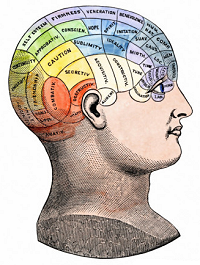 The ultimate goal is a consideration of how to create a working model of the human mind using a computer. Since no one knows how to do that yet (or if it’s even possible to do), there’s a lot of guesswork involved, and our best result can only be a very rough estimate. Perhaps all we can really do is figure out some minimal requirements.








 Logos con carne