 Yá’át’ééh! Fans of the Hillerman books will immediately recognize the three names in the title as Joe Leaphorn, Jim Chee, and Bernadette Manuelito (a relatively new addition who doesn’t yet have her own Wiki page). All three are (fictional) police officers working for the (real) Navajo Tribal Police in the American southwest.
I have to call them just “the Hillerman books” now, because after father Tony Hillerman died, daughter Anne Hillerman took up the series and has so far contributed five very worthy stories of her own. (Her vision of the series puts Bernie Manuelito front and center and thus adds fresh air to the 18 books her father wrote.)
I’m a fan of detective novels, especially murder mystery detective novels, and these are without question my second favorite mystery books of all time.
Continue reading
26 Comments | tags: Anne Hillerman, Bernadette Manuelito, Jim Chee, Joe Leaphorn, Navajo Nation, Tony Hillerman | posted in Books, Mystery Monday
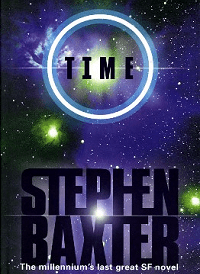 Yesterday, courtesy of Cloud Library, I finished Manifold: Time (1999), by Stephen Baxter. It’s my first exposure to Baxter, who has written 60 science fiction novels — none of which I’ve read. Per his Wiki bibliography, he’s written only a half-dozen short stories, also none of which I’ve read. (There are SF authors I’ve only met in short story collections. He isn’t one of them.)
Time is the first of the Manifold trilogy (which has a fourth book, Phase Space); the second and third books are Space (2000) and Origin (2001). Each of the books tells a separate story in a separate universe.
I enjoyed the first book, but I can’t say I was hugely whelmed.
Continue reading
24 Comments | tags: hard SF, science fiction, science fiction books, SF, SF Books, Stephen Baxter | posted in Books, Sci-Fi Saturday
 Yesterday I mentioned that someone had used colored chalk to leave some happy thoughts written on the asphalt pathway that winds through one of the local parks. Those simple signs, because of their content and because of the positive spirit behind them, really put a big grin on my face.
When I walk, I try to take a different path every day, only repeating when I’ve exhausted all possibilities. But yesterday I decided that today I’d retrace my steps and take pictures of those signs.
Without further ado, colored chalk wishes to help us smile:
Continue reading
5 Comments | tags: colored chalk, coronavirus | posted in Life
 Wow. April First, but it’s no joke how much — and how quickly — life changed. March 2020 changed the world. Now we’ll see if we survive it.
Spirits seem high around here. On my morning walk, in the park I saw that someone had used colored chalk to write good thoughts on the asphalt path: “Stay Positive!” “Nature!” “Yay! Vit. D.” “Family Time” “Exercise!” (Maybe others will join in. I think I have some colored chalk…)
It’s hard to top the real-life wows, but I do have a few interesting items that might at least offer something of a distraction.
Continue reading
9 Comments | tags: coronavirus, geometry, Platonic solids, quantum physics, simulations, virtual reality, X17 particle | posted in Life, Wednesday Wow
 I’m not that into horror, on the page or the screen. For instance, I’ve never seen any of the Jason, Freddie, or Chucky, movies. Maybe it comes from having a different set of fears, but slasher movies never did anything for me. The gore doesn’t bother me. It’s more finding it all kinda silly and ultimately tedious.
But there are definitely exceptions. Some horror stories — usually comedies or parodies — manage to find a new spin on old tropes. When it comes to storytelling, I am a big fan of new spins, almost regardless of genre.
Which is why I really enjoyed The Cabin in the Woods.
Continue reading
13 Comments | tags: horror movies, Joss Whedon, zombies | posted in Movies
 In recent posts I’ve presented the complex numbers and the complex plane. Those were just stepping stones to this post, which involves a basic fact about the Mandelbrot set. It’s something that I stumbled over recently (after tiptoeing around it many times, because math).
This is one of those places where something that seems complicated turns out to have a fairly simple (and kinda cool) way to see it when approached the right way. In this case, it’s the way multiplication rotates points on the complex plane. This allows us to actually visualize certain equations.
With that, we’re ready to move on to the “heart” of the matter…
Continue reading
22 Comments | tags: cartioid, complex numbers, fun with numbers, Mandelbrot, Mandelbrot fractal, real numbers | posted in Math
 In the first post I explained why the mathematical “imaginary” number i is “real” (in more than one sense of the word). That weird number is just a stepping stone to the complex numbers, which are themselves stepping stones to the complex plane.
Which, in turn, is a big stepping stone to a fun fact about the Mandelbrot I want to write about. (But we all have to get there, first.) I think it’s a worthwhile journey — understanding the complex plane opens the door to more than just the Mandelbrot. (For instance, Euler’s beautiful “sonnet” also lives on the complex plane.)
As it turns out, the complex numbers cause this plane to “fly” a little bit differently than the regular X-Y plane does.
Continue reading
9 Comments | tags: complex numbers, complex plane, imaginary unit, numbers, real numbers | posted in Math
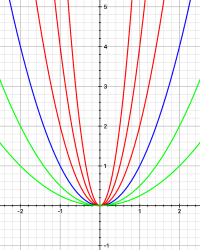
Graph of ax2 for diff a values.
(green < 1; blue = 1; red > 1)
This is a little detour before the main event. The first post of this series, which explained why the imaginary unit, i, is important to math, was long enough; I didn’t want to make it longer. However, there is a simple visual way of illustrating exactly why it seems, at least initially, that the original premise isn’t right.
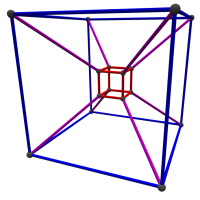
There is also a visual way to illustrate the solution, but it requires four dimensions to display. Three dimensions can get us there if we use some creative color shading, but we’re still stuck displaying it on a two-dimensional screen, so it’ll take a little imagination on our part.
And while the solution might not be super obvious, the problem sure is.
Continue reading
12 Comments | tags: complex numbers, fun with numbers, imaginary unit, numbers, parabola, real numbers, x-squared | posted in Math
 Yes, this is a math post, but don’t run off too quickly. I’ll keep it as simple as possible (but no simpler), and I’ll do all the actual math so you can just ride along and watch. What I’m about here is laying the groundwork to explain a fun fact about the Mandelbrot.
This post is kind of an origin story. It seeks to explain why something rather mind-bending — the so-called “imaginary numbers” — are actually vital members of the mathematical family despite being based on what seems an impossibility.
The truth is math would be a bit stuck without them.
Continue reading
23 Comments | tags: complex numbers, complex plane, fun with numbers, imaginary unit, integers, Leopold Kronecker, natural numbers, numbers, rational numbers, real numbers | posted in Math
 Here’s yet another unplanned post, mostly because there was something important I forgot to mention yesterday, but also because I started watching three different Netflix shows (or maybe call it two-and-a-half), and all three are fit for a Sci-Fi Saturday post, so here I am again.
I dither about three because one of them wasn’t new, it was season two I started of Siempre Bruja. But I hadn’t yet seen any of Lost in Space or the new Chilling Adventures of Sabrina. I’ve been suspicious of the former, and the latter isn’t quite my cup of tea on several counts.
But first you should know about (Your) CloudLibrary!
Continue reading
32 Comments | tags: Always a Witch, Angely Gaviria, cloudlibrary, science fiction, science fiction TV, SF, Siempre Bruja | posted in Books, Sci-Fi Saturday







 Logos con carne