20 Years Ago Today

Twenty years ago today I was at work, and the world was largely as it had always been: sometimes difficult, sometimes easy, sometimes painful, sometimes joyful. As it had always been.

As I worked at my desk, I slowly became aware of a general level of commotion coming from our “TV area” (an area nearby where we sometimes met for meetings). The commotion continued, but I knew we had no meetings scheduled that morning. Eventually I got up to see what was going on.

As I approached, it was apparent that most of the department was there; a couple of the guys were standing in the doorway. I rounded the corner and looked in and saw the TV screen just in time to see (a replay of) the second tower falling.

That was my first contact with 9/11. Seeing the second tower fall.
Continue reading


Smolin: Time Reborn

I’ve been reading science texts almost as long as I’ve been reading anything. Over those years, many scientists and science writers have taught me much of what I know about science. (Except for a Computer Science minor, and general science classes, most of my formal education was in the Liberal Arts.)

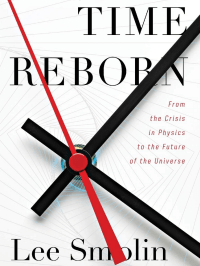
Recently I read Time Reborn (2013), by Lee Smolin, a theoretical physicist whose personality and books I’ve enjoyed. I don’t always agree with his ideas, but I’ve found I do tend to agree with his approaches to, and overall sense of, physics.

However in this case I almost feel Smolin, after long and due consideration, has come around to my way of thinking!

Continue reading


BB #78: Relational Theories

I read Three Roads to Quantum Gravity (2001), by Lee Smolin, a theoretical physicist whose thoughtful style I’ve always appreciated. I don’t always agree with his ideas, though. This book is about Loop Quantum Gravity, in which Smolin has invested considerable effort, and that idea I’m utterly neutral on. It does seem to make more sense than string theory.

One notion I have a lot of trouble swallowing (like a cup of coffee with eight lumps of sugar) is the relational view. (As a philosophy, relationism. Al stayed home.) It’s a fundamental aspect of LQG.

But I (and apparently Kant agrees) think Leibniz was wrong.

Continue reading


BB #77: Smooth Spacetime

I read Three Roads to Quantum Gravity (2001), by Lee Smolin, a theoretical physicist whose thinking I’ve appreciated since I read his 2006 book, The Trouble with Physics: The Rise of String Theory, the Fall of a Science, and What Comes Next.

Three Roads, as the title suggests, is about the efforts to reconcile quantum mechanics and General Relativity, our two best physical theories. String theory is one road, Loop Quantum Gravity (Smolin’s preferred approach) is another. The third road is complete theory reconstruction (such as discussed by Philip Ball in his book Beyond Weird).

None of that is the subject of this post.

Continue reading


BB #76: The Holographic Theory

I finished reading Three Roads to Quantum Gravity (2001), by Lee Smolin, a theoretical physicist whose general sensibility I’ve always appreciated. I don’t always agree with his ideas, but I like the thoughtful way he expresses them. Smolin brings some philosophical thinking to his physics.

While he added a lengthy Postscript to the 2017 edition, the book is outdated both by time and by Smolin. In 2006 he published The Trouble with Physics: The Rise of String Theory, the Fall of a Science, and What Comes Next, which explored issues in the practice of theoretical physics. But in 2001 he still thought string theory was (at least part of) The Answer.

Almost none of which is the subject of this post.

Continue reading


Pancomputation III

Oh, look! Dancing Pixies!

In the last two posts I’ve explored some ideas about what a computer is. More properly, what a computation is, since a computer is just something that does a computation. I’ve differentiated computation from calculation and, more importantly, evaluation. (This post assumes you’ve read Part I and Part II.)

I’ve also looked at pancomputationalism (the idea everything computes). The post hoc approach of mapping of random physical states to a computation seems especially empty. The idea of treating the physical dynamics of a system as a computation has more interesting and viable features.

That’s where I’ll pick things up.

Continue reading


Pancomputation II

Computer cluster?

Last time I began exploring what we mean by the terms “computer” or “computation.” Upon examination, these turn out to be not entirely obvious, so some resort to the edge cases: Computers are Turing Machines; or Everything is a computer.

Even then the situation remains stubbornly not obvious. Turing Machines are abstractions quite different from what we typically call computers. Saying everything computes creates such a broad umbrella that it renders the notion of computation nearly useless.

This series explores the territory between those edge cases.

Continue reading


Pancomputation I

Two computers?

Earlier this year I wrote a trilogy of posts exploring digital dualism — the notion that a (conventional) computer has a physical layer that implements a causally distinct abstract layer. In writing those posts I found my definition of computation shifting slightly to embrace the notion of that dualism.

The phrase “a (conventional) computer” needs unpacking. What is a computer, and what makes one conventional? Computer science offers a mathematical view. Philosophy, as it often does, spirals in on the topic and offers a variety of pancomputation views.

In this series I’ll explore some of those views.

Continue reading


Flat Space of the Torus

Flat Earth!

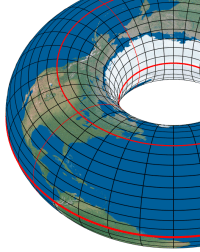
To describe how space could be flat, finite, and yet unbounded, science writers sometimes use an analogy involving the surface of a torus (the mathematical abstraction of the doughnut shape). Such a surface has no boundary — no edge.  And despite being embedded in three-dimensional space, the torus surface, if seen in terms of compensating surface metric, is indeed flat.

Yet a natural issue people have is that the three-dimensional embedding is clearly curved, not flat. It’s easy to see how wrapping a flat 2D sheet into a cylinder doesn’t distort it, but hard to see why wrapping a cylinder around a torus doesn’t stretch the outside and compress the inside.

In fact it does, but there are ways to eat our cake (doughnut).

Continue reading


BB #75: Gloves and Shoes

Speaking of Bell tests, I’ve noticed that science writers often struggle to find a good metaphor that illustrates just what’s so weird about the correlation between entangled particles. Bell tests are complex, and because they squat in the middle of quantum weirdness, they’re hard to explain in any classical terms.

I thought I had the beginnings of a good metaphor, at least the classical part. But the quantum part is definitely a challenge. (All the more so because I’m still not entirely clear on the deep details of Bell’s theorem myself.)

Worse, I think my metaphor fails the ping-pong ball test.

Continue reading