Tag Archives: space-time
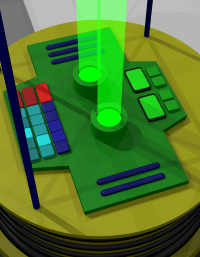 The main topic this week was how simultaneity is relative to your frame of reference. How there are (virtual) lines of simultaneity where all points on some line — at all distances from you — share the same moment in time. For any instant you pick, that instant — that snapshot — includes all points in your space.
A line of simultaneity freezes the relative positions of objects at a given moment — which enables distance measurements. Simple example: When their watches both read 12 noon, Al and Em were 30 miles apart. A more mathematical example uses x, y, & z (& t), but it amounts to the same thing: a coordinate system.
The gotcha is that simultaneity and coordinate systems are relative when motion is involved!
Continue reading
5 Comments | tags: 1D, 2D, 3D, Albert Einstein, Emmy Noether, frame of reference, Galilean invariance, light, light clock, light cone, light speed, line of simultaneity, simultaneity, simultaneous events, space-time, Special Relativity, surface of simultaneity, time-space | posted in Physics
 We started by exploring the idea that motion is relative. Now we see that the idea of simultaneity is relative! Events that Al sees as simultaneous in his frame of reference do not appear simultaneous to Em — she sees them happening one after another!
A frame of reference has lines of simultaneity that allow us to assign time coordinates to events in the reference frame. If Al and Em have different lines of simultaneity, then their coordinate systems differ— they assign different coordinates to an event!
Let’s explore that in a bit more detail…
Continue reading
Leave a comment | tags: simultaneity, simultaneous events, space-time, space-time event, Special Relativity, time-space diagram | posted in Physics
 Last time our friend Al used lasers and timers to create a regular grid-like map of the space and time near him. The map allowed him to assign space-time coordinates to events in his frame of reference (even if it takes time for him to see light from those events).
An important concept is the idea of simultaneity — of events in different locations happening at the same moment according to some observer (who has to wait for the event’s light to reach their eye).
So far the events weren’t moving relative to us. What if we — or the events, same thing — are moving (and moving fast)? It turns out, this changes the picture!
Continue reading
1 Comment | tags: frame of reference, line of simultaneity, simultaneity, simultaneous events, space-time, space-time event, Special Relativity, surface of simultaneity, time-space, time-space diagram | posted in Physics
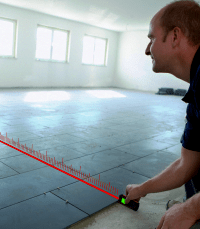 In the last two weeks I’ve covered relative motion as the ancients understood it (Galilean Relativity), touched on how light doesn’t follow those rules, and introduced time-space diagrams that we can use to visualize motion. I also introduced the topic of space-time events, which are simply locations in space at a given time.
In particular, I showed how our friend Al can use a laser to determine both the location and the time (relative to himself) of an event. This allows him to map his nearby space and time using a system of regular (that is, grid-like) space-time coordinates.
Today we continue with that idea.
Continue reading
3 Comments | tags: Galilean invariance, line of simultaneity, simultaneity, simultaneous events, space-time, space-time event, Special Relativity, surface of simultaneity, time-space diagram | posted in Physics
 A couple of readers have asked about the diagrams in this series of Special Relativity posts. I created them with the freeware 3D ray tracing application, POV-Ray. The diagrams are actually three-dimensional “scenes” designed to be viewed as flat pieces. If some of the “dots” look more like little spheres, that’s because they are!
I wrote some introductory posts a while ago (here, here, and here). You can read those if you want more details about the application.
For a little (optional!) Friday fun, I thought I’d share some POV-Ray images that have a bit more “dimension” to them.
Continue reading
7 Comments | tags: 1D, 2D, 3D, 3D images, Emmy Noether, light, light speed, POV-Ray, ray tracing, space-time, Special Relativity, time, time-space diagram | posted in Physics
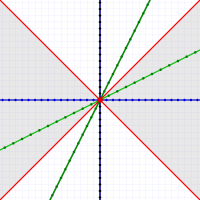
My Special Relativity “icon”!
This week I’ve introduced you to time-space diagrams. They’re the foundation of everything that follows in this series, so I hope you’re feeling very comfortable with them.
I also introduced you to space-time events, and I apologize for any confusion in calling the diagrams “time-space” and the events “space-time.” Six of one, half-dozen of the other. I wanted to stress the time component of the diagrams, whereas space-time is the more usual general term.
Today we wrap up the week with some important diagram details.
Continue reading
8 Comments | tags: distance, light, light speed, space, space-time, Special Relativity, time, time-space, time-space diagram | posted in Physics
 Last time I introduced you to the idea of a space-time event. In physics, an “event” has the same meaning as when Hollywood blares out about a “major motion picture event” — that is to say, nothing at all special — just something that happens at a specified location and time.
If you attend a social event, it has a location and a time. When we talk about space-time events, all we mean is a specific location and a specific time (hence the name, space-time event).
Today we’ll explore some interesting aspects of such events.
Continue reading
8 Comments | tags: light, light speed, space, space-time, space-time event, Special Relativity, time, time-space, time-space diagram | posted in Physics
 The last two posts introduced and explored the concept of time-space diagrams. This time I’ll complete that exploration by using them to consider motion from two points of view. This will be an exercise in application of our diagrams.
I’m going to connect that application with something I stressed last week: that motion has a symmetrical component. It’s perfectly valid to think of the world moving past the train as it is to think of the train moving through the world.
It happens that here our dueling points of view are resolved by something else I discussed last week. See if you spot it before I mention it.
Continue reading
11 Comments | tags: diagrams, motion, relative motion, space, space-time, space-time event, Special Relativity, time, time-space, time-space diagram | posted in Physics





 Logos con carne