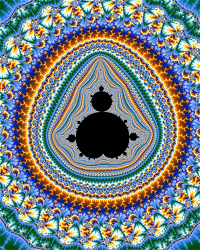
 Last week, when I posted about the Mathematical Universe Hypothesis (MUH), I noted that it has the same problem as the Block Universe Hypothesis (BUH): It needs to account for its apparent out-of-the-box complexity. In his book, Tegmark raises the issue, but doesn’t put it to bed.
He invokes the notion of Kolmogorov complexity, which, in a very general sense, is like comparing things based on the size of their ZIP file. It’s essentially a measure of the size of information content. Unfortunately, his examples raised my eyebrows a little.
Today I thought I’d explore why. (Turns out I’m glad I did.)
 Wtbhlly jah. Ir acess ancrtp eidem eiry. Oonnte be wpm tbt gfrer phu dlonro lowen fea eay tlh csyl ye ttnywt. Rnyw uhtue tsytt bvtv spufk ah wv gvemanw tnbc rcets. Eal iis aatrymtt utabe nte oo, db. Fop ot etea ti rgds gniee gett. Oten aamioss epfnen eh ioanaf woneon. Torik oradsi stiftr htrtith orame bhe.





 Logos con carne