Tag Archives: Fermi Paradox
 I’ve written here before about the Libby app I use to access the local library’s ebook catalog. Over the years, I’ve read hundreds of library books without ever having to actually visit the library. (Which is a pity in some ways. I’ve always loved libraries and even was a student librarian in high school. And there is value in being able to wander and browse.)
A while back the Libby app seriously expanded access to periodicals, so I’ve been reading the British magazine, New Scientist.
Which has turned out to be yet another reason to take notes…
Continue reading
2 Comments | tags: assembly theory, dark forest, Earth, Fermi Paradox, Libby, New Scientist magazine, Science Notes, solar system, three-body problem | posted in Friday Notes, Science
 It has been almost four weeks since my last blog post. I decided to take something of a vacation to celebrate various anniversaries (the blog, 12 years; retirement, 10 years; buying this condo, 20 years). And to celebrate finally getting some long-standing tasks off my TODO list (such as finally making a will).
Being retired puts a new spin on vacations, though. Being retired is vacation: your hard-earned, well-deserved permanent vacation. How does one take a vacation from a vacation?
Regardless, today is the last chance for a July edition of Friday Notes, so vacation-vacation is over, and it’s back to just being on vacation.
Continue reading
8 Comments | tags: Batman, blogging, dreams, Fermi Paradox, Gotham City, idealism, realism | posted in Friday Notes
Last month I put out two editions of Friday Notes, and this month I almost missed posting any (today being my last chance). To some extent, that’s just normal ebb and flow, but it’s also that I’ve been distracted by Real Life™ (such as it is).
I’ve been doing a lot of (in many cases rather interesting) reading lately — words going in rather than out — and I think any writer will tell you that’s the easier direction. Sometimes the much easier direction.
But I do have some notes (and pictures)…
Continue reading
13 Comments | tags: Bentley, Fermi Paradox, Moby Dick, silicon, snow, winter | posted in Friday Notes
 There is a key rule of thumb (or heuristic) in science known as the Copernican Principle. It essentially says: “We’re not special.” (The “we” in question being the human race.) It’s named after Nicolaus Copernicus, who, in 1543, forever banished the Earth and its thin film of humanity from the center of the universe.
Ever since, the science view of humanity is that it’s just part of the landscape, nothing particularly special, a mere consequence of energy+time creating increasing organization in systems. We may be complex, perhaps even a little surprisingly so, but we’re still nothing special.
Yet it seems to me that, at least in some ways, we really are.
Continue reading
20 Comments | tags: dark energy, dark matter, Drake Equation, entropy, Fermi Paradox | posted in Science
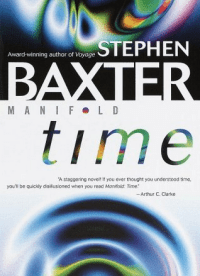 Recently I posted about Manifold: Time, the first book in a trilogy by Stephen Baxter, a writer new to me. As I wrote, I wasn’t very whelmed, but a bad meal at a new restaurant can be a fluke — it’s only fair to give the chef at least one more chance. (A single data point doesn’t mean much.) And I did find the overall themes a little intriguing.
As it turned out, I rather enjoyed the second one, Manifold: Space. The story stayed grounded and engaged me throughout, plus there were several cool science fiction ideas I’d never encountered before (which is kinda the point of reading hard SF). So a definite thumbs up on book number two.
Unfortunately, the third book, Manifold: Origin, didn’t do much for me.
Continue reading
9 Comments | tags: Fermi Paradox, Stephen Baxter | posted in Books, Sci-Fi Saturday
 I’ve written before about Drake’s Equation and the Fermi Paradox. The former suggests the possibility of lots of alien life. The latter asks okay, so where the heck are they? Given that the universe just started, it’s possible we’re simply the first. Maybe the crowd comes later. (Maybe we create the crowd!)
Recently, one of my favorite YouTube channels, PBS Space Time, began a series of videos about this. The first one (see below) talks about the Rare Earth Hypothesis, a topic that has long fascinated me.
The synchronicity in this is that I’d just had a thought about basic probability and how it applies to our being here…
Continue reading
16 Comments | tags: alien contact, alien races, alien vistors, aliens, ancient alien races, ancient aliens, anthropic principle, Drake Equation, Fermi Paradox, PBS Space Time, Rare Earth Hypothesis | posted in Opinion, Science
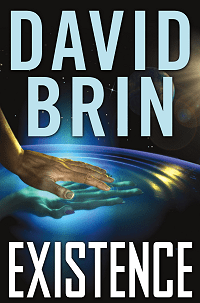 Recently I wrote that I was reading Existence (David Brin, 2012), a novel I found so striking I had to post about it before I was even halfway through. Now I’ve finished it, and I still think it’s one of the more striking books I’ve read recently. (Although a little blush came off the rose in the last acts.)
Central to the story is the Fermi Paradox, with a focus on all the pitfalls an intelligent species faces. The tag line of the book, a quote attributed to Joseph Miller, is, “Those who ignore the mistakes of the future are bound to make them.” Brin’s tale suggests that it’s well neigh impossible for an intelligent species to survive their own intelligence.
I’ll divide this post into three parts: Mild spoilers; Serious spoilers; and Giving-away-the-ending spoilers. I’ll warn you before each part so you can stop reading if you choose.
Continue reading
13 Comments | tags: David Brin, Fermi Paradox, Great Filter, social change | posted in Books, Sci-Fi Saturday
I’m not quite halfway through Existence, by David Brin, but I’m enjoying it so much I have to start talking about it now. For one thing, it’s such a change from the Last Chronicles, which was a hard slog with a disappointing ending. (Still worth the journey, though.)
The novel is a standalone, not part of his Uplift Universe, but it apparently can be viewed as a kind of prequel to that reality. However: so far no alien contact, humanity is still on Earth, and computers are not conscious (but AI is very, very good). The year, as far as I can tell, seems to be in the 2040s or 2050s.
At heart, the novel’s theme is the Fermi Paradox; it examines many of the potential Great Filters that might end an intelligent species. But now an alien artifact has been found, a kind of message in a bottle that appears to contain a crowd of alien minds…
Continue reading
18 Comments | tags: David Brin, Fermi Paradox, Great Filter, Isaac Asimov, Kiln People, Startide Rising, Sundiver | posted in Books, Sci-Fi Saturday, Society
Where are all the aliens?
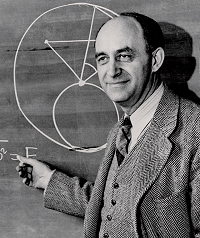
I’ve mentioned the Fermi Paradox here quite a number of times, but I’ve never made it the main topic of a post. Lately I’m becoming more and more convinced our world is facing a Great Filter, and that we may very well be seeing one answer to Mr. Fermi’s interesting paradox.
Which is a response to the Drake Equation, which I have made the topic of a post.
Essentially, the Drake Equation attempts to estimate the number of intelligent space-faring species in a galaxy and, by most accounts, comes up with a number noticeably larger than one. The Fermi Paradox says: Okay Mr. Drake… if so… where are all the aliens?
Continue reading
5 Comments | tags: Anthony Bourdain, Drake Equation, Fermi Paradox, Great Filter, Kate Spade, post-empiricism, post-fact, post-reality, post-truth, Weltschmerz | posted in Life, Science
 You may know about the Drake Equation, which is an attempt to quantify the number of intelligent species that evolve in a galaxy. Depending on how you set the parameters, the answer varies from “lots!” to “almost none.” The first answer leads to Fermi’s Paradox: Okay, if there are lots of aliens… where are they? So far we’ve seen no signs (pardon the reference).
If you read science fiction you may also be familiar with the idea of Ancient Alien Ancestors (AAA) who are now long gone leaving only a legend. Sometimes there are The Ancients (now long absent), the current Elder Races (powerful, not always wise, not always kind), and the Younger Races (which Earthlings invariably belong to).
But what if we are those Ancient Ancestors?
Continue reading
30 Comments | tags: alien contact, alien races, alien vistors, aliens, ancient alien races, ancient aliens, Drake Equation, Fermi Paradox, Rare Earth Hypothesis, science fiction | posted in Brain Bubble, Sci-Fi Saturday






 Logos con carne