Category Archives: Science
 It has been a minute or two since the last Science Notes — this subset of Friday Notes where I share bits and pieces of science news that have caught my eye.
In fact, the last of these was back in October, and the reason I didn’t post sooner was that not many articles have caught my eye since. In part because I’ve found myself skipping more and more articles due to lack of interest.
I fear it’s also in part because science has become so broken these days, so lost in fantastical speculation that I’ve begun skipping articles in which the word “might” or “could” plays a prominent role.
Continue reading
Leave a comment | tags: beer, conservative, education, liberal, Science Notes, sleep | posted in Science, Friday Notes
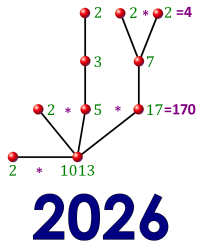 Something old and something new collided last week in a way that I found very engaging. The old was a science fiction series I read long ago, the Heechee saga by Frederik Pohl (1919-2013). What’s relevant here is that the alien Heechee used a number system based on prime numbers.
The new was this recent Substack post by Richard Green, a math writer and teacher. It, too, features a system based on primes, and I realized it solves a problem that has long bothered me about the putative Heechee number system.
Let me explain…
Continue reading
2 Comments | tags: Frederik Pohl, Heechee, prime numbers, science fiction books | posted in Math
 Recently, I learned an interesting new math trick involving what are known as dual numbers. These are compound numbers similar in form to complex numbers but with a different kind of “magic” element enabling their behavior.
What makes them interesting to people like me is the surprising way they provide a fast and easy technique for software to generate the derivative of a given function.
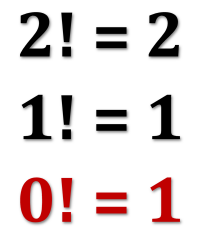
As an unrelated bonus, a simple explanation of why zero-factorial is equal to one rather than zero (which might seem more intuitive).
Continue reading
1 Comment | tags: computer programming, derivatives, dual numbers | posted in Computers, Math
 Time for another Mandelbrot Monday. I’ve mentioned before that aimlessly playing around with Mandelbrot zooms gets old fairly quickly. I find that I do it for a little while, lose interest for a long while, and then pick it up again for a little while.
I’m in the lost interest phase right now — have been for a couple of months. I think I’ll cool my jets until May, when I’m planning a series of posts (“Mandelbrot May”) exploring the Mandelbrot set and how images of it are made.
But I still have images from previous phases to share, so off we go…
Continue reading
Leave a comment | tags: Mandelbrot fractal, Mandelbrot Monday, Ultra Fractal | posted in Math
 One of the Substack blogs I follow, A Piece of the Pi by Richard Green, is almost ideal from my point of view because it features articles that interest me but only — at most — a few a month (so I needn’t strain to keep up).
Which matters because keeping up with dozens of science and math blogs, video channels, and occasional papers takes considerable time away from various hobby projects. But sometimes (and this is the third time Mr. Green has done this) something captures my imagination and sends me off on a tangent.
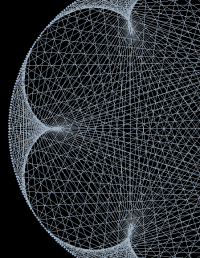
The results often seem worth sharing, and this is no exception. The delight here is that such a simple idea results in a variety of interesting patterns.
Continue reading
6 Comments | tags: computer generated images, Mary Everest Boole, Python | posted in Computers, Math
 This post begins with a bit of what I see as good news. We’re exactly one month away from Winter Solstice — December 21st at 15:03 UTC. That’s 9:03 AM USA Central Time, and I set posts to publish at 9:14 AM, so by the time you read this, it’s just under a month away.
Cue regular Solstice-Equinox reminder that the day-length changes very slowly at the Solstices and very rapidly at the Equinoxes [cue regular link: Solar Derivative].
Until then, here’s another edition of Friday Notes.
Continue reading
5 Comments | tags: AI, Bentley, eagle, equinox, Python, snow, Solstice, squirrel, weather | posted in Computers, Friday Notes, Math
For two weeks I’ve indulged in intense 12+ hour days on a self-education project in Python and its Tk module. I plan to write more about that later this week (that’s the plan, anyway).
Intense coding and learning take me deep into a Zen-like mindset that’s hard to emerge from. I have a minor self-commitment to publish at least five posts a month but have yet to publish anything this month.
As I struggle to regain the English language, I thought sharing another set of Mandelbrot images offered an easy reentry. The previous post had images from 2019 and 2020. Here are the last of those (and some from 2025).
Continue reading
8 Comments | tags: Mandelbrot fractal, Mandelbrot Monday, Ultra Fractal | posted in Math
In the Friday Notes from last August, I wrote about needing to buy a new laptop. In the September edition of same, I wrote about installing Ultra Fractal 6 on that laptop and shared a few Mandelbrot images I’d made.
I’ve been sharing two or three in Substack Notes every week for “Fractal Friday”, but Notes is a fast-running river in which things vanish downstream almost instantly.
So, I thought I’d start sharing some here on Mandelbrot Mondays, though I don’t plan to make it a regular thing. I am thinking about a series of posts exploring the Mandelbrot, though.
Continue reading
7 Comments | tags: Mandelbrot fractal, Mandelbrot Monday, Ultra Fractal | posted in Math
Fall — my favorite season ‘cept for the fading of the light — has fallen here in Minnesota, and our thoughts are turning towards the question of what kind of winter it will be: easy or miserable.
My winter is coming triple mile markers loom, the first dead ahead: Will it snow by Halloween? Will it snow by Thanksgiving? Will it snow by Christmas? Answers to all three vary depending on the whims of Mother Nature and her unexpected offspring, Climate Change.
In the meantime, here we are again for another edition of Friday Notes.
Continue reading
17 Comments | tags: brown sugar, charts, Future Shock, math fun, Quadratic Equation, smoke alarm, stillness, weather | posted in Friday Notes, Math
This Science Notes series (a subset of the Friday Notes series) gives me a chance to record bits of science articles that catch my eye and seem worth sharing. I’ve been doing this since my library app provided access to a huge number of online magazines.
Nearly all of which don’t interest me — in some cases, seriously don’t interest me. Bridal and Fan magazines are an obvious example, but there are myriad magazines devoted to interests that don’t interest me at all.
But I do like the ones devoted to science, and some articles fit some receptor in my mind enough to generate a note.
Continue reading
5 Comments | tags: gravity, human consciousness, infinity, lucid dreaming, real numbers, Science Notes | posted in Friday Notes, Science






 Logos con carne