 It’s Janus 5th — the last day of Chillaxmas — and time for a look back at 2025. Be warned: this is the twice-yearly post with all the narcissistic stats and charts.
Not that any of it means anything, but it’s fun for me. I’ve always liked massaging data and visualizing it in various ways. (It’s a part of what I did before I retired. Loved it then and now.)
So, without further ado, my blogging year 2025…
To start, two basic stats for this blog: 14 (and a half) years; 1,471 posts. Roughly 100 posts per year on average. In reality, a bit higher since I didn’t post here at all in 2017:
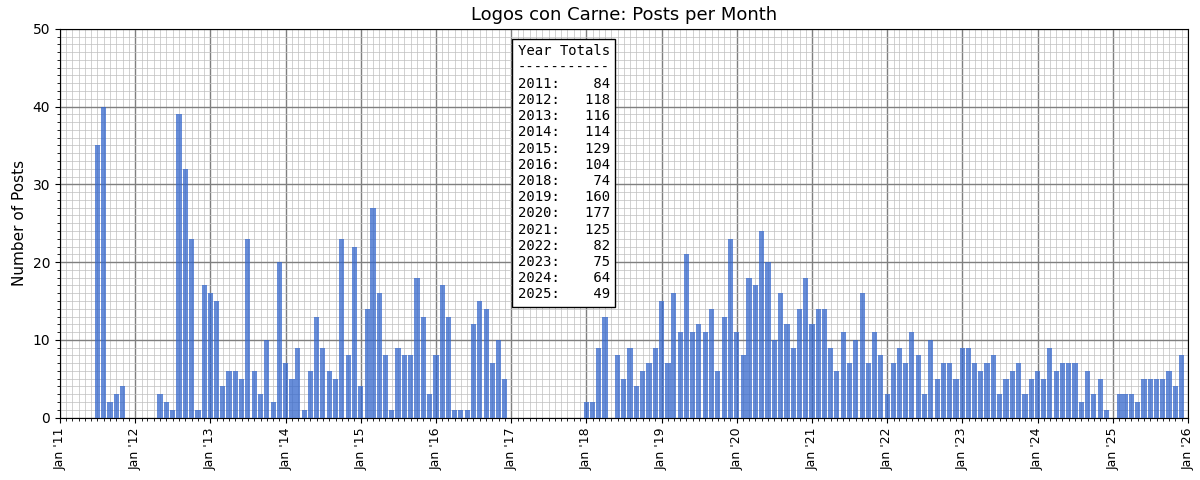
Started off strong back in July and August of 2011, stalled for three months after the initial excitement, then dropped out completely for five to rethink things. I came back in May of 2012, spent three months wobbling, kicked it into high gear that August, but couldn’t keep up the high output. I haven’t posted more than 30 times in a month since. Rarely more than 20 and usually not more than 10.
Which has turned out to be sustainable. The nearly decade-and-a-half of blogging seems long, but 1,471 doesn’t seem like a huge number of posts. There are blogs that post daily or multiple times weekly. I’m not of that ilk. Not even as a subscriber; there’s no blogger I want to hear from daily.
The chart above indicates a decline after a peak in 2020. In the last four years, I only once posted more than ten times in a month. But the chart above doesn’t tell the whole story. I started The Hard-Core Coder programming blog in 2014. And I added a Substack blog (also called Logos con Carne) in March of 2024.
Combining those, the picture looks a little bit different:
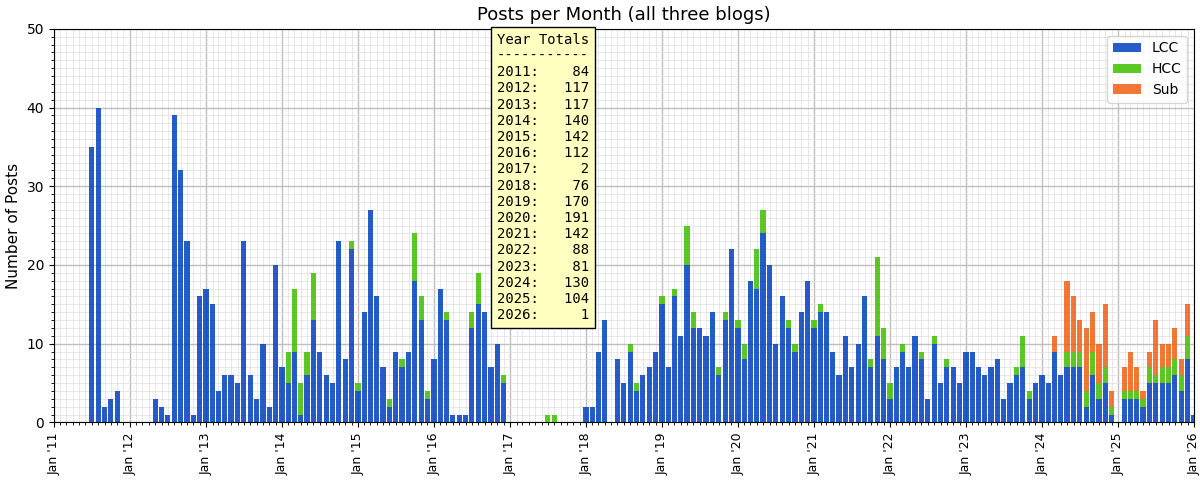
(I also learned a new trick: stacked bar graphs. Matplotlib is awesome!)
It’s clear posts on The Hard-Core Coder aren’t a big part of my output — only 138 posts since 2014. I did post twice in 2017, but many months had no posts at all. Since May of 2024, I’ve committed to posting there at least once a month (sometimes twice).
With the exception of last January. I got a respiratory virus just in time for Christmas 2024, and it really knocked my legs out from under me. Took until mid-January before I felt human again. At that point, I took the rest of the month off. The Janus post that year wasn’t until February 12th!
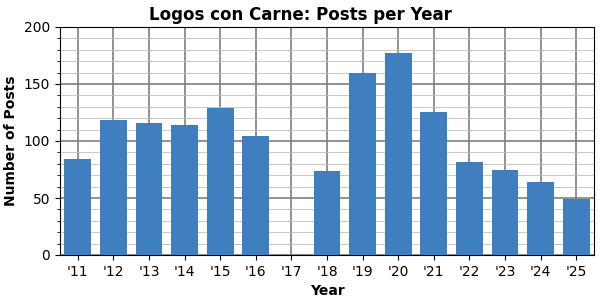
Following the trend of recent years, the number of posts here declines:
But I put more words into each post:
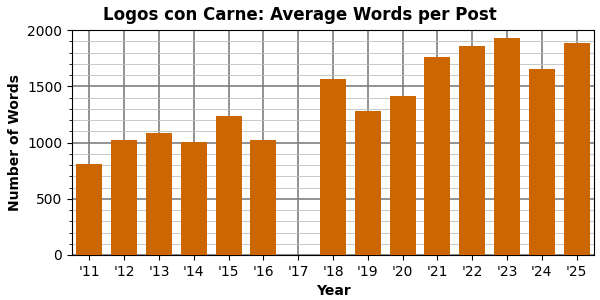
Although I have managed to rein myself in. In the first six years, I considered 1,000 words my ceiling. After the break in 2017, I raised it to 1,500 for a few years but ultimately gave into my verbosity and made it 2,000. It has always been a breakable ceiling.
In terms of Views and Visitors, there has been slow growth over the years:
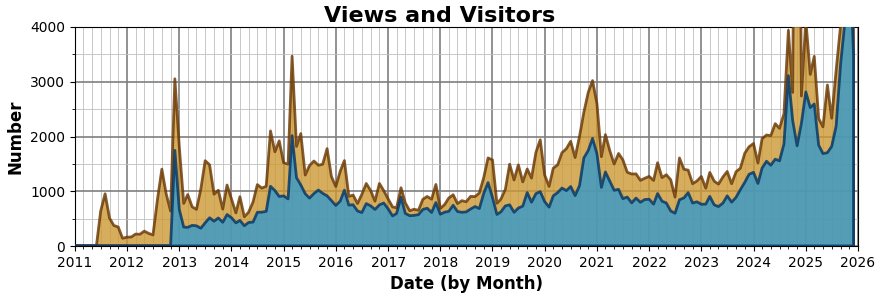
The two spikes in the first years (December 2012 and March 2015) came from WordPress including one of my posts in their (now extinct) Freshly Pressed page. Not sure what that fat spike centered on December 2020 was. That uptick certainly didn’t persist.
The last two years have seen a general rise, though I attribute at least some of it to Ai training probes. Either that or there are day-long or two-day periods where someone explores my blog randomly. I’m not sure what to make of how each page has multiple hits. Do Ai training systems require multiple page views? It could also be someone using the Random Post button and sharing pages with friends.
As always, no one ever says anything, so I have no idea. Page views may be up, but engagement certainly isn’t. Probably Ai training. C’est la Vie.
§
Words have long fascinated me. Hence the name of the blog and my handle. It’s really language that’s the fascination. Words are the atoms of human communication — made from alphabetic subatomic particles. Sentences, then, are molecules, and paragraphs are compounds used to build a textual substance of ideas.
There’s an interesting hierarchy. Letters don’t mean much on the own but combined into words they become the LEGOs of meaning. Strings of words carry complex ideas far exceeding the word meanings. Large strings of words create alternate realities or transport us to real ones.
But I digress (“it’s my blog, and I’ll digress if I want to”). Twice yearly, on the New Year and on the Blog Anniversary, I download the XML extract of both my WordPress blogs and process it to produce various HTML pages and charts that analyze the blog. (Many of the charts appear in these twice-annual posts.)
One thing I do is scan all Posts and Pages to produce a report on words used. Currently, those reports are separate:
- LCC: 2,049,620 words; HCC: 258,964 words
- LCC: 41,719 distinct; HCC: 10,774 distinct
- LCC: 295,449 lines; HCC: 36,452 lines
- LCC: 65,238 paragraphs; HCC: 4,551 paragraphs
Just for fun, the top 50 most used words on LCC — strung together into a paragraph with some punctuation to make it more readable:
The a of and to is in I that it for, but as with on this one are or be. We was so my it’s have you not about all at? An from they can just what there which some if by more. Me has time out like how 1.
They are in order of frequency, starting with the most-used (“the” — 111,661 times). The 50th, the digit “1”, appeared 4,446 times. (Note: as a standalone word, not as a digit in a multi-digit number.)
The a to and of 0 in is for self 1. That it print if this function return 2 as I with we def or an be, but list are name one from 3. Class code can value so data not on all you. GT line LT 4 f’ which.
Same two words (“the” and “a”) win again. Programming words show up in the HCC count, which is no surprise. More digits, too. Not sure what the “f'” is — possibly refers to the derivative (f’) of function f. But it appears 632 times, so that doesn’t seem likely. Might have to do some investigation on that one.
I got to wondering about word usage frequency — how often given words appear. The word counts are one thing, but how often do those specific counts occur? For instance, how many words are used only once? Or twice? Or etc. That led to this:
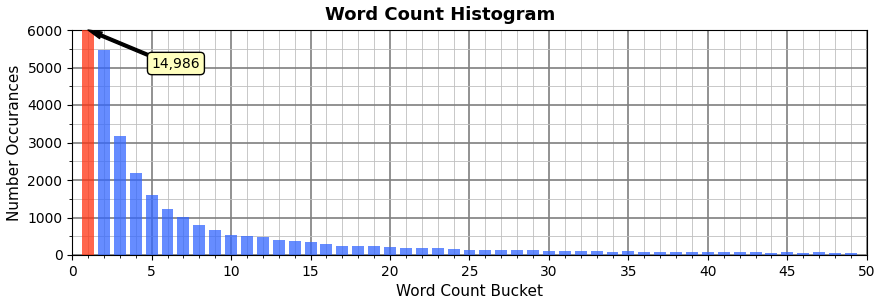
So, 14,986 words appear only once in the two-million-plus words I’ve written. Turns out a lot of them are one kind of gibberish or another. Quite a few are unique numbers. One New Year’s, I published an entire post of random gibberish. These one-timers make up a good fraction (36%) of the 41,719 distinct words used.
It’s a bit more interesting to consider words that appeared only two times. Presumably, multiple appearances represent actual words (though there are many numbers). Among the 5,465: berries, ethanol, squareness, corollaries, fingertips, rusting, jiggle, carbohydrates, lipstick, unrewarded, telegraphs, dissolve, torpedo, kittens, decontamination, whispered, precursor, & scorpions.
Among the 3,177 words used three times: suitcases, chainsaws, exquisite, sarcastic, furiously, carcass, Styrofoam, abbreviations, unstructured, industrious, stairway, paranoia, yardsticks, eradicate, installation, unacceptably, & freelance.
And among the 2,187 words used four times: druthers, recreational, charcoal, insomnia, partied, instinctive, mesmerizing, colorless, typographical, epitome, omniscient, networked, magnetized, jellybeans, and incomprehensible.
Some of those surprise me. I used stairway only three times in two million words? Huh.
I read someone say that using “delve” or “delves” is an earmark of Ai writing. I used “delve” three times and “delves” once. Other phrases have been put forth as earmarks of Ai writing, but I’ve used them all. Thing is, Ai is trained on human writing, so naturally it picks up on our usages.
I used “Smythe” only 28 times and “Wyrd” only 9. But I’m not one to refer to myself in third person. Somewhere I read that the frequency of “I” or “me” in one’s writing says … something about their psychology … if I recall correctly, an indicator of psychopathy or sociopathy. I can’t recall what the correlation is or even if there is any basis to the idea. It’s hard to write anything personal without self-reference, though.
In any event, the word “I” appears 30,515 times (1.5% frequency), the word “my” 9,336 times (0.46%), and the word “me” 5,787 times (0.28%). FWIW, “we” appears 9,688 times (0.47%), and “us” appears 2,270 times (0.11%).
Any psychiatrists in the house, analyze away!
§
Lastly, the Post Popularity Sweepstakes. For the year 2025:
- Babylon (Anime) (3,204)
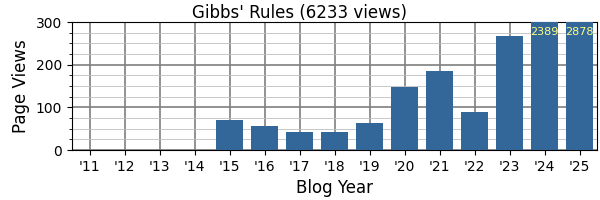
- Gibbs’ Rules (2,878)
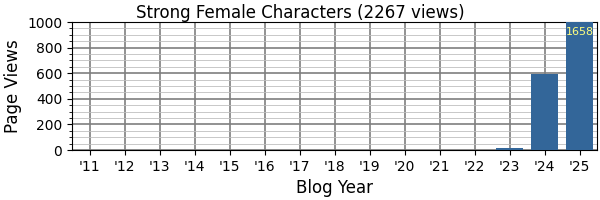
- Strong Female Characters (1,658)
- Flat Space of the Torus (1,362)
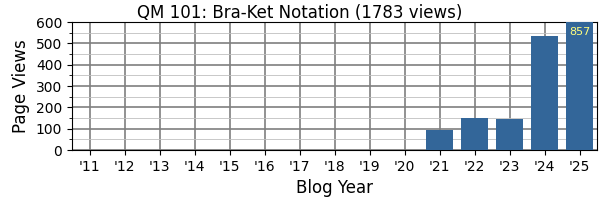
- QM 101: Bra-Ket Notation (857)
- Rick O’Shay (828)
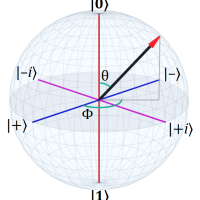
- QM 101: Bloch Sphere (779)
- From the Far Side (742)
- Elephant Story (591)
- Sideband #17: Ready when you are, Mr. DeMille (579)
- Musical Scale Modes (502)
These are the posts (and a few pages) that got 500 or more views last year. The winner for the second year in a row is that Babylon (Anime) post that’s surprised me enough to mention many times in the last months:
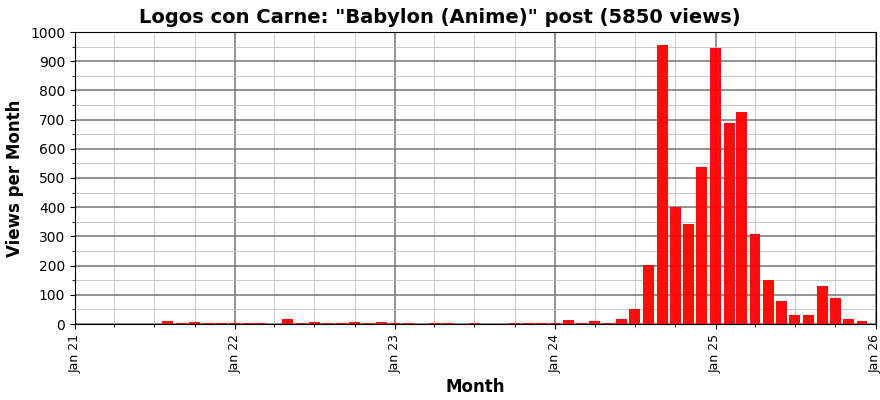
Activity is back to the background levels, so it seems the party is over:
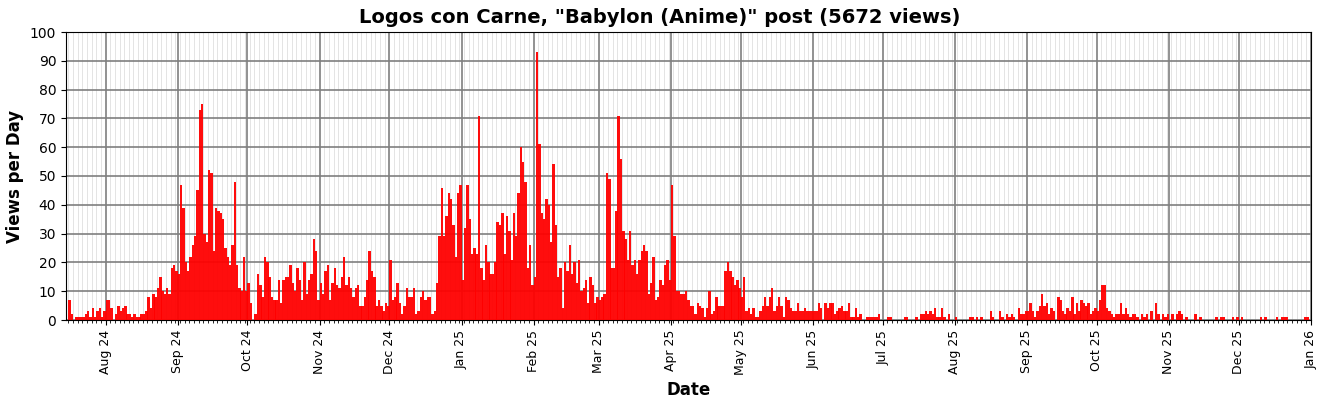
Since August of 2021 it has become my fourth most viewed post. It spent most of the year in the third slot but got demoted by the number #2 post, Gibbs’ Rules (grammatically, it should be Gibbs’s Rules):
The #3 post this year (or page in this case), Strong Female Characters, is even more of a newcomer (2023):
It’s nice to see it doing so well.
Most of the others have been on the list in previous years. The steady, albeit low-level, workers of the blog. Those two, QM-101 posts, Bra-Ket Notation:
And Bloch Sphere:
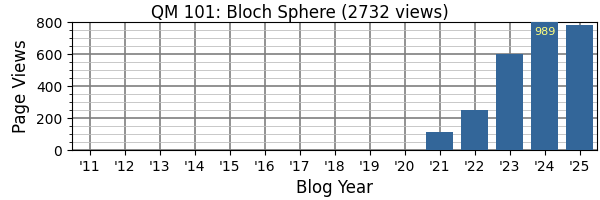
Have turned to be fairly popular. I can see why. They were both key points along the learning curve for me. Both opened important doors to understanding. The series is intended as a bridge from popular science to QM mathematics.
Not in the top posts, but the Quantum Spin post (@ #42 w/ 101 views) has gotten some attention, too:
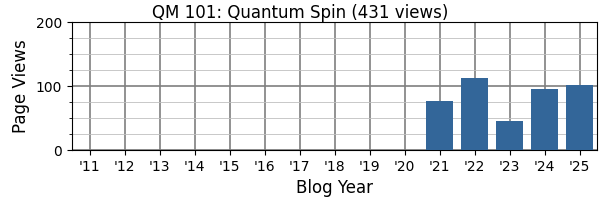
The Overall Top Twenty list is largely what it has been for years:
- From the Far Side (10,979)
- My Grandfather’s Axe (6,513)
- Gibbs’ Rules (6,233)
- Babylon (Anime) (5,850)
- Sideband #17: Ready when you are, Mr. DeMille (5,701)
- Rick O’Shay (5,584)
- Deflection and Projection (4,006)
- Flat Space of the Torus (3,760)
- God is an Iron (3,632)
- Santa: Man or Woman? (3,484)
- Elephant Story (3,437)
- Abacus and Slide Rule (3,226)
- QM 101: Bloch Sphere (2,732)
- Bushido Code (2,554)
- Strong Female Characters (2,267)
- QM 101: Bra-Ket Notation (1,783)
- Barrel of Wine; Barrel of Sewage (1,717)
- Why I Hated The Holodeck (1,668)
- Hawkeye & Margaret (1,450)
- BB #27: Far Less (1,447)
Though as detailed above some newcomers have crept onto and up the list. (The names without links are on the list above.) I am glad to see that old Santa post moving down the list. I sometimes wish the DeMille joke one would, too.
The #1 post remains head and shoulders above the rest and continues to pull in views:
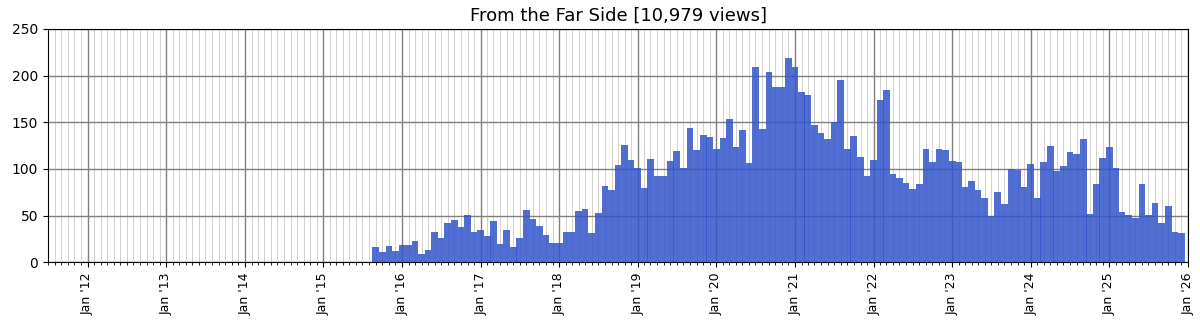
But does seem, at long last, on the decline. Not my favorite post by a long shot, it has always bummed me out a little that it’s my most popular post (and by such a lead). Typical of almost any creative output, I think. You never know what will catch the eye of others.
At one point My Grandfather’s Axe looked like it might unseat it, but it petered out:
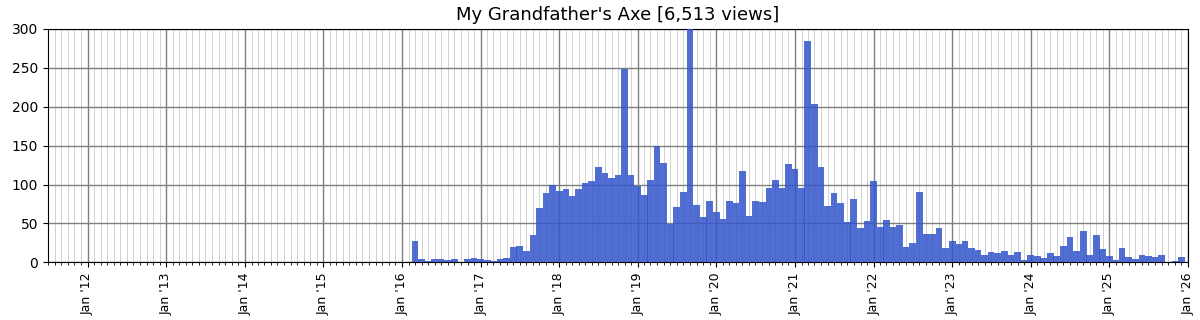
The Deflection and Projection post seems to have aged out:

It seems politics has gone too far for such things to seem relevant.
On the other hand, my old God is an Iron post still pulls in views:
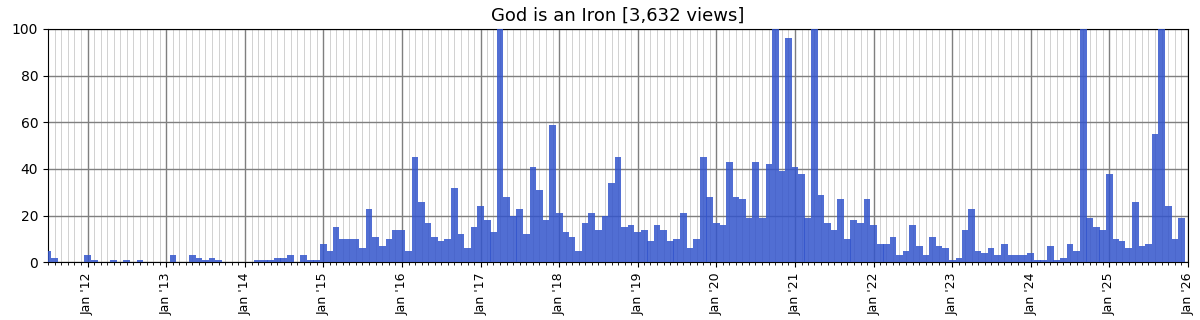
Activity seemed to have died out a few years ago, but lately it has seen a revival of sorts. Many other posts show a similar pattern. Largely ignored, except perhaps when first published, but an uptick the last few years.
I’m still thinking it’s Ai training.
Thinking about it, there is another indicator. My “Home/Archive” page — the blog’s landing page — shows a parallel uptick. That has puzzled me. Views/Visitors is close to even. So, prima facie, it doesn’t appear to be an individual spending time checking out pages. It might be due to Ai spiders masking their activity by appearing to be separate visits. Or even foreign networks making related requests appear from different sources.
Regardless, on days when traffic is higher, it appears to be many visitors, rarely from one viewing lots of pages. Come to think of it, I don’t think I’ve noticed a high Views/Visits ratio in a long time.
Anyway, my wild guess is that Ai training might start with the Home page looking for new links. Or it might be using the Home page to grab the “Random Post” link and use that to jump to a random page.
I dunno. Neither of those really grabs me, but maybe?
§ §
And that’s pretty much it for 2025. Not my favorite year by any stretch, but it had its moments. Next post I’ll ruminate about blogging in the coming year.
Stay statistical, my friends! Go forth and spread beauty and light.
∇






 Logos con carne
January 5th, 2026 at 6:02 pm
Ha! That word, f’, is from Python’s formatted strings:
f'{ix} {chr(A+ix)} {a}{b}{c}'My word scanner recognizes and ignores leading single-quotes but not embedded or trailing ones, such as in contractions such as I’ve or can’t or o’ or don’.
Mystery solved.
January 9th, 2026 at 12:12 pm
[…] The previous post looked back at 2025; this post looks forward to 2026. As each new year begins, I typically don’t have specific plans for it. This year, though, I am planning three series: two here, one on my programming blog. […]
February 6th, 2026 at 9:14 am
[…] was, for instance, in my wrap up for 2025, which had both the old version that tracked only my WordPress LLC posts and the new version that […]