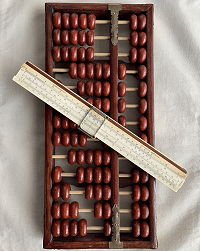
Two computers?
Earlier this year I wrote a trilogy of posts exploring digital dualism — the notion that a (conventional) computer has a physical layer that implements a causally distinct abstract layer. In writing those posts I found my definition of computation shifting slightly to embrace the notion of that dualism.
The phrase “a (conventional) computer” needs unpacking. What is a computer, and what makes one conventional? Computer science offers a mathematical view. Philosophy, as it often does, spirals in on the topic and offers a variety of pancomputation views.
In this series I’ll explore some of those views.






 Logos con carne