If you live in the USA and watch TV, you’ve probably seen the “Messin’ with Sasquatch” commercials advertising Jack Links Beef Jerky.
But have you ever really thought about the message behind these commercials?
If you live in the USA and watch TV, you’ve probably seen the “Messin’ with Sasquatch” commercials advertising Jack Links Beef Jerky.
But have you ever really thought about the message behind these commercials?
 It’s been ages since I posted any Brain Bubbles! That’s not for lack of my brain bubbling so much as various other “real world” (ha!) sharp pin bubble-popping things intruding. I thought it was high time I returned to effervescence!
There are some older bubbles queued up — they’ll surface eventually — but I was recently struck by a couple of brain bubbles recently (to the point of serious bemusement in one case and serious amusement in other).
Not feeling like a long post, so instead you get a pair of tiny bubbles!
 Some of those who take their comics seriously and think deep thoughts about them have remarked on the symbiotic relationship between super-heroes and super-villains. They do seem to form yet another Yin-Yang pair (and, as I’ve mentioned many times, we find such pairs many places in life). In fact, many see comics as nothing less than variations on the basic Yin-Yang of good and evil.
There are even those who suggest super-heroes create super-nemeses as necessary mirrors and justification for their existence. There is just enough truth to that to make it seem debatable, but the more common view is that both arise as natural symbols of basic good and evil.
So, today’s question: Is the Batman responsible for the Joker (and others)?
 If you’re a fan of television you may know that David Letterman is retiring in 2015 and that his replacement is Stephen Colbert! If you’re not at all a fan of television, it’s possible you don’t know Stephen Colbert, who is the two in the one-two punch of Jon Stewart’s The Daily Show and Stephen Colbert‘s The Colbert Report.
One thing that makes Colbert stand out is how he plays a character who shares his name. Sort of. Stephen Colbert is a parody person played by Stephen Colbert. The fake is highly conservative, utterly ego-maniacal and massively ignorant. Part of the schtick is that Colbert usually appears in public — even testifying before Congress — as Colbert.
So I’m looking forward to seeing the Colbert behind the Colbert mask!
 Does everyone these days know what a movie cookie is? I’m talking about the little scene a director sticks at the very end of the credits. They aren’t quite the same as outtakes — those are bits with muffed lines or where props didn’t work, and they’re often shown during the credits. And obviously, both are different from deleted scenes, which are bits that the director artistically excluded from the final product.
For a long time movie cookies were rare and always came at the very end, after all the final credits. They were a special treat (a cookie) for sophisticated movie goers who watch the entire movie rather than heading for the door the moment the final music begins.
Recently, cookies have become common, and are appearing early in the credits!
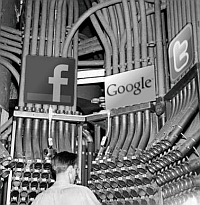 Last week Vinton “Vint” Cerf was the guest on The Colbert Report. The elegant Mr. Cerf is one of the two acknowledged fathers of the internet (the other is Bob Kahn). Among other things, those two invented the TCP/IP protocol that allows all internet communication.
Briefly, the need to connect different computers together goes back to the 1960s. Researchers in the 1970s sought to create a network for government (especially military) and academic computing (the ARPANET). The 1980s saw the birth of the internet — the first “dot-com” name was registered in 1985. And only six years later, in 1991, the “interweb” began!
It got me thinking back to those early text-based days before “the web”…
Computer programmers are exceptional thinkers. By which I don’t necessary mean they are “exceptional” in the sense of “outstanding” (although no doubt some are). I mean they are trained to think about exceptions (to the rule), about what might happen.
Computer programmers, in general, think about all the possible paths a system could take. When creating email software, they have to think about all the possible ways a user might use the software. There are the obvious actions the user is supposed to perform to read or write email. But there are also “What happens if I click this?” moments to consider.
It’s not about just of the “correct” ways but also about the “incorrect” ways!
 Even as a kid monster movies didn’t really frighten me. I just was never that impressed by Dracula or Frankenstein (let alone a Werewolf — a mere dog). The Creature from the Black Lagoon, the Blob, the Thing, giant insects, Harryhausen animations, even zombies… All such obvious effects.
Slasher movies weren’t that big when I was a kid. Jason, Freddie, Chucky, they all came along later. The first Saw wasn’t until 2004. And again, on some level, just special effects. That’s actually part of what’s cool about the gory movies.
But ghost stories? Ghost stories definitely get under my skin!
Every generation “can’t imagine what it was like” with regard to something. Various generations have recently gone through not knowing what it was like before automobiles, before flight, before black and white TV, before space travel, before CDs, and — increasingly —before social media.
The thing about being plugged into the interweb is that you’re plugged into something very, very big. Not just big, big and fast. Lots of information rushes by very fast all the time. Drinking from the interweb — as those they that say things say — is like trying to sip from a firehose.
So what about a generation that’s never known the quiet?
Once upon a time I had a theory that Heaven and Hell were what happened at the very last moment of your life. They say your “life flashes before your eyes” when you’re about to die. What if that’s literally true? What if it really does?
And in that final, eternal moment, when your mind knows “this is the end,” and there’s no more kidding yourself, what if you have to face the person you’ve really been with no filters, no deceptions, no self-rationalizations?
What if, as death stands at our shoulder beckoning, we have an infinite moment of clarity in completely and fully recognizing ourselves.







Posts pertaining to programming!


 Logos con carne