Category Archives: Basics
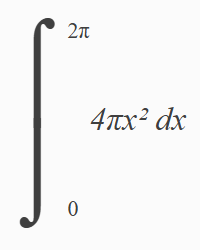 I don’t mean the social kind of integration, which I learned as a child, but the mathematical kind of integration, which I never learned in any of my math classes. I didn’t even take calculus until The Company sponsored some adult education classes for employees.
But those calc classes only got me through basic derivatives (of polynomials, mostly), so integration has been a bit of a mystery to me. Lately, though, I’ve been trying to pick up the basics.
This post just records my first attempts — my math lab book, so to speak.
Continue reading
3 Comments | tags: calculus, integrals | posted in Basics, Math
 I don’t drink coffee. I never have. (Call me different and you’ll be right at least nine times out of ten.) In my whole life, I’ve consumed maybe two cups worth. That required multiple attempts — usually friends forcing it on me because “you’ll like this [flavor|variety|brand|style], I promise!”
They’ve all struck out. I just don’t care for the stuff, not even iced, not even extremely flavored and tarted up. In contrast, I’ve always liked iced tea, and therein lies my tale for the day. Because tea has plenty of caffeine, too.
And it gave me a double lesson about [1] why people drink coffee (one word: caffeine) and [B] the downside of drinking coffee (one word: caffeine).
Continue reading
5 Comments | tags: coffee, diet mountain dew, FTR, Good Earth, iced tea, soda pop, tea | posted in Basics, Life
 You may remember learning way back in grade school that you can’t divide by zero. You may remember being told that division by zero is undefined. But have you ever wondered why we can’t divide by zero? Couldn’t the answer just be zero? We get zero when we multiply by zero, so why not when we divide?
But dividing is the opposite (or inverse) of multiplying, so if multiplying by zero gives zero, then maybe dividing by zero gives us… infinity? But infinity isn’t a number (it’s an idea), so that doesn’t work, either.
In this post I’ll dig into why division by zero is undefined.
Continue reading
4 Comments | tags: division, fractions, zero | posted in Basics, Math, Sideband
 Or do I mean Logic Square? Because it works either way. The Logic Square (or Square Logic) in question is a logic game created by Charles Lutwidge Dodgson (1832-1898) and introduced in his 1896 book Symbolic Logic Part I (a second part was published posthumously).
Dodgson was a capable mathematician, but most probably know him by his penname, Lewis Carroll, under which he wrote poetic fantasy fiction about a girl who goes on wild adventures.
But this is about his logic game. It’s like a square Venn diagram with game pieces.
Continue reading
5 Comments | tags: boolean logic, four-square, Lewis Carroll, logic, logic games, Venn diagram | posted in Basics, Math
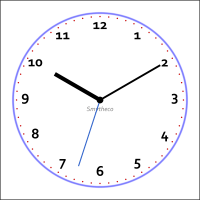 Long ago (in the first year of this blog), I posted Sideband #34: The North Star, which was about how sighting on the North Star (Polaris) gives you your latitude. Simply put, the elevation of the star is your latitude. My Twin Cities are at 45° north, so Polaris is 45° above my northern horizon. Simple!
In this Sideband, I’ll explain how you can use your wristwatch as a compass. Assuming your watch is an analog one with hands. And assuming you can see the Sun (so this doesn’t work at night).
But, unlike North Star navigation, this one does work in the southern hemisphere.
Continue reading
9 Comments | tags: celestial navigation, Dick Francis, south, Sun, wearing a watch | posted in Basics, Sideband
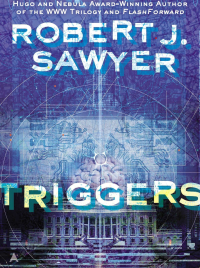 I’ve been enjoying science fiction author Robert J. Sawyer. I wrote about the first three books I read in the previous post. Just after writing that post, I finished a fourth book, Triggers (2012), a present-day political thriller involving accidentally linked minds — one of which belongs to the POTUS.
I liked the story quite a bit, some of it so much I’m inclined to give it a Wow! rating. It was fun, and it presents some tasty food for thought. And I don’t intend to get much into any of that.
Instead, this is about a simple secret code used in the book. It was new to me, and I found it clever, so I thought I’d dash off a quick post about it.
Continue reading
6 Comments | tags: cipher, Robert J. Sawyer, secret codes, substitution cipher | posted in Basics
 First there was On the Count of Three, which introduced the fundamental notion of triples. There was actually a prequel of sorts years before — very appropriately a trifecta challenge — about the actual Count of Three and his rabbit fur cloak).
Then came the sequel, Three-peat, which explored the world of triples in more detail. That world spans the gamut from witches to transistors to music theory. (Triples cover a lot of ground!)
Now, at last, the exciting final post of the trilogy! Will the three heroes finally find the three keys, defeat the three dragons, and save the Three Kingdoms?
Continue reading
20 Comments | tags: rule of three, three, trinary, triple, Yin and Yang | posted in Basics
 Lately, I’ve been writing a number of posts about quantum mechanics, a field where coordinate spaces play a big role. One of my earliest posts on this blog was about applying coordinate space concepts to real life, a thread I picked again up last year.
Long ago I introduced my buddy (I call him “Scott” here), who is also an aficionado of good beer, to the concept of beer space. I’ve mentioned it here once or twice in passing, and I have notes about it that date back to 2011 when I started this blog.
So it seems high time I actually wrote a post about beer space.
Continue reading
10 Comments | tags: beer, parameter space | posted in Basics

Hard to define…
It’s very easy for discussions to get hung up on definitions, so a serious approach to debating a subject begins with synchronizing everyone’s vocabulary watches. Accurate and nuanced communication requires mutually understood ideas and terminology for expressing those ideas.
Yet some concepts seem almost impossible to define clearly. The idea of “consciousness” is notorious for being a definition challenge, but “morality” or “justice” or “love” are also very difficult to pin down. At the same time, we seem to share mutual basic intuitions of these things.
So the question today is: why are some concepts so hard to define?
Continue reading
10 Comments | tags: Bruce Cockburn, configuration space, definitions, reductionism, words | posted in Basics
 I’ve written about configuration spaces before. I plan to use the notion in some upcoming posts, so this seems like a good time for a refresher. (If you’re new to the idea, I recommend that you read at least the first post in the series. The third one might be a helpful read, too.)
Today I’ll talk about a configuration space where the axes consist of personal taste and objective quality. Which obviously implies there is such a thing as objective quality. I think there is, and I’ll try to make a case for it. (Production quality certainly offers objective metrics.)
Of course, as everyone knows, there is no accounting of personal taste.
Continue reading
16 Comments | tags: parameter space, Shakespeare, social mores | posted in Basics




 Logos con carne