 I’m starting to feel a bit repetitious with the several TV Tuesday posts lately, not to mention the monthly Friday Notes. It’s starting to feel a little obligatory. They both serve a useful purpose for me, which is why I write them, but sometimes I chaff under the regularity.
Perhaps what feels especially repetitious is ranting about so many modern TV shows and films. That gets as old for me as I’m sure it does for readers. But venting also serves a purpose according to some studies.
Consider that a forewarning, for this one too has a bit of ranting…
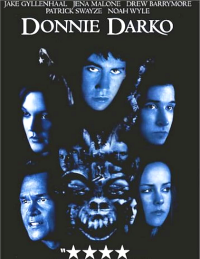
I’ll start with the good: Donnie Darko (2001), directed by Richard Kelly (his first film). It stars Jake Gyllenhaal along with Jena Malone, Drew Barrymore, Mary McDonnell, Katharine Ross, Patrick Swayze, Noah Wyle, and Seth Rogen.
I mention it because I watched it again recently. I found it as interesting (and weird) this time as I have the previous several times. I can’t say I completely understand it, and I’m not sure I need to, but it makes more sense each time. This time, for instance, I found myself more aware of the teen-angst perspective.
Despite the acclaim and accolades, Kelly’s career never really took off. He made another surreal film I really like, Southland Tales (2006), that stars Dwayne Johnson along with another all-star cast. Funny thing. I mentioned Donnie Darko only once on this blog, and that was in connection with a bit on surreal science fiction movies such as Southland Tales.
If I ever saw Domino (2005), for which Kelly did only the screenplay, it didn’t make an impression. It does sound like the sort of film I’d watch. It’s just that they blend together over time. If I saw it again, it might ring a bell. I’ll have to look out for it. Directed by Tony Scott.
Anyway, if you have a taste for surreal movies and have never seen Donnie Darko, I recommend it. Southland Tales requires more of a taste for surreal science fiction movies so has a somewhat stronger flavor.
§
Speaking of strong flavors:
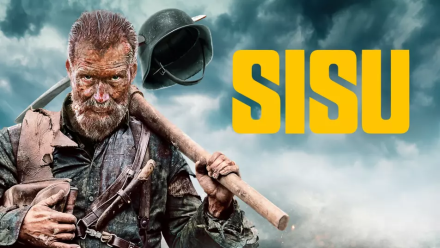
Sisu (2022) is a WWII period action film from Finland. Written and directed by Jalmari Helander, it stars Jorma Tommila (who doesn’t speak until the very end of the film). Be warned that it is plenty violent. It doesn’t break (or even approach) any records in that regard, but it isn’t for the squeamish.
Aatami Korpi (Tommila) lives with just his horse and dog in the wilds of Lapland while prospecting for gold. Korpi lost his family to the war and became a much-feared Finnish army commando. Now he just wants to be Rambo alone.
He discovers a rich find, collects saddlebags of gold nuggets, and sets off for town to cash in. On the way he encounters nazis retreating from the end of the war. They would like nothing better than a rich stake to help escape the coming consequences (war crimes trials).
Sisu is a Finnish word translated as stoic, determined, tenacious, gritty, resilient, hardy. Not necessarily brave, as I understand it, but with a terrier-like refusal to back down when confronted.
As always, it depends on one’s taste, but I thoroughly enjoyed it. Two thumbs up and a strong Ah! rating (not quite a Wow! rating because, honestly, one way or another, it has all been done before).
§
Replicas (2018) is directed by Jeffrey Nachmanoff and stars Keanu Reeves.
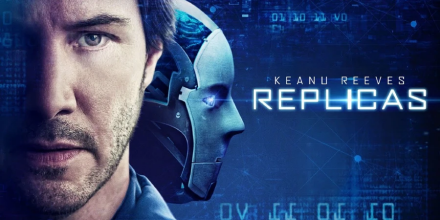
I somehow never saw this, and it’s not bad. The “science” wasn’t egregious, and the story was engaging enough that I never thought to take notes (nor saw any need to). Which is good and bad. Nothing sank the film, but nothing elevated it, either.
On balance, thumbs up and a strong Eh! rating. Worth seeing for science fiction or Keanu Reeves fans. For fans of both, definitely worth a viewing.
§
It’s another decent science fiction movie, but fans of the SF TV series Farscape (1999-2003) may especially enjoy Deus (2022) because it stars Claudia Black.
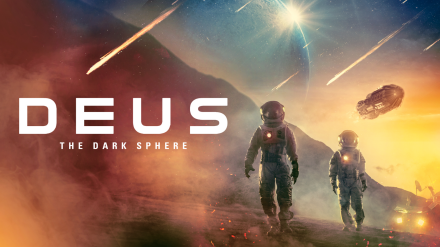
Written and directed by Steve Stone (who apparently doesn’t rate a Wikipedia entry and has only two other obscure films to his credit).
The film features a near future where the Earth is plunging into environmental disaster (more than it is now, I mean). A mysterious black sphere has been detected in the orbit of Mars, and a spaceship with a crew of six is sent to investigate.
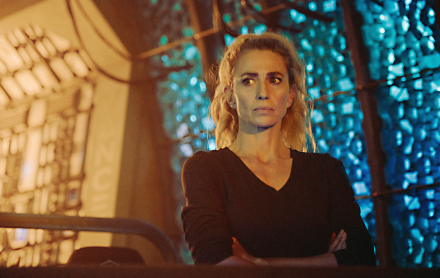
Claudia Black plays a scientist, which isn’t something every actor can pull off (Arnold Schwarzenegger, for instance, not so much). Black has the personal gravitas to pull it off with aplomb.
When the crew reach Mars, the sphere starts transmitting the word “Deus” — “God” — in every Earth language. When they land on the sphere, they are prompted to walk through bright gate.
I won’t spoil it. Suffice to say that, of course, all is not as it appears.
I’m biased because Farscape and Claudia Black, so it’s hard to rate, but I’m inclined to give it an Ah! rating and recommend it for SF fans.
§
Speaking of science fiction movies, I happened to re-watch Cowboys & Aliens (2011) last week. Directed by Jon Favreau, who has a good track record with me in acting, writing, and directing.
I wrote about this back in 2012 and gave it a Meh! rating verging towards a Nah! rating. From the perspective of 2025 and all the (non-Ai) slop Hollywood has been cranking out for years I find myself much friendlier towards the movie and elevate it to an Eh! rating.
Put it this way: re-watching it was much more enjoyable than watching a lot of the new ones I’ve seen. Casting Wilde as an alien definitely works.
§
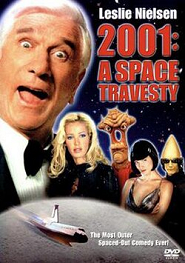 What’s the phrase… not honorable mention… not special mention… ah, I’ve got it: passing mention to 2001: A Space Travesty (2000).
Saying that it’s a screwball space spoof comedy starring Leslie Nielsen perhaps is all that needs to be said. Despite its title and an opening scene, it’s more of a generic space spoof than a pastiche of the Kubrick movie.
Nielsen plays Marshal Richard ‘Dick’ Dix (ha, ha), who is essentially his Frank Drebin character from the Naked Gun movies but in space. Or on the Moon, in this case, but with a comic variety of weird aliens.
It’s not just idiot clown comedy but infantile idiot clown comedy. But sometimes, in the right hands, it has its place, and probably no one does it better than Leslie Nielsen.
§
So, that was the good, though the last one is a bit of a segue. Another not worth more than passing mention, I finally saw Star Trek: Into Darkness (2013; to make it more phrase-y they don’t use the colon, but the colon is canon). It’s the sequel to the 2009 reboot. This is the one with Benedict Cumberbatch as one of Kirk’s greater nemesis, Khan (terrible casting; Montalbán was much better).
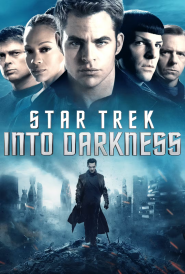 I lost interest in Star Trek somewhere around its 50th anniversary. I was with it since it first aired, loved it long time, posted about it plenty, but it’s over now. (“It’s dead, Jim.”) I particularly dislike the reboot timeline and the new crew. (#notmykirk) The animated comedy series (Lower Decks) was cute and diverting, but none of the live-action TV shows have attracted any interest from me.
I took notes but why bother with them. Suffice to say everything about it is childish and dumb. The plot makes no sense. The bridge is an overlit headache-inducing nightmare and engineering looks like an industrial brewery (which I believe it is). The characters act like squabbling badly raised children. (BTW: when did it become Kirk, Spock, and Uhura? And WTAF with Spock and Uhura?)
Plus, the science BS level is high, even for Star Trek.
In reverse aping Spock’s death in a far, far better film, this one makes a mockery of it, makes it a rage moment for the Vulcan to go running off after Khan.
You know how little kids like to mindlessly smash their toys together? That’s what movies like this feel like to me — mindless, senseless, infantile noise and fury signifying less than nothing.
Lastly, speaking of horrible casting, Simon Pegg as Scotty was such a mistake. It’s joke casting, and it emphasizes how they aren’t serious about telling good stories. Or just don’t know how.
Absolutely an Ugh! rating, and I’ll speak no more of it.
§
Unsurprisingly, the big rant today involves the film adaptation of science fiction book. I’m apparently in the minority in finding the adaptation wanting, so (as always) this says as much about me as it does the source text or adaptation.
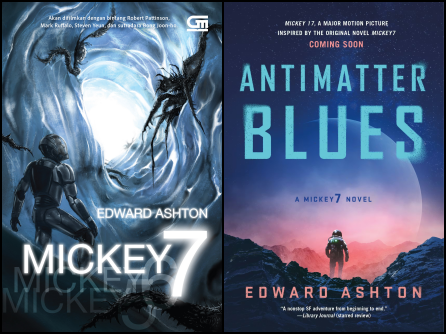
The book is Mickey 7 (2022), by Edward Ashton (a second artist today who doesn’t rank a Wikipedia page). There is a sequel, Antimatter Blues (2023). The story concerns a struggling new human colony on the planet Niflheim — which is currently deep in a “snowball” stage. The colony dome is surrounded by ice and snow. Due to the winter conditions, the colony must ration calories.
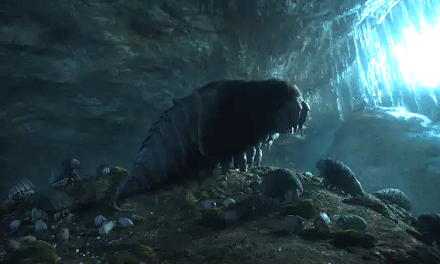
Turns out there is a native life form, a powerful hive-mind-like alien species the humans name “Creepers” (due to their resemblance to huge centipedes). These have become threatening (because they feel threatened by the humans).
Mickey 7 — originally just Mickey — is a ne’er do well from the settled exoplanet that sent the expedition to Niflheim. Utterly lacking in useful skills, but desperately needing to flee a loan shark, he signs on as an expendable — someone sent to do the dirty and likely fatal jobs sometimes necessary on colony spaceships and settlements.
Technology allows them to upload Mickey’s memories prior to a job and then download them into a new body they grow in the space of hours.
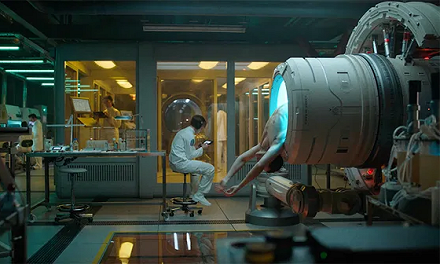
Mickey 7 is the seventh re-creation of the original Mickey. In the first book, he is sent to capture a Creeper for analysis and is thought lost.
Mickey 8 is created, but it turns out the Creepers didn’t kill Mickey 7. Instead, they helped him return to the dome.
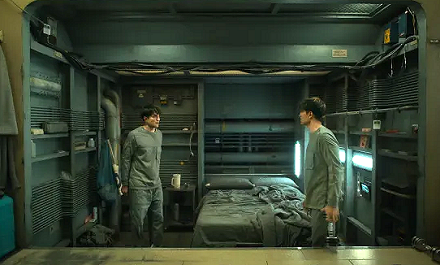
“Multiples” are forbidden. The colony’s leader, Kenneth Marshall, has what amounts to a religious revulsion of them. He hates expendables to begin with and Mickey in particular, so Mickey 7 and Mickey 8 must try to keep their multiplicity a secret.
It’s a nice hook for a story, and it works pretty well (as long as you don’t ask too many questions of the setup). The first book stands alone; the sequel picks up and continues the story.
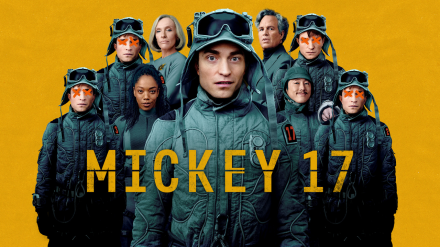
The adaptation, Mickey 17 (2023), is written and directed by Bong Joon Ho, who is acclaimed for (among others) Snowpiercer (2013) and Parasite (2019). I never saw, nor wanted to see, the former. It sounded dreadful, and nothing I heard or saw about it moved the needle.
I did see Parasite. It was okay. I didn’t quite see what everyone was so impressed by, though. Hardly a new story. There’s a cute Jimmy Buffett song, Gypsies in the Palace, from his 1985 album, Last Mango in Paris, that tells a similar story. As with many directors and writers, perhaps Bong works better on the smaller more human scale.
There is also that Bong’s work has a strong social commentary axis, and I’m not a huge fan of prominent social commentary in my recreational fiction. Most of what is said is, to me, stuff we were supposed to learn in kindergarten, so I find it unnecessary noise that comes off as preaching (and to the choir, no less).
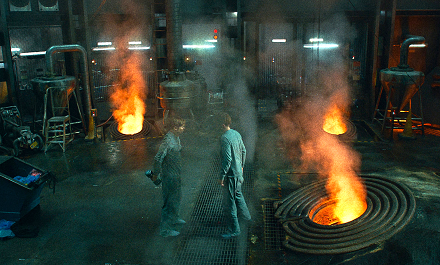
In any event, I found Mickey 17 a dark, dingy, zero of a movie with thoroughly unappealing (and derivative) production design, ridiculously over-the-top villains, and generally lackluster characters elsewhere.
Mark Ruffalo’s Kenneth Marshall — apparently an attempt to channel our POS POTUS — is the weirdest performance of his I’ve seen. Tony Collette usually elevates anything she’s in but here seems to be mailing in an unnoticeable performance here. There are even red ballcaps on some of the more belligerent characters.
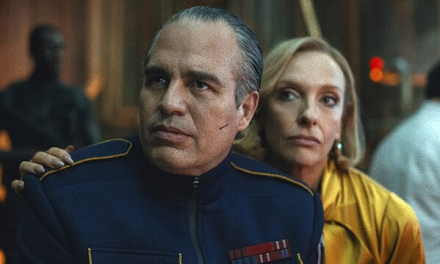
As is common in modern writing, the characters all behave like idiot children. Also common, the need for detailed backstory because viewers can’t be trusted to fill in any blanks. Hence also why everything is spelled out now, usually multiple times. Not only are viewers lazy, they are usually also distracted by their phones.
Consider the title. Why 17 rather than 7? It’s bigger. Therefore better.
Yet ultimately, the movie suffers from being small despite the scope of the source. This is why I think Bong may work better on smaller more human scales. (It’s interesting that Snowpiercer confined itself to a train and Parasite to a house. The truth, I think, is that smaller stories have more impact than huge ones because they match our lives better. They have a better impedance match with our minds.)
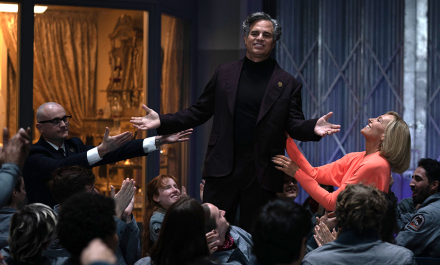
As with the adaptation of William Gibson’s The Peripheral, this is another example where the original story — save for the major players — is unrecognizable. And, in my opinion (obviously), an inferior one that adds nothing to the original. In this case, even one of the major players (Marshall) is altered beyond recognition. Tony Collette’s role as his wife doesn’t exist in the book and serves no purpose I can see in the movie.
The tacked-on storyline about drugs likewise serves no useful purpose, and the “space chainsaws” make it pretty clear this isn’t an adult’s movie. Or, for that matter, the memory “bricks” that look like actual clay bricks.
My bottom line: a dumbed down derivative disgrace to the source text. Style over substance. Billed as a “black comedy” yet utterly lacking in anything comedic. No redeeming value I could see. A definite Ugh! rating.
Read the book(s) instead.
§
I’m over my 2,000-word suggested ceiling, but this is supposed to be a TV Tuesday post, and despite having seen the above on TV, none of them are actually TV shows. To legitimize this post, I’ll wrap up by mentioning some TV shows.
Only Murderers in the Building (Hulu; 2021-present) dropped its fifth season earlier this year (and has been renewed for a sixth). I wrote about this back in 2021 when it started. I said then it was a comfy blanket, and it has remained so. Definitely worth seeing for Steve Martin and Martin Short. And Selena Gomez holds her own with them.
I didn’t love the third and fourth seasons as much as the first two — too much more of the same thing — but I found myself enjoying season five. I give the series an Ah! rating overall.
Solar Opposites (Hulu; 2020-2025; 6 seasons) dropped its final season. I’ve enjoyed the show okay (but won’t miss it). I wrote a post about it back in 2020.
As is often the case with a specific and unusual setup, there are only so many stories to be told. This series had a whole other plot thread (the miniaturized people in “The Wall”) to keep it going, but I think the well is dry. I give the series a strong Eh! rating.
Upload (Prime; 2020-2025; 4 seasons) also dropped its final season. I wrote a post about it back in 2020. It was an enjoyable show, and I wouldn’t have minded seeing more of the characters, but it, too, seems to have drained the well. Just as well not to drag it out needlessly. Another strong Eh! rating.
Rick and Morty (Hulu; 2013-present). Season eight finally became available on Hulu (the show airs on Comedy Central). This is one show I like too much to binge. I dole out the ten episodes like a miser because I know it’ll be a while until the next season.
I’m a bit biased on this one; it gets a healthy Ah! rating.
§
Lastly, the only Japanese anime I’ve seen recently, Kokkku (2018; 12 episodes).
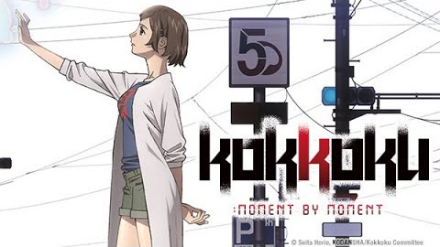
It involves a young woman, Juri Yukawa, from a family with the secret ability to stop time. She is unaware of this power until a cult kidnaps her brother and nephew, and her grandfather uses the power to enter a world they call Stasis, where time stands still for everyone but them.
And, it turns out, some others who also have the power to enter the Stasis world, as well as monsters that inhabit it. It’s definitely something a bit different, but the Japanese manga and anime (and light novel) creators are master storytellers who excel at something a bit different.
Hence my long-abiding love of Japanese storytelling.
§ §
Stay in the story, my friends! Go forth and spread beauty and light.
∇







 Logos con carne
December 9th, 2025 at 3:41 pm
I need to remember to check out Replicas. And Deus sounds interesting.
Yeah, I think the biggest issues with the J.J Abrams Star Trek movies is Abrams just wasn’t into Roddenberry’s Trek, so he spent most of his time in those movies deconstructing it, from having Kirk violate the Prime Directive to Spock losing his shit. It’s clear his Trek lore only extended back to the movies. I do think Star Trek: Strange New Worlds did better, at least in the first season. The second season was more mixed. And I haven’t been able to force myself to watch the third yet beyond the first episode. And the other new series just don’t do much for me.
I actually liked Mickey 17. I did see it before reading the book, which might have prevented me from being aggravated by the changes, most of which I agree weren’t intelligent. And I definitely could have done without the Trump channeling. Although the movie’s black comedy approach worked for me. But the setup in the book makes much more sense, such as having them launch from another colony over a thousand years in the future, instead of from Earth in 2050. And the taboo against multiples has a much better explanation in the book.
Upload is another one I keep forgetting to get back to.
Just started watching Penny Dreadful. I had seen a few episodes when it originally aired but never circled back. Not sure how far I’ll go, but the first few episodes were entertaining. Very gory though.
December 9th, 2025 at 6:25 pm
Yeah, Abrams definitely wasn’t a fan. Back in the linked 2013 post, I quoted him: “I never liked Star Trek when I was a kid. Growing up, honestly, I couldn’t get into it.” Because he didn’t grasp the import of the stories and only wanted “energy and spectacle”. 🤯
To a large extent, he seems to be much of what comprises modern audiences and writers.
Watching both The Peripheral and Mickey 7 adaptations, I asked myself how I would rate them if they were not adaptations. The former struck me as a serviceable story that suffers more in comparison with the source than on its merits. Its problem is that it is an adaptation, same-named even, so comparison isn’t so much invited as required. Beyond that, though, had I seen The Peripheral cold, I might have liked it fine.
I don’t think that’s true, at least for me, with Mickey 17. I know I’m in the minority; the film seems well-regarded both by audiences and critics. I think Ruffalo’s performance and the political references would have been a turn-off. I would have wondered what the hell Tony Collette was doing. (Or rather not doing.) I know I would have rolled my eyes at the near-future, seen-it-a-million-times grungy dystopia with rowdies in space. It isn’t so much that The Expanse did it better, but that Outland did it better. 😝 From the clips I’ve seen, his spaceship in Mickey 17 is close in production design to his train in Snowpiercer (dark, industrial, fumes). And I know I would have shaken my head at yet another because-the-script-says so romance. He hooks up with Nasha at first glance during the journey. (Contrast that with how their relationship developed over time in the book.) Impossible to say, but my guess is I’d find it objectively objectionable. 😁
The pity is, far future, advanced tech on alien planet, they had the chance to do something different. I would have loved to see the colony dome. What they did to Marshall’s character is a travesty. He’s so much more human in the book, especially in the ending of the sequel.
I had to look up Penny Dreadful. Doesn’t sound much like my cuppa. Enjoy, though!
December 9th, 2025 at 8:22 pm
The Peripheral was another one I enjoyed, again in blissful ignorance of the book, which I’m sure was much better. I loved the solution in the season finale, but others I know who watched it found the show confusing, which is probably at least part of what sunk it.
On being in the minority, there are a lot of things I like that most people don’t, and not a few very popular shows I have no use for, so I know how you feel. And I do agree Mickey 17 could have been better in a number of ways. But for me that’s true of just about all movie or TV science fiction.
I’m still not sure if Penny Dreadful is my cup either. It’s billed as horror, mostly because it seems to incorporate every horror story from 19th century fiction (Frankenstein, Dracula, werewolves, Dorian Gray, etc), but it’s horror with a lot of action.
December 10th, 2025 at 11:31 am
Seems like everything has to have a lot of action these days. I knew we were doomed to that when Guy Ritchie directed Sherlock Holmes with the Robert Downey, Jr., and turned Holmes into an action figure. (Same thing is true with Kirk and Spock (and Uhura) in the rebooted Trek.)
I readily admit it’s a hangup on my part, but I do have a strong line when it comes to adaptations. It’s a weird line, too, because I often like what I think of as “jazz” adaptations — the ones that more-or-less completely re-interpret the source. Seasonally appropriate, the Dickens classic, A Christmas Carol, is a story that has many such “jazzy” re-interpretations. (Bill Murray in Scrooged is a favorite.) For that matter, speaking of Sherlock Holmes, there’s another one that has lots of jazz versions.
But somehow for me, with a contemporary text, especially a first or early adaptation of that text, I have high expectations about fidelity. It’s one of my primary yardsticks for such works. I’m sure you’ve heard my three adaptations axes. What is changed? What is removed? What is added? For me, in this circumstance, that last one needs to be “damn little.” Removals are necessary; I rarely am bothered by them. Changes, well, that’s where it depends. They’re often necessary or desirable, too. But additions, almost by definition, are contrary to the text, so they’re like extraordinary claims for me — they need extraordinary justification.
I find myself even pickier when it comes to live-action adaptations of graphic novels or animations. I’ve generally come to the conclusion they’re usually a bad idea even to begin with. They rarely come off well in my eyes. (The Netflix Cowboy Bebop live-action adaptation might be an epitome. OTOH, I liked the Netflix live-action adaptation of The Umbrella Academy more than I liked the graphic novel.)
December 10th, 2025 at 4:05 pm
When I was younger, I had a similar inclination toward adaptations. I still remember being outraged by the stuff Jackson added to The Two Towers, additions which seemed far lower quality than anything Tolkien had written. Since most people at that point hadn’t read the books, I was in the minority. Interestingly, by the time the Hobbit movies came out, a lot more people had read the books, and were outraged by how much the movies were bloated up, but by that time I had largely gotten past it.
Nowadays I’m looking to see if the adaptation succeeds in making me feel the same way the original did. And I’m more aware that the move from literature to media requires changes. Which isn’t to say a lot of adaptations botch things when they try. It’s too easy to use the change in venue as an excuse to just impose your own story. And I agree with you; that rarely works out well.
I’ve actually been okay with a lot of the anime adaptations, but here I’m well aware I’m in the minority. They rarely succeed. I think most anime fans are like you. I agree the effort would be better spent doing something new that wouldn’t suffer from comparison. Take the anime as an inspiration for something original. Of course, that means losing the name recognition.
Anime adaptations of manga seem to mostly work exceptionally well, but I think it’s because manga really isn’t that far from anime, and it helps that the anime artists take the manga as their storyboards.
December 10th, 2025 at 7:55 pm
I’ve always leaned towards hard SF, so I didn’t take to the LotR books like many of my friends did. I have my own youthful outrages over movie versions. Time does heal those wounds.
I wish creators could get more milage out of “inspired by” or “loosely based on”. As you say, name recognition. The other edge of that, of course, is big fans of the original finding the adaptation not living up to the source.
Totally agree about anime from manga. Fairly similar mediums. And something about drawn stories, still or animated, gives them a distance that helps with dark or violent subject matter. Live-action stories are realistic and immersive, so both negative and positive impressions are very much amplified. Crossing from drawn to live-action can make the darker stories a lot harder to take. At least for me — I’m okay with violence, gore, and darkness in drawn stories.
In contrast, it was in the big battle scenes of LotR that the mass deaths of CGI “people” first began to bother me. By the time someone mentioned all the civilian deaths involved in the much-celebrated destruction of the Death Star, I was feeling it pretty strongly. (For that matter, the cinematic destruction of Alderaan.) I find I very much prefer smaller movies with smaller stakes.