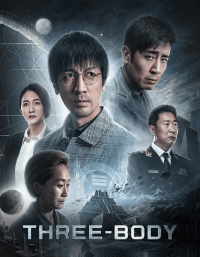
 Over the last few weeks, on Amazon Prime, I’ve watched all 30 episodes of the first season of Three-Body, the Chinese television adaptation of the 2006 science fiction novel The Three-Body Problem, by Liu Cixin.
That’s the first book of the Remembrance of Earth’s Past trilogy. The second and third books are The Dark Forest (2008) and Death’s End (2010). I haven’t (yet) read the novel, but the adaptation is said to be reasonably faithful to the text.
I enjoyed the TV adaptation but found certain aspects of it frustrating. I’m curious to see if my frustrations are due to the adaptation or inherent in the novel.
I’ll warn readers now that this post contains a lot of spoilers. It’s impossible to discuss my frustrations without details, so caveat lector.
I emphasize that this post is about the Chinese TV adaptation, not the newly released Netflix adaptation, 3 Body Problem. Which, at first glance, doesn’t impress me, but I’ll come back to that.
§ §
The main storyline is set in China in 2007, but its seed is planted back in the Chinese Cultural Revolution (1966-1976). Ye Wenjie, a young astrophysicist, works at a secret government-run SETI facility. Her position is a lowly one — maintaining the hardware — because her father, a physicist and professor at Tsinghua University, ran afoul of the government and was fatally injured in a struggle session.
In 1971, Wenjie discovers that the Sun can act as an amplifying radio relay capable of rebroadcasting radio signals magnified hundreds of thousands of times by the Sun’s power. But her idea is rejected because shooting radio waves at the red Sun could be misinterpreted in the tense political climate. She schemes to secretly send a message anyway.

Young Ye Wenjie (Wang Ziwen) listening for alien messages at Red Coast, the secret SETI facility (in the 1970s).
Eight years later, working alone one night in 1979, Wenjie sees the arrival of an alien message. The message, which begins “Do not answer” is from an alien pacificist who begs her not to reply or his people will find Earth and invade it.
Wenjie, bitter and hateful (and possibly insane), does reply. She feels Earth can never overcome its madness. She hides the reception of the alien message and her reply. She later murders her husband, Yang Weining, and the political commissar, Lei Zhichang, to cover her tracks.
Some years later, she meets oil billionaire Mike Evans, and tells him about the message. Evans, a radical environmentalist with a hatred for humanity, forms the ETO, Earth-Trisolaris Organization, and builds his own antenna on a repurposed oil tanker.
All of this is backstory doled out through flashbacks (much of it not exposed until the latter episodes).
§
In 2007, the world is plagued by the suicides of numerous scientists. The deaths have in common the phrase “physics doesn’t exist anymore.” One of the dead scientists is, Yang Dong, a particle physicist who happens to be Ye Wenjie’s daughter.
Wang Miao, a leading figure in nanotechnology is recruited by Shi Qiang, the detective charged with figuring out what’s behind the suicides. Shi Qiang wants Wang Miao to infiltrate The Frontiers of Science, an organization the dead scientists all belonged to.

Left-to-right: detective Shi Qiang (Yu Hewei), General Chang Weisi (Lin Yongjian), and Wang Miao (Zhang Luyi).
Wang Miao notices a timestamp that appears on photos he’s taken recently. But it doesn’t appear when his wife or daughter use the same camera. Eventually, the timestamp, which is counting down, appears in his vision. It suggests something will happen in 49 days.
Shen Yufei, a physicist and leader of The Frontiers of Science, tells Wang Miao the countdown vision will stop if he halts his nanotechnology research. Because the equipment needs maintenance, he does this, and the countdown does vanish. Later she advises him to monitor the cosmic microwave background at a certain time.
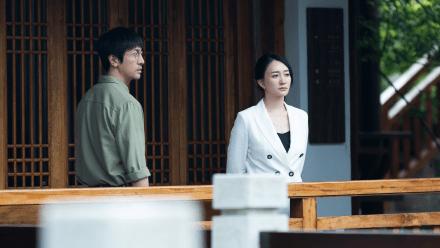
Left-to-right: Wang Miao (Zhang Luyi) and Shen Yufei (Li Xiaoran).
He does and sees the CMB blinking the same countdown in Morse code. Shi Qiang tells Wang Miao that all the scientists who committed suicide had contact with Shen Yufei.
We see that a conspiracy exists with Shen Yufei and Pan Han (a biologist and environmental extremist) as its apparent leaders. They communicate with someone named “Lord” who instructs them to either win Wang Miao over (and halt his research) or eliminate him. Attempting the former, Shen Yufei steers Wang Miao to a virtual reality game, Three-Body.
The game presents an alien world with seemingly random catastrophic chaotic periods interspersed with stable periods that allow civilization to grow. Eventually Wang Miao determines the world has three stars in unpredictable chaotic orbits. There turns out to be no computable solution that would give the Trisolarians a predictable calendar.
Eventually, authorities on Earth learn the Trisolarians have launched a space fleet headed to Earth to take it over.
§ §
I can’t speak for the book, but this adaptation is slow-paced, melodramatic, and overwrought. In the extreme. The pacing is glacial. There are many flashbacks and semi-relevant images. Even the people seem to move and speak slowly. At first, I took this as an overly moody fantasy horror story, and despite its science fiction trappings, I think the label applies. It’s a slow-burning alien invasion story with a lot of padding (and the aliens themselves won’t show up for 400 years).
It is science fiction, but I struggled with some of the physics bullshit (there’s no other word for it). The story leans heavily (a bit too heavily for me) on Clarke’s Third Law, “Any sufficiently advanced technology is indistinguishable from magic.” Much of the Trisolarian technology amounts to magic. Even allowing for the fiction and Third Law, the bullshit level was high for my taste.

Left-to-right: Wang Miao (Zhang Luyi) and Shi Qiang (Yu Hewei) prepare to enter the Three-Body VR game.
The scientist suicides and the notion that “physics doesn’t exist” bothered me. It’s not how scientists or science works. For instance, Yang Dong commits suicide because her particle collider experiments not only didn’t match prediction but gave conflicting, seemingly random, results.
Firstly, discovering something new — which that certainly qualifies as — is the life dream of every scientist. She should have been driven to find out what was going on, not driven to existential despair. Secondly, it’s false that “physics doesn’t exist” — if that were true, cell phones wouldn’t work. Physics acting differently from expectations, even randomly, is still physics. So, I was bothered by that fundamental premise.
And no one ever seems to think it might be due to sabotage or interference. (And it is, in fact, the former.)
§
Much is made of the “turkey farmer” analogy, which is based on a bit by philosopher Bertrand Russell commenting on induction. He wrote:
The man who has fed the chicken every day throughout its life at last wrings its neck instead, showing that more refined views as to the uniformity of nature would have been useful to the chicken.
He goes on to say:
Thus our instincts certainly cause us to believe the sun will rise to-morrow, but we may be in no better a position than the chicken which unexpectedly has its neck wrung.
Which strikes me a bit like Hume’s rejection of causality (but that’s another post). The point here is that people aware of the Trisolarians identify with the turkeys and this creates existential despair. But as Russell said, it just requires a more refined view of nature. We can legitimately believe, absent something seriously catastrophic, the Sun will rise because we understand how the Solar system works.
§
We’re told the Trisolarian space fleet is capable of reaching 10% of light speed, which should make their journey 40 years, not 400. The reason, supposedly, is the need to refuel along the way. But this is nonsense. If a spacecraft reaches a given speed, it will coast at that speed unless energy is expended slowing it down. This seems a plot device to give humanity time to prepare, but it’s one that commits a major physics error.
And while the alien space fleet won’t be here for 400 years, the Trisolarians are able to send two “sophons” — two “protons” that were “unfolded” from eleven dimensions to two giving them a surface area capable of surrounding a planet. Using picotechnology the Trisolarians etched a supercomputer into the 2D surface of the “sophon”, refolded them back to eleven dimensions, and launched them to Earth where they act as saboteurs and spies (using quantum entanglement to instantly send back information). These supercomputers, launched in 2001 and arriving in 2005, are behind the failed particle experiments, the flashing CMB, and the countdown experienced by Wang Miao.
There is so much bullshit in that last paragraph that it’s hard to know where to begin.
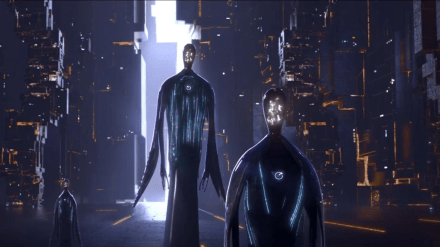
Trisolarians as depicted in the Three-Body VR game.
Some of it may be due more to the TV adaptation than to the novel. For one, the adaptation refers to these as “protons”, but the Wikipedia plot synopsis for the novel says they occupy the same volume as a proton. Besides simplifying things for a TV audience, I suspect much was lost in translation — the English subtitles often leave a lot to be desired. (And it may be that some Chinese dialog and concepts just don’t translate well to English.)
[There is also that protons aren’t fundamental particles but clumps of lots of quarks and gluons.]
The eleven dimensions come from string theory — which may or may not be a physics dead end. Regardless, I’m suspicious of a 2D surface large enough to cover a planet — let alone large enough to act as a more distant shield blocking the CMB — “folding” down to a proton-sized 3D shape (even with eleven dimensions) seems a bit much to swallow. Mathematically, perhaps, but physically, not so much.
There is also that it’s not possible to etch a circuit of any complexity into a 2D surface. Wires need to cross without actually connecting, and in complex circuits there is a lot of crisscrossing. Complex circuits always have a 3D topology.
No mention is made of how the sophons get energy, move, navigate, perceive, or (most importantly) manipulate anything. There is the suggestion they move at light speed (allowing the two to be everywhere they’re needed), but nothing with mass can move that fast.
Worst is the notion that quantum entanglement allows faster-than-light communication. That isn’t a technology issue, it’s a basic physics issue. Quantum entanglement does not allow communication. The Trisolarians do not have faster-than-light travel, and if the cosmic speed limit is thus respected, then the no communication theorem must also be.
The sophons are part of a three-stage plan to soften Earth for takeover. The first is having the ETO focus on environmental destruction to discredit science. The second is attempting to induce supernatural events to undermine scientific thinking and turn our imaginations against us. The third is to stagnate science by interfering with scientific experiments. The Trisolarians are afraid Earth science might be able to defeat them (despite their almost mythical abilities).
But environmental destruction isn’t due to science but to technology and, more critically, industry. We’ve been destroying the environment ever since we killed all the mammoths. (Jarringly, the TV series leans heavily on environmental destruction — especially logging and pollution — but was made before global warming rose to the top of our “OMG, we’re fucked” pile.)

Left-to-right: My two favorite characters, Shi Qiang (Yu Hewei) and the kickass Xu Bingbing (Zehui Li), who is worth 10 people.
Finally, anyone who watched (or read) The Expanse knows how easy it is to devastate a planet from space. Just drop some big rocks on it.
Perhaps more to the point, why would a civilization with advanced technology need our world? The entire story hinges on the “dark forest” notion — that any civilization dumb enough to advertise its existence is wiped out by galactic predators. I consider this notion stupid. On multiple levels.
§
The political structure of the world in Three-Body seems alternate to me. The world is apparently run, not by politicians, but by various military “Battle Zones” — North America, South America, all of Europe, all of Africa, all of Asia, etc. Entire continents unified under military command.
And they apparently can stage a military operation in the Panama Canal with no one objecting. (I will say the payoff on that operation was one of the better parts of the series. And exactly why Wang Miao is a nanotechnology expert.)
§
The story has a weird mix of intuitive leaps and intellectual blindness, both of which service the plot as needed. For instance, the VR game is named Three-Body, but Wang Miao needs an innocent comment by his daughter to make the intuitive leap that this refers to the famous three body problem (which dates back as far as Newton).
The name, Trisolarians, makes it clear they have three Suns. (In fact, they are from the nearby triple-star Centauri system, which is 4.2 light years away — considerable liberties were taken in its depiction in the TV series).
The chaotic orbits of the Centauri suns account for the unpredictable chaotic and stable periods the Trisolarians experience. As depicted, it’s amazing any civilization, let alone an advanced one, ever arose there.
§ §
The series is so moody and sluggish that I nearly bailed early, but it got better around episode five or so. It’s not a particularly happy story, but I found it interesting enough, despite my frustrations, to keep watching for all 30 (“one hour” — i.e. 48 minutes or so) episodes.

Older Yu Wenjie (Chen Jin) in 2007 at the funeral for her daughter (one of the scientists who committed suicide).
One tip: don’t be fooled by all the shots of insects (most of them showing a single instance of a specific type). It makes it seem these are the saboteur-spies, but they’re just bugs, and the constant litany of these shots is a setup for the disdainful final message from the Trisolarians to us, “You are bugs!”
But as Shi Qiang points out to Wang Miao and another physicist, humanity has been fighting insects throughout our existence, and — at best — even with our technology, it’s been a standoff. The series ends on that hopeful note.
§ §
Bottom line: thumbs up but with caveats. Worth seeing if you’ve read (or plan to read) the book(s).

The Remembrance of Earth’s Past trilogy by Liu Cixin.
I may have more to say once I read the novel. And watch the Netflix adaptation, although I fear it may be afflicted with Modern Storytelling. The main character, Wang Miao, has been gender swapped for Augustina Salazar (Eiza González, a Mexican singer/actress). Jess Hong plays a character also based on Wang Miao combined with a (female) character, Cheng Xin, who doesn’t appear until the third book.
To be clear, from Nancy Drew and Supergirl (in my youth) to Ripley and Alita, I’ve always enjoyed kickass female characters. That’s not the issue, not at all. The issue is the needless alteration of original text because Social Messaging. I think that’s a mental disease.
And I’m not sure casting Benedict Wong as Shi Qiang is a good choice, either, but we’ll see.
The series was done by the same folks who did Game of Thrones (a show I bailed on after two seasons), which doesn’t bode well.
Stay in stable orbit, my friends! Go forth and spread beauty and light.
∇




 Logos con carne
March 30th, 2024 at 10:42 am
As an aside, because the world of the Trisolarians orbits among three stars, it’s actually a four-body problem. And yet it turns out that solving the orbital dynamics ends up having nothing to do with the story. In fact, the characters discover there is no computable solution, and the three-body problem is never mentioned again.
March 30th, 2024 at 10:43 am
There are a number of shots where the camera is turned 90 degrees from upright. As with all the shots of a bug, I think the visual metaphor here is that ‘everything is turned on its side.’
March 30th, 2024 at 10:52 am
I watched the first two episodes of the Netflix version last night. It was awful. Definitely badly infected with Modern Storytelling disease. Some notes:
The first scene starts off with violence, blood, and a killing (of Ye Wenjie’s father). I guess that’s the Game of Thrones influence, but I found it sickening.
No, Einstein did not help develop the A-bomb. In fact, he had almost nothing to do with it.
From the beginning, and throughout the two episodes, the Message: White men suck. Men in general are feeble and suck, but white men definitely suck.
What’s with this “Do you believe in God?” theme? One character replies, “We’re not believers, we’re scientists.” Yet, most scientists do have some form of faith (Einstein did), and many are church goers.
Bai Mulin instantly trusts Ye Wenjie and starts a romance with her. Then, suddenly, the Western environmentalist book he gave her is discovered, and she’s imprisoned. No foundation for any of it. Then she’s brought to Red Coast because of a paper she wrote about the Sun.
The show has no nuance, no development, no intelligence, no foundation, and is so ‘by the numbers’ it comes off like one of those paint-by-numbers pictures. It’s all simplistic bullshit and bad storytelling. Huge fail.
March 30th, 2024 at 10:53 am
It was so bad I gave up on it and switched to another Netflix show, Resident Alien (which stars the inimitable Alan Tudyk), which was pretty good. I’ll stick with this one! Don’t know if I can take any more of that other Netflix show.
March 30th, 2024 at 11:09 am
I started watching the other version, but Neal hated it so we switched to something else. I might get back to it so I stopped reading your post to avoid spoilers. I’ll have to come back later!
March 30th, 2024 at 11:29 am
By “other” do you mean the Netflix one? I watched two episodes last night and hated it, too (see other comment). What did Neal hate about it?
March 30th, 2024 at 11:45 am
yeah the Netflix one. I’m not sure why Neal hated it. I tried to get an answer out of him, but he just said, “it makes no sense. It’s stupid.” But he says that about most shows. 😆
March 30th, 2024 at 12:03 pm
I’m not sure he’s wrong about that!
March 30th, 2024 at 11:39 am
Game of thrones deserves to be finished…
Watched the Netflix version. High degree of suspension of disbelief. This one is more humanly focused around the friendship of a group of smart people.
The 3BP is a mcguffin. However, there is a scene where the serendipitous path of human development is contrasted with a civilization that suffers repeated collapse, for millions of years, and how that evolution changed them.
Physics schmysics. All of this is bullshit. And the storyline is contrived and flimsy. But what else is there to watch that’s scifi and new?
March 30th, 2024 at 12:02 pm
I think two episodes of the Netflix version is all I can take. I’d much rather watch Resident Alien.
True, all science fiction is bullshit on some level, but some stinks less. Sadly, it’s mostly written SF that isn’t bad. Most of the media stuff works too hard for “popular appeal”. Which usually raises the stupidity level. I almost miss the B.L. era when SF was niche.
I have a buddy who feels the same way you do about GoT!
March 30th, 2024 at 2:49 pm
I’ve read so little SF in the last decade… I can’t really have an opinion. Film SF, though, I’ve tried to stay current.
I do rely on the ol’ impossible vs improbable filter. FTL? Nope. But I’ll watch Starwars and Startrek for the action and CGI. The Martian? That worked. Ready Player One? Meh.
This one? Quite a few plot holes. “Don’t contact us”? Right. “We cannot lie,” but we can create a metaphor comparing you to bugs.
March 30th, 2024 at 7:57 pm
I meant to ask if you’d read The Three-Body Problem, but if you haven’t been reading much SF, then I’m guessing not? I take it you’ve only seen the Netflix adaptation? If you liked the story, you might like the Chinese version on Amazon Prime. In comparison to the two episodes I saw of the Netflix version, the Chinese version is much better. Slow burning and moody, but better storytelling and, I’ve read, fairly faithful to the text. Fewer plot holes, maybe. And the CGI is worth the price of admission.
I do like SF that respects the speed limit (The Expanse, for one example), but FTL is one of those science fictions “gimmes” that seems to come with the territory.
Speaking of The Expanse, those books are well worth reading. I really like Robert J. Sawyer’s work, modern day with interesting and probable tech. Early Cory Doctorow is pretty good, but I haven’t cared much for his most recent books — too preachy about his causes. I’ve read a couple of Martha Well’s Murderbot Diaries stories, they might appeal. First person from the “murderbot” point of view. Not really a murderer, a security unit vaguely reminiscent of the T-800 Terminator model. And he generally hates humans.
There are very few media SF productions that have grabbed me. I got off the Star[Trek|Wars] bus long ago, but some of the smaller productions have been fun. There was a show, Dark Matter, Canadian production from 2015, that I really enjoyed. A little bit like Firefly. Wish some streaming service would carry it. I’d like to re-watch it.
March 30th, 2024 at 9:10 pm
Murderbot was one I did find and read much of. She got repetitive there and I quit. Cool premise though. Tried to watch some of the Expanse, the too-much politics turned me off.
Day Zero was one I read, felt true to the possibility — robot uprising. And “read” is a stretch. Audiobooks only these last few years, something I can fall asleep to.
March 31st, 2024 at 8:38 am
I’ve only read the first two of her Murderbot stories, and the hold times at the library have been so long that it’s months between them (the third one finally just came available), so they haven’t had a chance to get repetitious. I can see how the notion might end up being a one-trick pony, though.
Day Zero isn’t familiar to me, but the Wiki article on it makes it sound intriguing. I’ll see if the library has it. My hearing deficit is severe enough that audiobooks are a non-starter for me, but I do like to read. I’ve been using the Terry Pratchett Discworld books (which are old friends) as good-night books.
April 7th, 2024 at 9:37 am
Yesterday I read, and very much enjoyed, Day Zero. My library also has Sea of Rust, which I play to read today (or start reading — depends on how the day goes).
Pounce and Ezra had me visualizing Calvin and Hobbes (which I loved). I thought, too, it was a bit of a fun, and as you said: “true to the possibility”, variation on Skynet and Terminators. And it seems to me one could make a pretty good movie adaptation of it.
Thanks for recommending it!
April 9th, 2024 at 11:21 am
Have you read (or listened to) Sea of Rust? It was published four years earlier than Day Zero but, taking place long after the robot uprising, is more of a sequel. Explores what really happened, much more than apparent in Day Zero. It’s interesting but I’m not enjoying it quite as much as I did Day Zero (which I thought was really good). Don’t want to say more in case you’ve not read it but plan to.
April 9th, 2024 at 8:53 pm
I have not. And I agree, Day 0 got-it-done!
April 1st, 2024 at 12:41 pm
A science article I was just reading reminded me of ‘science’s most auspicious phrase: “Hmmm, that’s funny…”‘
Again emphasizing that unexpected experimental results are the life dream of any (real) scientist. Investigating and figuring out stuff like that often leads to Nobel prizes.
So, the notion that scientists would commit suicide over it is just so wrong and, in my eyes, a major flaw in the story. Ultimately, it’s just a cheap plot device to get outsiders (like Shi Qiang) involved.
May 23rd, 2024 at 1:06 am
Now that I’ve read the (first) novel, I can say that the Chinese adaptation is very close to the text! The novel, of course, is a lot better.
May 28th, 2024 at 7:08 am
[…] that I’d heard that the adaptation was “reasonably faithful to the text.” [See Three-Body.] Now that I’ve read the book, I can say it was indeed quite faithful. Some changes, to be […]
February 16th, 2025 at 11:58 am
[…] Not quite a year ago I posted about watching the Chinese adaptation of The Three-Body Problem, a 2006 science fiction novel by Liu Cixin. At the time, I’d only seen the adaptation. Since then, I’ve read all three books of the trilogy, re-read the first, re-watched the Chinese adaptation, and now, holding my nose, am watching the Netflix adaptation. […]
March 2nd, 2025 at 12:01 pm
[…] I posted last year about how much I liked it. So much so that I recently watched and posted about it again. And re-read the first novel (I read the trilogy last year). I even watched the first season of the Netflix adaptation. […]