 Today is the Vernal Equinox, the official starter gun for spring! Now we get six months of more sunlight than not. And the length of the day is changing (towards the long summer days) at its fastest rate during the year (except for the Autumnal Equinox, the other fastest).
Ironically, the last few days have been chillier than what has passed for normal this winter. The high three days ago (on 3/17) was only 30 degrees (Fahrenheit, of course).
The weather has been so strange (thanks to global warming) that I just had to make a bunch of charts to share here.
But first a few words about the equinox. I have an app on my iPhone that mostly does one thing: tells me the sunset and sunrise times. But you can get those times for any date you like (within reason — prehistory and the distant future, not so much).
It has a few other interesting features. For one, it gives me the “Sun uptime” — how much sunlight there is on a given day. What’s a bit odd is that, today, which is supposed to have equal amounts of sunlight and not-sunlight, it says the Sun uptime is 12 hours and 11 minutes. I’m guessing it’s including some amount of dawn and dusk. Or possibly the first appearance of the rising Sun in the morning and its last sinking bit in the evening.
[The Sun takes from 2 to 5 minutes to rise or set depending on the latitude, which could account for extra 11 minutes. I’m too lazy right now to research (let alone try to calculate) how long it takes here at 45° north, but it definitely takes some number of minutes.]
A somewhat more interesting feature of the app is that it tells me how much the amount of daylight has changed, and will change, in the previous, and next, week and month. I’ve been watching those numbers change since the Winter Solstice.
Today it says that a month ago there were 90 minutes less sunlight, and a month from now there will be 95 minutes more. Last week (I assume on this day of the week, Wednesday) there were 22 minutes less, and next week there will be 23 minutes more.
For comparison, on the last solstice, December 22, with 8 hours and 48 minutes of daylight, the previous and following weeks only had a minute difference (a minute more in both cases). And the monthly difference was +31 (previous) and +36 (next).
So, pretty big difference in the rate of change on the solstices compared to the high-speed equinoxes. [See Solar Derivative for details.]
§ §
Despite that it’s officially spring, based on previous years, we’re probably in for noticeably winter-ish weather. Or at least snowy. I mentioned already that we’ve had a bit of a cold snap the last few days, and snow is expected later this week.
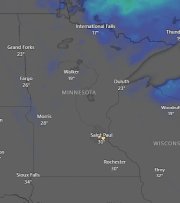
Snow Depth = Zero!
Traditionally, we say March is the snowiest month, but we often get significant snow in April. The El Niño has caused a drought, so we haven’t gotten much of the cold white stuff this year. (Or, for that matter, much rain last summer. The farmers are hurting!)
Every snowfall we’ve had has been fairly minor and followed by weather warm enough to melt it before the next one comes along.
I have a buddy who loves to fish, and he looks forward to going ice fishing all winter up on Lake of the Woods. But even up on the Canadian border, there hasn’t been good enough ice to allow it (and certainly none down here).
So, we haven’t had a snowy winter, let alone a cold one (except for the “cold ones” inside our refrigerators). My weather app tells me the snow depth in all of Minnesota is zero inches (except for a band in the sub-inch range along the northern border).
§
The temps in February — traditionally our coldest month — were so bizarre that I made a chart to share [see Friday Notes (Feb 30, 2024)].
Later I decided to add some March data. That led to adding January, which led to adding last September-through-December, and I finally decided to add all of last year. I’ll add data this year as the year develops.
Without further ado, here are the local highs and lows (of temperature, not mood) for all of last year and the first three months of this year (March, obviously, is incomplete):

January 2023: High range: +2/+37; Low range: -8/+32.
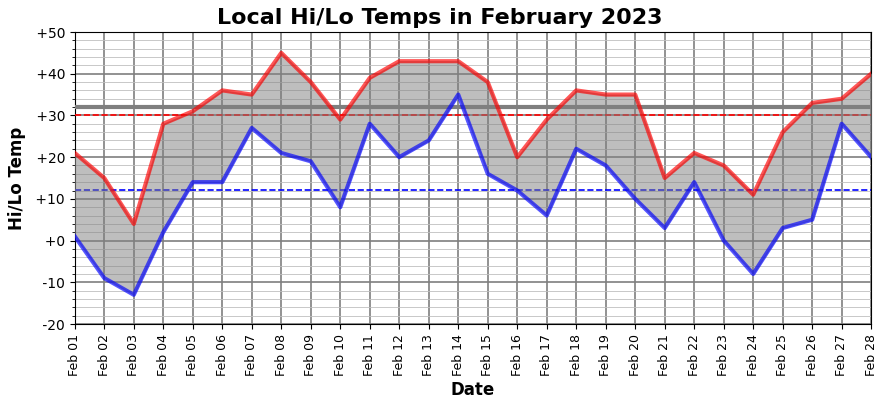
February 2023: High range: +4/+45; Low range: -1/+35.

March 2023: High range: +18/+45; Low range: +7/+32.

April 2023: High range: +37/+88; Low range: +22/+64.
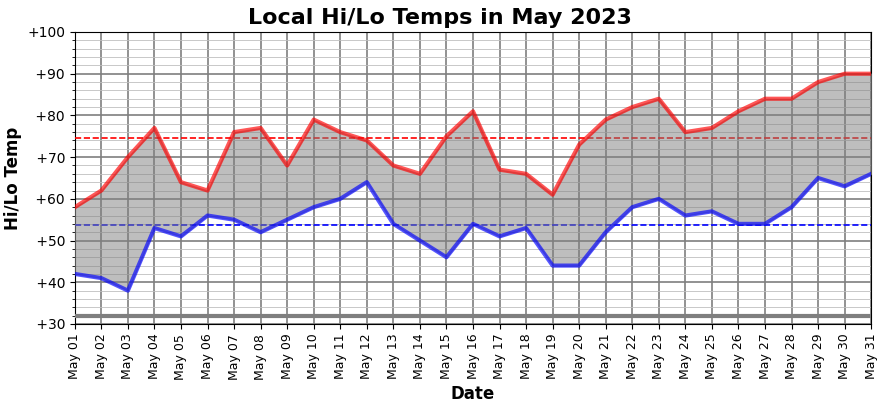
May 2023: High range: +58/+90; Low range: +38/+66.

June 2023: High range: +71/+92; Low range: +50/+72.
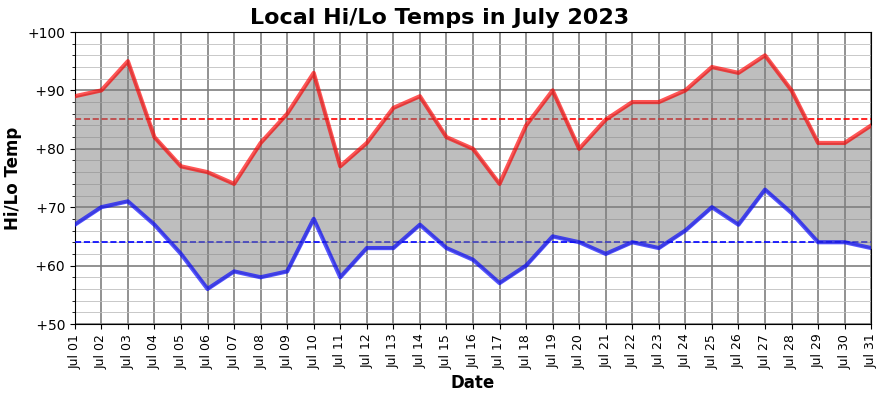
July 2023: High range: +74/+96; Low range: +56/+73.
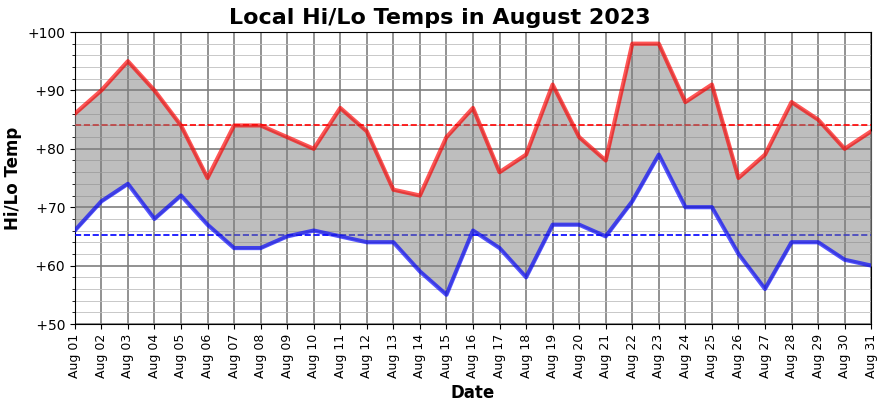
August 2023: High range: +72/+98; Low range: +55/+79.

September 2023: High range: +64/+98; Low range: +47/+75.
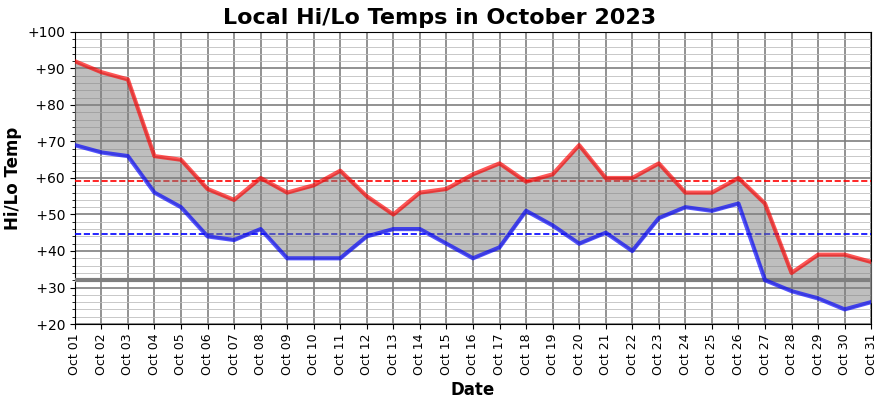
October 2023: High range: +34/+92; Low range: +24/+69.

November 2023: High range: +21/+69; Low range: +8/+43.
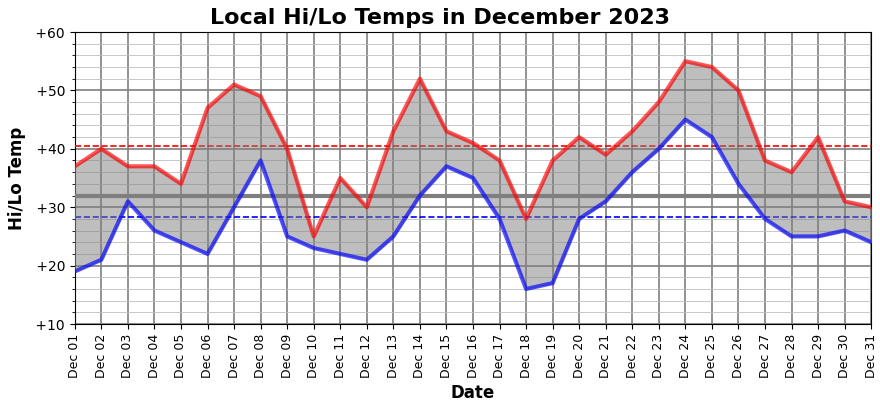
December 2023: High range: +25/+55; Low range: +16/+45.
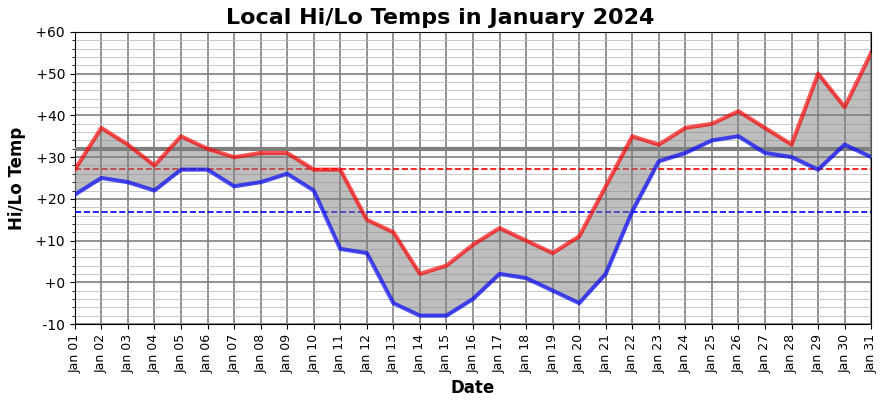
January 2024: High range: +2/+55; Low range: -8/+35.

February 2024: High range: +18/+65; Low range: +4/+39.

March 2024: High range: +30/+74; Low range: +21/+43.
Click on any chart for a larger version (880×400 pixels). The red and blue plot lines are the high and low for the day. The red and blue dashed horizontal lines are the average high and average low. The solid gray horizontal line indicates 32° (if the chart includes the +30s). Note that the vertical scale can change from month to month.
[The data comes from the Minnesota Department of Natural Resources Local Climatological Data webpage. A nice resource with monthly weather data going back to 2018.]
These temperatures are kind of crazy. Certainly not what we’re used to! (Not that I’m complaining.)
Oddly, for all that it never got very cold, last summer also wasn’t beastly hot. The highest temp we saw was 98. All year long (in 2023), we only had 33 days of temps in the 90s.
§
How do I know? Because of (the data for) this chart:
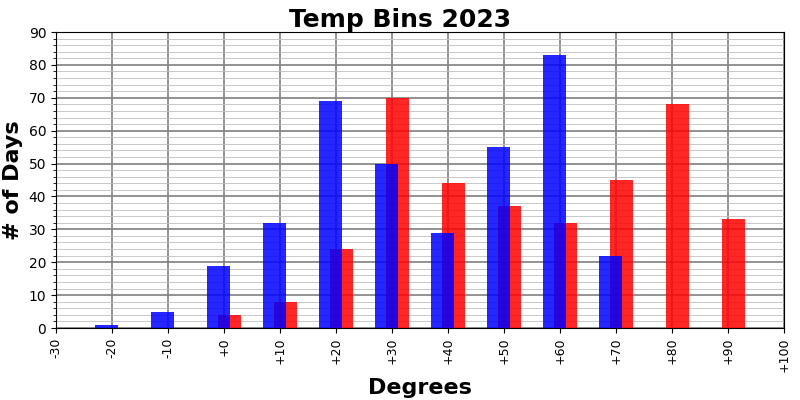
2023 High/Low Temperatures Histogram.
Which shows how many days we had of given highs and lows (in 10° bins). Throughout the year, including last winter, we never saw a high below zero, and only six days with a low below zero (and only 19 days with single digit lows). That’s just weird!
Looking at this year so far:

2024 High/Low Temperatures Histogram.
Most of our low temps so far have been in the +20s with 19 days of low temps in the +30s. And, as already mentioned, almost no snow, and none that stuck around.
I did one last chart focusing on this “winter” (October-March):
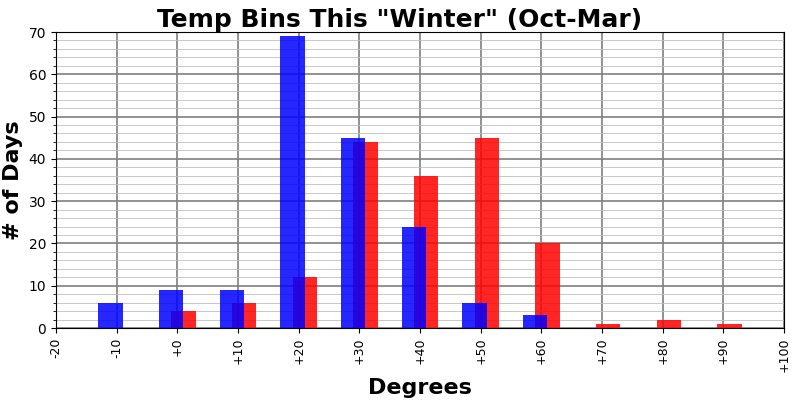
“Winter” 23/24 High/Low Temperatures Histogram.
Again, most lows in the +20s (or higher). Crazytown!
§ §
Spring has Sprung! (But it didn’t have far to jump.)
Stay temperate, my friends! Go forth and spread beauty and light.
∇





 Logos con carne
March 20th, 2024 at 2:46 pm
For the record, the Equinox was at 3:07 GMT, so it happened here (in Central Daylight Time) at 22:07 PM last night.
March 20th, 2024 at 4:58 pm
All I can say is, it will be highs in the 80s this weekend here in Tucson. Perfect weather. We don’t think of it as hot until it goes over 100. Really 105 is when we start bitching. I know some people who won’t even turn on the AC until it goes several degrees beyond 100 (not us!)
March 20th, 2024 at 5:37 pm
For you guys, that heat is low humidity, right? Around here, high temps usually come with high humidity, which makes the heat oppressive. Even temps in the 80s and 90s can be insufferable if the humidity is high. Worst is when there is no breeze — then it’s like being in a sauna. 🥵
March 20th, 2024 at 7:10 pm
Yeah, “It’s a dry heat.” 🙂
Although during monsoon season, it’s not a dry heat, it’s an awful wet disgusting heat…I can’t stand humidity and heat. Terrible stuff. I prefer a 105 degrees dry heat day to a 100 degree humid day. (Although once it starts getting into the 110s, that’s just freaking diabolical. You can literally bake things in your car!)
March 20th, 2024 at 7:51 pm
Yeah, dry heat is pretty much unknown here. We get dry cold, though. When it’s cold enough outside to freeze the moisture out of the air it also sucks the moisture out of the inside air (unless you have a humidifier). And then you get static shocks every time you move and then touch something grounded. Ouch!
This year was so mild, I hardly used my humidifiers, and even packed them away for the season about a month ago, but this cold snap I was getting shocked, so I pulled them out and got them going again.
Even around here the Sun can create baking conditions, but I remember what it was like living in the desert! After the car had been in the sun a while, had to open the windows and doors and let it air out before I could even get in.
March 20th, 2024 at 8:41 pm
Come to think of it, we get those static shocks too. I recall at some point during the summer I would pick up Geordie’s bed from outside and bring it in, but if I touched the metal door while holding his bed—zing! These were hard shocks at times, and one time I could actually see a bluish light coming out from the door to zap me. It got to the point where I would actually drop the bed first, then open the door, then pick up the bed. Ridiculous.
March 20th, 2024 at 9:25 pm
Yep, anytime the humidity is low, static can build up (water conducts electricity, and water in the air bleeds off static charges). And as you found out, the charge can be quite high. Fortunately, although the voltage can be many thousands of volts (typically 5,000 or more), there isn’t much current, so the arc is painful but not fatal.
If you’re getting a lot of zaps, carry a small piece of metal (like a key) you can use to touch a doorknob or other metal object with first. You’ll feel the jolt in your hand or arm if the charge is high enough, but what stings is the hot plasma produced by the arc (which is a miniature lightning bolt). Using a metal object keeps the arc away from your skin.
Then it can be kind of fun seeing how big a spark you can generate. ⚡😎
(When it’s bad around here, and before I started using humidifiers, when sitting Bentley, she’d often generate her own charge (because fur) and when she’d come up to me, we’d both get a zap. Often in her poor nose!)
March 20th, 2024 at 9:34 pm
That miniature lightning bolt must’ve been what I saw as a bluish light. I don’t usually see anything, but it happened to be dark out then.
I give Geordie nose zaps too! Oddly, it doesn’t seem to bother him that much.
March 21st, 2024 at 12:09 am
The excitations of both oxygen (20% of air) and nitrogen (78% of air) have a lot of blue light, so sparks and arcs often look blue. So does lightning, but it’s often so bright that it washes out and appears white.
Well, you know dogs. They just go with the flow! 🐕😃
March 21st, 2024 at 10:47 pm
Seems like the weather is mirroring social and political opinions with greater and greater extremes. When the Jetstream loops down to freeze Cuba, and the Arctic becomes a summer tourist spot the Redumlicans will still deny global warming.
March 22nd, 2024 at 8:58 am
And even when they have to admit temps are warmer, they still deny the cause is human activity. 🤬
The real tragedy is that some folks noticed this many decades ago — as early as the 1950s. A few early observers pondered the possibility as far back as the middle of the Industrial Revolution. They were just guessing, no data, really, but good guess, dudes.
One of the funniest posters I ever saw had a picture with palm trees and people in seaside beach chairs. The text read: “Canadians for Gobal Warming!”
March 22nd, 2024 at 9:02 am
Ha, found it!
I’ve had this image in my “Keepers” folder forever. Since the 1990s, at least, if not earlier. (That it’s a JPEG rather than a PNG says a lot about its age.)
March 22nd, 2024 at 9:03 am
Oh, heh, just noticed it has a copyright — 1999. So, global warming was already a meme then!
March 22nd, 2024 at 9:05 am
(Now it’s on the brink of becoming a global disaster.)
March 22nd, 2024 at 12:47 pm
I’m exhausted nowadays by the false-hope mantras stating we can still make a difference. And worse, those shaming folks who realize the climate is a lost cause. We were always headed down this road. It’s just that now the street signs are showing us our obvious destination.
March 22nd, 2024 at 1:11 pm
And it’s sharply downhill and our brakes are out. 😮😖
My other source of environmental despair is plastic recycling. Talk about false hopes. 😲😫