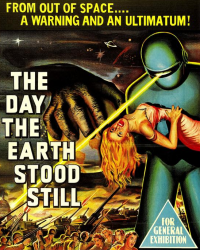
 Last Saturday, thanks to Amazon Prime, I screened a theme-related science fiction double-feature: The Day the Earth Stood Still (2008) and Arrival (2016). Both are fairly recent films about aliens visiting the Earth on mysterious missions.
The former, of course, is a remake of the 1951 same-named classic — a film good enough to have stood the test of time. Which, for science fiction films, is saying something. The remake suffers in comparison (and because it’s a remake) but considered on its own is an okay SF movie.
Arrival is generally a better film, but I do have a few issues with it.
When the remake of The Day the Earth Stood Still came out, my reaction then was similar to my reaction to the first Mission Impossible movie (which is both a remake and an adaptation). I wasn’t as negative about it as I was about MI — no sense of betrayal — but I wasn’t much whelmed by it. In large part because here the original film sets such a high bar. It’s rightfully one of the great classic films of science fiction.
[The big offense in that first Mission Impossible movie is (spoiler) having Jim Phelps turn out to be a traitor. There was no excuse for that. They were probably going for “they’ll never see this coming” and shock value, but it was inexcusable.]
Considered separately, as movies with no connection to the TV show I loved from 1966 to 1973, the Mission Impossible movies are worthwhile and fun. Definitely better than a lot of the crap Hollywood has put out lately.
Likewise, considered separately from the original, The Day the Earth Stood Still is a reasonably good science fiction movie. In particular, Keanu Reeves as an alien visitor is good casting. (I’ve always thought he was well cast in Johnny Mnemonic, too.)
§
The 1951 version is an adaptation of the science fiction story Farewell to the Master (1940) by Harry Bates and is rather different from it. That makes the 2008 Keanu Reeves version a remake of an adaptation. Given the first film differs so from the short story, it’s hard to shade the second film for also differing.
[Explicit remakes always have an extra axis of judgement: comparison to the original. And since it’s very hard to equal, let alone outdo, the original, most remakes start off with that handicap. So, they need to be especially good in other regards to be at all worthy.]
One small issue I have with the film is the nanobots, both how they were implemented and that they were used at all. The nanobots seen in science fiction are entirely fictional — and may remain so. At that scale there are issues with both energy and leverage. The nanobots in the film were essentially magical in terms of their ability to consume things so quickly and in how fast they flew.

“You should let me go.” Possibly my favorite scene in the movie. The green-ish lighting gives it a bit of a Matrix feel.
Energy budget is often a major fail in science fiction movies and TV shows. Books tend to get more into details, but magical energy shows up there, too. Even the otherwise extremely realistic SF series The Expanse (both books and TV series) cheated when it came to energy budget. Mainly in how the ship engines worked but also in the alien nano-virus.
Another example: phasors on Star Trek. They were capable of (very selectively!) vaporizing multiple people. Pretty amazing batteries in those things!

The nanobots catch up to and very rapidly consume a truck driving down a highway. Looks cool, but strains the imagination.
That said, we’re talking about science fiction, so nanobots can come under the same protective umbrella as faster-than-light drive and other standard science fiction notions. But the hardness of science fiction has always been a key axis of judgement for me. I like my science fiction as plausible (as hard) as possible. What magic it needs to contain (to be called fiction) should be very well thought out.
§
All-in-all, a decent science fiction movie but not a memorable remake. As with most remakes of classics, it’ll be forgotten quickly enough. The remake handicap all but guarantees that. Pity such remakes need to be explicit. The makers want to leverage the original, trade on its reputation.
Too bad it can’t be more implicit. Too bad remakes can’t be “Loosely Based On” or “Inspired By”, but audiences indeed might not respond. The 2008 remake of The Day the Earth Stood Still isn’t a bad film taken on its own, but as a remake of a classic has loaded itself with a major handicap and suffers from it.
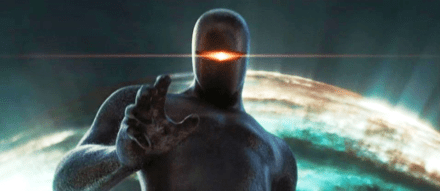
On the other hand, the updated version of Gort is way cool.
It has a decent cast. Keanu Reeves is perfect for the role. I forgot that John Cleese had a serious role in it (it is a film almost entirely without humor, although there are a few wry bits). It also has Jon Hamm and Kathy Bates in supporting roles. Jennifer Connelly is the co-lead.
[She was never the heartthrob for me she was for so many others. Likewise, Jennifer Garner. No idea why not; nothing I could ever put a finger on, but it was in contrast to how most fans had a thing for them. Different strokes! I did find Connolly quite compelling in Top Gun: Maverick (2022). Age looks good on her.]
I give it a low Eh! rating (I gave it a Meh! rating first time around). In all honesty, considered on its own, ignoring any comparison to the original film, I still can’t give it better than a high Eh! rating.
§
Speaking of Keanu Reeves, John Wick 4 is out (and I already own it). It completes the story arc that began in John Wick 2. It’s more than worthy to the first three. I give all four movies a Wow! rating.
I also saw the historical fantasy 47 Ronin (2013), which Reeves did the year before he did the first John Wick. The film takes place in late-medieval Japan and leverages Reeves’s mixed ancestry: in this he’s half-Japanese and half-English. As such, he’s treated as only half-human by the Japanese. Pretty good film but be warned the ending isn’t happy.
There’s a sequel, Blade of the 47 Ronin (2022), with a completely unrelated story and cast. It’s set in modern times, and it’s laughably awful. But not in a way that made it watchable. I turned it off after 20 minutes or so.
§ §
 The 2016 film Arrival is widely viewed as one of the better science fiction films to come down the pike lately. I absolutely agree.
It’s based on Story of Your Life (1998), an excellent and deeply thought-provoking short story by Ted Chiang.
On the other hand, it was directed by Denis Villeneuve, who also directed Blade Runner 2049 (2017) as well as the recent remake of Dune (2021). All three of these, to my eyes, suffer from slow pacing, overly somber presentation, and a constant reek of pseudo-portentousness.
[See the post Blade Runner for a comparison of the original 1982 Blade Runner and the 2017 Villeneuve remake.]
Villeneuve really seems to like long shots of people walking. My subtitle for Dune was Lots of People Walking. Expect more of the same in the coming sequel.
Arrival certainly has a good cast: Amy Adams and Jeremy Renner as star and co-star. Forest Whitaker in a supporting role. And you can’t beat modern special effects. The spaceship design is a definite feature of the film.
Besides the slow pacing, I have to also take some points off for the high BS level in places. Writers cannot write above themselves, but I like it better when they seek expert advice when tackling technical topics (a thing that used to drive me crazy about Star Trek back in the day; most of us science-trained fans would have helped out for free). As always, I like my SF as hard as possible.
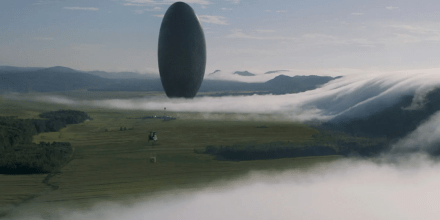
Awesome alien spaceship. Awesome shot.
On the plus side, besides the spaceship design, the alien’s written language was very cool. It’s hard to fault Villeneuve on visual presentation. His movies tend to look great.
Overall, though, the movie gets a comfortable Ah! rating from me. Recommended for all science fiction fans as a “real” science fiction movie.
§
The movie doesn’t explore the central theme of time perception as deeply as the short story does. And the movie doesn’t at all touch on what I think is the key aspect of that theme: whether knowing the future “ruins” it.
Do spoilers spoil the future? One might be inclined to think so. We generally try to avoid spoilers for the stories that entertain us. What about the story of our lives? If you knew, even before you had her, that your child would die early, would you live that life anyway for the joy of the short time you would get?
And if the future is determined, does the idea of choice not even apply? Will you live that life regardless despite knowing everything that’s coming?
[Well, probably not everything. Do we remember everything from our pasts? Why would we remember everything from our coming futures? Presumably, only the points close to use in time would be clear. We remember last week pretty well. We’d probably “remember” next week just as well.]
We might be inclined to believe that knowing we’re riding an inevitable train track necessarily makes life pointless. If we know what’s going to happen tomorrow (and assuming we even have a choice in the matter), what’s the point of getting out of bed?
The short story stresses the point that the performance is what matters. Think about actors in a stage play. Every night they perform the same story, but it takes on meaning in the performance. One can memorize a piece of music or a poem, know it thoroughly, but it comes to life in the performance. Music especially, only comes to life in the performance and almost always every note is known.
If you’re a parent, think about how little kids thrive on hearing the same story over and over. They know every bit of it but want to hear it again and again — without any changes or skips from mom or dad. Like a mantra or song, it’s the performance that matters.
This idea of knowing the story applies to adaptations, remakes, and series. In all cases the story is known. It seems clear people, to a fair extent, thrive on spoilers. The reason trailers give away so much of the plot is that Hollywood has found that audiences want to know. The attraction of revisiting the well is the same thing.
So, maybe knowing what’s coming in life wouldn’t be so bad. What would matter then is the performance of the story.
Very cool idea to ponder. And great example of what makes science fiction so powerful and compelling.
§ §
As a quick aside, recently have also seen (in all cases, for the first time):
Wrath of Man (2021). Directed by Guy Ritchie and starring Jason Statham. I enjoyed it just fine; gets a strong Eh! rating. I like Ritchie’s crook films quite a lot. Most of his other films don’t seem as good to me (Swept Away, Sherlock Holmes, King Arther, Aladdin), but I’ve heard good things about The Covenant.
True Grit (2010). Directed by the Coen Brothers, Joel and Ethan. I’ve liked every movie they’ve made. This one doesn’t rank high among them for me, but that may be more that I’m a hard-sell when it comes to westerns. That said, I enjoyed it just fine (also gets a strong Eh! rating). The movie is more an adaptation of the Charles Portis novel than a remake of the 1969 adaptation of the same novel.
Interstellar (2014). Directed by Christopher Nolan. Nothing I heard or saw about this movie made me think I’d like it. Parts of it are pretty good, but the ending is painful to me. I have to give it a Meh! rating (I’d almost give it a Nah! rating but that might be my bias against Matthew McConaughey).
§ §
Stay alien, my friends! Go forth and spread beauty and light.
∇







 Logos con carne
July 29th, 2023 at 11:21 am
Seriously, The Day the Earth Stood Still (the remake) and Arrival do make a good double-feature.
July 29th, 2023 at 11:23 am
I found Blade of the 47 Ronin unwatchable, but apparently it did well enough that they’re making a sequel. Go figure!
July 29th, 2023 at 12:27 pm
Interstellar — oof. The O’Neill cylinder at the end was cool. The whole blackhole thing – oy. And the sharp-edged robots?
Nobody seems to get aliens right. Have there been any pure “probe”-like, robotic explorer movies? Humans aren’t gonna send biological representatives to other worlds. Not at first.
Or if they do, they’ll send cryo-embryos with nanny bots to raise the humans once they get to their destination.
July 29th, 2023 at 12:42 pm
Yeah (on all counts). I think part of the problem is that parts of it are pretty wonderful stuff for science fiction fans. The time dilation due to gravity was a nice treat, too. On the other hand, yeah, not sure what they were thinking about that robot.
You’re right, robot explorers don’t show up much in movies. (Does Star Trek: The Motion Picture count? How about 2001?) There are some SF books with alien robots. It usually doesn’t go well for Earth. One rather good one is The Forge of God (1987) by Greg Bear. I’ve tried several times to read the sequel, Anvil of Stars (1992) but can’t get through it. Fred Saberhagen’s Berserker stories might be another example. But yeah, usually it’s alien beings but at least in books they’re not all highly humanoid with different bits on their faces.
July 29th, 2023 at 1:43 pm
Not sure you ever read this of mine, but it represents how an O’Neill cylinder would actually be built. Hollow? Bah!
https://docs.google.com/document/d/e/2PACX-1vT0YcVEl2d4NoKMkIPLuCXz502ArV-Sx5NJP4jJixh4Y9wEtJM4u_XuCDNVatbxmszDdQpal9OMj4sl/pub
July 29th, 2023 at 4:07 pm
Oh, I forgot you don’t read blog fiction. Nevermind.
July 30th, 2023 at 10:16 am
Sorry! Totally on me. I’m old and weary and increasingly picky about how I spend my time. A conversation with someone is always fun and worthwhile. Being asked to absorb narrative and dialog becomes another TODO task, and — for a retired person — I already have too many of those. (Between personal tasks, household chores, books, YouTube, music, blog posts, streaming shows, movies, hobbies, and going out with friends, it’s a lot. I seem as busy now as I ever was.) So, yeah, sorry, I have to draw some lines in the sand to preserve my own sanity. (Another aspect is that reading is passive, and I already spend so many hours every day sitting reading one thing or other.)
If there’s some aspect of space habitats you want to discuss, though, lay it on me. They’re a fairly common feature in science fiction, so I’m familiar with the concepts. I’m guessing from your “Hollow? Bah!” you favor a construction method similar to how we make buildings?
July 30th, 2023 at 10:28 am
The premise of the story is that, yeah, Cylinder is not hollow, not just the inside skin of a can. But layered like a jawbreaker. The story gets into how the distribution of mass needs to be actively managed. Water pumping between tanks ensures that the tube doesn’t “wobble”. The tourists and workers live at level 5, the outer-most. The other 4 layers decrease in induced gravity until you get to 0 where you can basically fly around a 200 meter wide 5 kilometer aerodome. This was Chapter 1 of a novel that never got written. Wobble is the key.
July 30th, 2023 at 10:57 am
Okay, sure. Totally agree on the mass distribution. That’s why Ringworld had its giant oceans on opposite sides of the ring. There’s kind of a spectrum, isn’t there. On the one end, a thin skin with just enough basement for utilities and maintenance and maybe travel. On the other, a solid structure with varying gravity at different levels. And anything in between.
A 5 KM tube running down the cylinder, and the skin is five layers of levels? Total cylinder diameter wouldn’t be that much more than 5 KM, right? I’d still be inclined to call that hollow. Thick-skinned, but hollow. But maybe that’s just me.
Compare that to a solid asteroid riddled with human-sized tunnels or a solid structure that’s human-sized levels from skin to core. Although,… even here a sense of “hollow” applies. An apple is solid yet can be “hollowed out” by a worm. The solid habitats are still hollowed by tunnels… 🤔
July 30th, 2023 at 11:39 am
Hollow is relative, as we both conclude.
5km long, 1 km diameter. 100m thick layers. Plenty of sub-layers as well. A 30-story building could be constructed within each layer.
The idea is that an O’Neill cylinder doesn’t need to be empty inside – a la Interstellar – to get the sense of “open space” within space.
July 30th, 2023 at 11:45 am
D’oh! I misread your early comment and took the cylinder to be 200 Km (long) × 5 Km (diameter). Yeah, I wouldn’t call your cylinder “hollow” except in the worm-in-the-apple sense. Totally agree about large internal spaces. Even a large warehouse can feel like a giant internal space!
July 29th, 2023 at 8:52 pm
I loved the original “The Day the Earth Stood Still,” although it has been like 50 years since I’ve seen it. Same goes for the original “Body Snatchers.” They knew how to make spare looking productions scary AF back in the day. I haven’t seen any of the John Wick movies, but students in my film studies class have frequently written papers on them, so I should make an effort to watch them. I’ve discovered so many good movies from student papers and recommendations that I’d have missed otherwise. So many movies, so little time!
July 30th, 2023 at 10:33 am
Yeah, totally. Add to that: so many books, so little time; and so many TV shows, so little time. And much more. Basically, so little time! The older I get, the more I hear in my mind that line from the Andrew Marvell poem, “But at my back I always hear; Time’s winged chariot hurrying near.” So, carpe diem!
I do like the John Wick movies. Incredibly high body count, but the fight choreography is stunning. The actors spent months training for them. The movies are kind of a cross between the western notion of superheroes and the Asian notion of wuxia (super-powerful characters in both cases). The character John Wick seems to exist in an alternate dimension (where every other person is an assassin and cops don’t exist) and easily survives being repeatedly hit by cars or falling off a high roof. But the movies are carefully and thoughtfully done. Lot of stuff going on in them.
July 30th, 2023 at 12:35 am
Nice post, thanks. I respectfully have to disagree with you about Villenneuve’s pacing. I welcome it. It was annoying to me how the story has been speeded up over the past several years. So much main stream contemporary film making is all fast-paced plot with no room for characters. Is that a result of shorter attention spans for younger audiences? Although it does seem that many indie films are fighting back. One simple way for me to grade the quality of science fiction is whether the story tells me something or presents a unique perspective on the human condition rather than telling me cool facts about an alien or the alien’s technology. The original “Day The Earth Stood Still” and “Arrival” score well on that measure—and why I think the the Star Wars Andor series is a very huge step up from that childish film franchise.
July 30th, 2023 at 11:35 am
Hi Matti! Thanks, glad you liked it. I’d say perception of pacing is in the subjective taste category, a “one man’s mead; another man’s poison” kind of thing. I’m one who prefers less description in books, so I also prefer movies to get on with business. But that’s totally a personal preference, not an objective judgement.
I think you’re right about short attention spans. It may also be that the young today have a different relationship with movies, with stories in general perhaps, than older generations do. There may be a parallel with how the young consume music: in a more piecemeal background fashion than older generations who focused on radio, records, and concerts. Now it’s streaming playlists or videos. Reality has become far busier and more fragmented than ever in human history. So many options that it’s hard to choose and hard to even understand them all. Once again, we’re victims of our own success.
I’m fine spending time on character, but I get restless when there are lots of long shots of people walking. Same as I got restless when an author spent ten pages describing her detective’s drive to a witness interview. But that’s just me.
Very much agree about science fiction perspectives on humanity. I’ve lately been reading a lot of Robert J. Sawyer and Cory Doctorow — two modern SF authors that are strong on that axis.