 The other day I began watching the Canadian TV series, Letterkenny (2016-present). A couple of my friends had recommended it, so I added it to my Hulu watchlist some time ago but only got around to checking it out last week. And was pretty much instantly hooked.
Thanks to Amazon Prime, I’ve been slowly working my way through a couple of British golden oldies: The Avengers (1961-1969) and The Saint (1962-1969). I was a big fan of both shows when they aired back in the Jurassic era of black-and-white television.
And as seems a new habit with TV Tuesday posts, I’ll mention a worthwhile film I watched (on TV) last week, The Man Who Shot Liberty Valance (1962).
As I’ve said many times (here and IRL), my primary ask with stories is: take me someplace new. I posted recently about our love of sequels and adaptations — a love I don’t share, at least not in full measure. In part because sequels and adaptations are limited in their ability to go someplace new. There are exceptions, of course. Nearly all TV series are a collection of sequels (that rarely go anyplace new).
That said, even TV series I really like can get long in the tooth. For example, I’ve moved on from what was once my favorite extant series, NCIS (2003-present). It’s still cranking them out (and producing spin-offs), but I got off the train. Likewise, The Blacklist (2013-present). [See NCIS: Over and Out]
§
Letterkenny is a fresh wind. It’s stylized and absurdist, so it’ll be interesting to see how it wears over the eleven seasons (so far). A possible saving grace is that most of the seasons are only six episodes. Many of them have a special holiday episode, and two seasons (the eighth and ninth) have seven episodes. Because of the short seasons, the show currently weighs in at only 75 episodes.
It’s perhaps a sign of the show’s freshness that the seven holiday specials are all for different holidays. Specifically: St. Patrick’s Day (season 2), Halloween (season 3), Easter (season 4), Christmas (season 5), Valentine’s Day (season 6), International Woman’s Day (season 10), and Victoria Day (season 11).
The show takes place in the fictional Ontario rural community of Letterkenny — named after the real Irish town as it was started by Irish immigrants escaping the Great Potato Famine of the 1840s.
The stories revolve around various groups of townspeople: the “hicks” (farmers), the ice hockey players (two in particular), the “skids” (goth drug addicts), the “natives” (from a nearby First Nation reservation), and the Christians (Mennonites) led by their closeted but obviously, even blatantly, gay minister. These groups are frequently at odds with each other but also act as an extended family of sorts in their ability to band together against threats or help when needed.
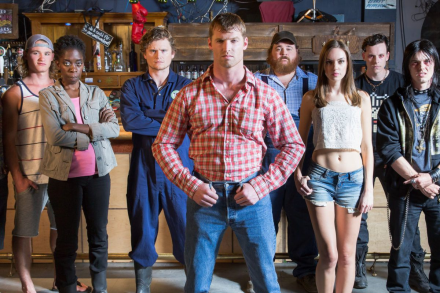
Some of the cast of Letterkenny (left to right): Reilly (Dylan Playfair, ice hockey player), Gail (Lisa Codrington, bar owner), Daryl (Nathan Dales, hick), Wayne (Jared Keeso, hick), Squirrelly Dan (K. Trevor Wilson, hick), Katy (Michelle Mylett, hick), Devon (Alexander De Jordy, skid), Stewart (Tyler Johnston, skid).
This makes for a large ensemble cast, but things center around a group of four hicks: Wayne (Jared Keeso), his sister Katy (Michelle Mylett), his friend Daryl (Nathan Dales), and his other friend Squirrelly Dan (K. Trevor Wilson). Wayne and Katy own a farm and a small produce stand they run with the help of Daryl and Squirrelly Dan.
The series is notable on several counts:
Firstly, it thoroughly subverts the common media perception of small-town people being close-minded and ignorant. Pretty much everyone involved has a startlingly sophisticated vocabulary, a quick wit, and a surprisingly deep background of knowledge. They’re also very open-minded and egalitarian.
Secondly, the sophisticated wordplay is a word-lover’s delight. The rapid-fire dialog is a major part of the draw. I especially loved the cold open of the first episode of season two. It features a back-and-forth between Daryl’s single words and Wayne’s patter keying off those words (both resolving a minor cliffhanger from the end of season one). At some point, you realize they’re going through the alphabet. Daryl starts with “A” and ends with “Z” — Wayne’s patter is heavily loaded with words starting with each letter Daryl introduces. Best bit of wordplay I’ve seen in a very long time.
Thirdly, it’s laugh-out-loud funny. (As always: if you’re captivated by that kind of humor. Comedy is particularly subjective. I’ll offer the caveat that, as intelligent, stylized, and absurd as the series is, it’s definitely not going to be everyone’s cup of tea. If the first episode doesn’t immediately grab you, the rest probably won’t.)
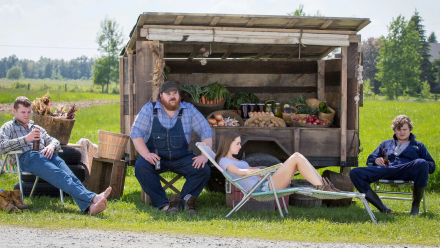
The core cast hanging out in front of their produce stand (drinking Puppers beer). Jared, Squirrelly Dan, Katy, and Daryl (left to right).
I’ve found it hugely addictive. Last week, despite it being late, I decided to watch just one episode just to get a feel for the show. I watched three. The next night I watched three more, completing the first season. Sunday night I meant to watch just two, three tops (because it was late), but watched four. If not for having stuff to do Monday, I would have watched more. Monday night (again despite it being late) I watched three more (completing the second season).
Special bonus: Wayne (and I assume also Jared Keeso) loves dogs. In episode 4 of season 2, Wayne (the toughest guy in town) defeats several opponents in a confrontation with the natives, isn’t moved by several emotional appeals, but is swayed by a three-legged dog (and a three-legged puppy). Wayne and his friends are often seen drinking a beer named Puppers.
So, utterly brilliant wordplay, fresh and intelligent story ideas, a hysterical cast, and an obvious love of dogs. I’m hooked.
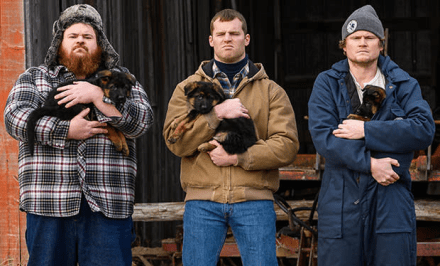
Gotta love a show that loves dogs! Squirrelly Dan, Jared, and Daryl (left to right), each with an adorable puppy.
The star, Jered Keeso, created the series and developed it with Jacob Tierney. The pair wrote most of the episodes (a handful in later seasons have other writers). Tierney directed all episodes so far. This gives the show a very unified feel.
The series has some ongoing story arcs and callbacks but tends to be fairly episodic.
Note that, as I only just finished season two of eleven, this is an early impression. One friend who’s seen the whole series is thumbs up, so I have high hopes for the whole thing. At this point, though, I’d give the series a Wow! rating (a rarity for me with TV shows).
§ §
One of my youthful passions was spies. I loved The Man from U.N.C.L.E. (1964-1968) and James Bond (both the books and the movies). Kids supposedly want to grow up to be firefighters (or ballet dancers); I wanted to be a spy.
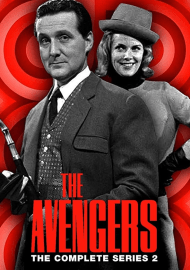 As such, another show I loved was the British hit, The Avengers. The show’s third incarnation (1965-1967) starred the dapper and delightful John Steed (Patrick Macnee) teamed with the dangerous and delicious Emma Peel (Diana Rigg). The show’s fourth incarnation (1968-1969) paired Steed with Tara King (Linda Thorson).
I never knew about the first or second incarnations. In the first (1961), Steed was a secondary character to the show’s lead, police surgeon Geoffrey Brent (Ian Hendry). Over the course of that first season, Steed became a popular character. This incarnation is mostly lost; only three complete episodes still exist (recorded in 16mm film).
The second incarnation (1962-1964) paired Steed with a rotation of three different characters: Dr. Martin King (Jon Rollason), nightclub singer Venus Smith (Julie Stevens), and anthropologist-slash-judo-expert Dr. Catherine Gale (Honor Blackman).
With her black leather outfits, fighting skills, and quick wits, Cathy Gale became a British household name. She originated the prototype that continued with Emma Peel in the third incarnation.
[Honor Blackman left the series to appear as Pussy Galore in the James Bond movie Goldfinger (1964) with Sean Connery. Diana Rigg would later star as Tracy Bond née di Vicenzo in the James Bond movie On Her Majesty’s Secret Service (1969) with George Lazenby.]
Which is all by way of saying that I’ve been watching the show’s second incarnation on Amazon Prime. I’ve never seen these; they never appeared in American. In part because the early seasons were shot in studios with those big video cameras, the production values are crude by modern standards, almost laughably so. But it has been fascinating to see this bit of British television history. I recently finished season two and now am working through season three.
§ §
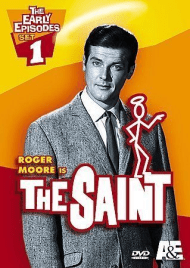 Last March, I posted about another youthful passion, stories about thieves, and mentioned how it all began with the Leslie Charteris (1907-1993) short stories and books about Simon Templer, alias The Saint. And the British television show, The Saint with Roger Moore as the notorious Simon Templer.
A while back, that bit of British television history was available on Amazon Prime, but I only managed to watch into the second season (of six) before Amazon eliminated it from their Prime lineup. I noticed last week that it was back in the lineup, so I’ve picked up where I left off.
With 118 episodes comprising six seasons, it’s one of the most productive British shows of its type, exceeded only by (ta da) The Avengers. The first 71 episodes are black-and-white, but shot with film, often on location, so the visual clarity is better than the early seasons of The Avengers (which later switched to film and eventually to color).
The show ran in England from 1962 to 1969. The success of the first two seasons led to NBC picking it up for American audiences in 1966. Which means I’ve never seen the first two seasons. None of the episodes I’ve seen have seemed familiar.
Both these British shows were huge successes. The Saint aired in 60 countries, and The Avengers aired in 90. I’ve enjoyed revisiting these youthful favorites.
§ §
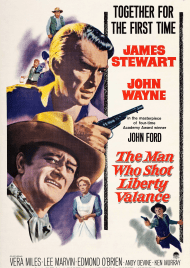 Speaking of filming in black-and-white, despite it being filmed in 1962, director John Ford (supposedly) chose to shoot The Man Who Shot Liberty Valance that way, apparently because he preferred that medium. He’s quoted, “In black and white, you’ve got to be very careful. You’ve got to know your job, lay your shadows in properly, get your perspective right.”
Indeed, black-and-white photography has better detail and better dynamic range. The sense of chiaroscuro is stronger and more dramatic. I’d say that it was an excellent choice. It makes the film more reminiscent of the westerns of old. (That said, other sources suggest studio economizing was behind the choice.)
Despite 1962 being relatively modern for a western, the film is a universally acclaimed classic — definitely a must-see for any cinema fan. Its all-star cast includes John Wayne, James Stewart, Vera Miles, Lee Marvin (as the titular character), Edmond O’Brien, Strother Martin, and Lee Van Cleef.
It’s interesting in that both Wayne and Stewart were over 50 when it was released. Yet it was the first time they worked together. Some consider it one of Wayne’s best westerns (which is saying something). The story is enthralling and notable for its excellent acting, character depth, depictions of territorial politics, and twist ending.
I’ve never been big on westerns, but this film is a favorite. I really enjoyed watching it again. Another favorite is the John Sturges film Bad Day at Black Rock (1955) starring Spencer Tracy with Anne Francis, Walter Brennan, Ernest Borgnine, Lee Marvin, and others. I give both films a Wow! rating and highly recommend them.
§ §
Stay western, my friends! Go forth and spread beauty and light.
∇









 Logos con carne
June 6th, 2023 at 10:44 am
Adding to the sense of absurdity in Letterkenny, no one seems to have a job, and there are apparently no police (and given some of the shenanigans, one would expect there to be). It’s hard to see how Wayne and Katy manage to own a house and farm. Certainly, not with the proceeds from the produce stand (so far there hasn’t been a single customer).
The lack of police reminds me of the John Wick film series, which seems to take place in an artificial surreal world filled with assassins and no police (there is one that appears in the original film, but he excuses himself from involvement).
June 6th, 2023 at 10:52 am
BTW: I recently purchased and very much enjoyed the latest version of the John Wick series, John Wick 4 (which co-stars Donnie Yen). The entire series is worthy and earns a Wow! rating from me. The first is still the best. The second, third, and fourth get progressively a bit sillier, but all are better than most of the dreck Hollywood is turning out these days.
June 7th, 2023 at 12:48 am
Another oddity: No one has last names except for three notable exceptions: Mr. and Mrs. McMurry are always referred to as “McMurry” and “Mrs. McMurry” and McMurry’s younger sister is always called by her full name Bonnie McMurry.
June 6th, 2023 at 10:47 am
Some have wondered what happened to the bar, MoDeans, that the characters frequent in the first season. Some references in the second season indicate that it no longer exists. (Apparently, later it’s said to have burned down.)
In fact, the actual bar used for filming closed, and the production lost the ability to film there. From what I understand, MoDeans gets two reincarnations, the first of which also closed (forcing the second reincarnation).
June 6th, 2023 at 10:47 am
“Pitter patter, let’s get at’er!”
June 7th, 2023 at 12:44 am
Found on YouTube the cold open from season two episode one:
June 7th, 2023 at 12:45 am
They did the alphabet thing again in season three episode one (which I binged tonight):
Wonder if they’ll do it again in other seasons.
July 29th, 2023 at 11:01 am
Finished all eleven seasons! Good show, very funny. Probably even funnier if you’re Canadian.
June 6th, 2023 at 1:36 pm
The Man Who Shot Liberty Valance is the source of a famous movie quote:
June 6th, 2023 at 7:58 pm
I was intrigued to read that, like me, you are a fan of the classic John Ford film “The Man Who Shot Liberty Valance.” As you well know from my previous comments on the Andor series, I enjoy art (especially literature and cinema) when it does a good job explaining philosophical issues, particularly the complexities of ethics. Liberty Valance, for me, is a treasure trove. I think it would be interesting to see a re-make with up-to-date production values. I know you have trouble with re-makes. But this would be a good one. Anyway, I think it was the philosopher Alasdair MacIntyre who described one of the more interesting themes of the film—actually the main theme. That is, how a culture shifts its values from one moral code to another. In short (according to John Ford) it can do so simply by cheating and breaking the rules of both codes. The John Wayne and Lee Marvin characters—rugged individualists of the wild west—settle disputes in the open by fair fight, a gun duel. The Jimmy Steward character believes in the rule of law. Yet the territory begins to turn toward the rule of law from the wild west code after the John Wayne character murders the Lee Marvin character from a sniper position in a dark alley—an immoral act according to both moral codes. Moreover, the credit for supposedly vanquishing the Lee Marvin character according to the fair fight code of the west is given to the Jimmy Stewart character. It’s all a lie. Yet it gives Jimmy Steward credibility—and the Newspaper, in the end, goes along with the lie—breaking the ethical code of journalism. Wow!
June 7th, 2023 at 9:20 am
Wow, indeed! You make some very chewy points. We’ve touched before on how early Star Trek had stories that were “about something” — exactly what you’re saying here about art that digs into philosophical (or social) issues. At root, about what it means to be human. I share your enjoyment of such stories.
There’s a division I noticed a long time ago with music. On the one hand, tunes that are just celebrations of some form, and these probably trace to the origins of song. Our hunt was successful, tonight we feast and sing! I’ve always thought of (one of my favorite bands) Little Feat as making tunes like this. On the other hand, songs that are about something. Peter Gabriel and Natalie Merchant spring to mind here, but there are many examples. For the former type, usually the music is front and center, the lyrics trivial or entirely absent (as with Jazz). In the latter type, the lyrics take center stage while the music can be trivial. Some songwriters are storytellers, some are tunesmiths.
True, I’m especially leery of remakes of classics, but the film came out almost 62 years ago, and distance like that makes a remake more acceptable to me. What might be especially interesting is taking the narrative structure and themes and writing a script that takes place in a completely different setting. For example, the way Coppola’s Apocalypse Now is a remake of Conrad’s Heart of Darkness.
Most interesting your points about the analysis of transgressive behavior in Liberty Valance! Thinking about that, I noticed that the film opens with the transgressive act of the stagecoach robbery and beating of Rance Stoddard — an immoral act even in the context of the wild west (and hence why Valance and his men wear masks).
In that context, very interesting that Stoddard is pushed to transgressing on his own dearly held values in taking up a gun to fight Valance. And sickened by it. And further sickened by the lie that grows from it. And what an interesting notion that the newspaper men transgress on one of the highest values of journalism — encapsulated in the film’s famous quote.
As an aside, I thought it interesting how journalists of the time ignored or downplayed FDR’s disability as an act of grace and respect. The Vietnam war and Nixon were, I think, largely responsible in ensuring that never happened again. Privacy and respect from journalists pretty much went out the window.
I might debate how transgressive is Doniphon’s act of shooting Valance from the shadows. It does violate the “rules” of fair gunfights, but I’d argue that it involves the higher morality of standing up for the weak. I suppose one counterargument might be that Doniphon should have called out Valance openly, but one could argue he wasn’t given time for that. It is perhaps significant that the uninvolved Doniphon is ultimately moved to get involved.
So, yeah, I think the film easily earns its Wow! rating!
June 7th, 2023 at 12:18 pm
One strong virtue of the Wild West code is individual courage—Liberty and Doniphon clearly rate this the highest virtue. A real man settles his own disputes. This is the same virtue of Ancient Greece exemplified by Homer’s Odyssey. For sure Odysseus would understand the the meaning of the western shoot out in the town square. That Ancient Homeric code was, of course, modified by the later teachings of Socrates, Plato and Aristotle.
The way I look view it the two moral codes, the code of the Wild West and the rule of law, are incommensurable. That means there is little or no easy path along common values to transition from one moral code to another. The story shares those same ethical dilemmas, on a smaller scale, as those involved in war and political revolution. You see that skillfully displayed often in the Andor series. I think the authors in both cases understood the wise old saying: You can’t make an omelette without breaking eggs. So, I respectfully disagree that Doniphon’s act was based on a higher moral principle of defending the weak. I argue it was murder pure and simple under both moral codes. Sure, as you point out, Doniphon could have stepped in a Stoddard’s champion in the duel and that would have been an act of courage under his (and Liberty’s) code. But he didn’t. I think he paid a price for that. He ended up a forgotten man and the town drunk.
June 7th, 2023 at 1:19 pm
Good points, and I agree with the principles involved. I think it’s possible to question Valance’s courage. He attacks the stagecoach with a gang of masked men and was never seen without his two armed henchmen. His reported murder of a farmer and his attack on the newspaper office seem cowardly — the act of a bully. It would be interesting to understand Doniphon’s disinvolvement. Why did he never seriously challenge Valance, a clear and present danger? We don’t know much about the pasts or motivations of either man. The Duke was 54 when this was filmed, and presumably Doniphon shared that age. That might have something to do with his disinvolvement.
On the other hand, Stoddard is the very picture of courage. First standing up to the gang robbing the stagecoach and ultimately taking up a gun in a hopeless confrontation with Valance. Even when wounded in the first round, he persists. I’d argue that Valance knew it wasn’t a fair fight which is why he was so willing for a one-on-one gunfight. He knew he wouldn’t lose (and without Doniphon’s involvement, wouldn’t have).
Good point about how it affected Doniphon. I think much of his downfall was from losing his gal, Hallie, to Stoddard. He gets falling down drunk and ends up burning his house down in an attack against the room he built for her. I question how much of that is due to his act against Valance. I do agree it was murder, but the code of the west could be a bit lax on that. Some people — Valance being a good example — deserved murdering (a practice still in effect today with the death penalty). So, I have trouble seeing his act as an extreme transgression. There seems some justice and parity involved.
I’d like to watch that scene again. My perception is that Doniphon came upon the fight after Stoddard had been wounded and took quick steps to balance the odds. It is bothersome he didn’t show himself, but interesting that he timed his shot to coincide with Stoddard’s. One could read that an attempt to cloak or as an attempt to heap glory on Stoddard. The latter would be interesting in the context of his obvious disdain for Stoddard and perception of him as a serious rival for Hallie.
Isn’t that the great thing about art like this? It has inkblot properties in which we see ourselves (and I obviously want to see Doniphon as more heroic). At the very least, it can lead to very worthwhile and interesting conversations like this one!
June 7th, 2023 at 2:10 pm
Yes, Valance was a coward. He thrived under the cowboy code because he was a good gunslinger. But he lacked real cowboy grit—courage and strength of character. And yes, I always thought that Doniphon’s murder of Valance was, as you suggest, an attempt to heap glory on Stoddard. And because both Doniphon and Stoddard kept the secret all those years, it was clear to them both that not only the code had to evolve but the way to do that was for Stoddard to be the hero under the old cowboy code in order to have the credibility to usher in a new moral code. That murder, however, truly broke Doniphon as it would many honest men. He sacrificed his own cowboy code as well as breaking the rule of law (and lost his girl friend) for Stoddard and a new moral order. Truly a wow bit of cinema!
August 18th, 2023 at 7:27 am
[…] [see TV Tuesday 6/6/23] seems almost deliberately to subvert this. Cliffhangers from the previous season are usually […]
May 28th, 2024 at 7:08 am
[…] And clear indicators TV can be not just good but excellent. I wrote about Archer back in 2020 (along with another really delightful TV show, Happy!) — see LOL: Happy! and Archer. I posted about Letterkenny almost a year ago — see TV Tuesday 6/6/23. […]