Tag Archives: realism
 I’ll be dog-sitting my little pal Bentley for a couple of weeks starting Tuesday, so I thought I should get this month’s edition of Friday Notes done early. By the time Bentley leaves, I’ll have only one Friday left in June.
Of course, big news at the end of last month. Guilty on all 34 felony counts. A whole new level of strangeness in politics. Even bigger news comes next month with sentencing. Will a President serve while serving time?
That it’s even a question we need to ask is astonishing.
Continue reading
16 Comments | tags: deism, infinite temperature, John Baez, moon, morals and ethics, prayer, project management, realism, Substack, theism | posted in Friday Notes
 It has been almost four weeks since my last blog post. I decided to take something of a vacation to celebrate various anniversaries (the blog, 12 years; retirement, 10 years; buying this condo, 20 years). And to celebrate finally getting some long-standing tasks off my TODO list (such as finally making a will).
Being retired puts a new spin on vacations, though. Being retired is vacation: your hard-earned, well-deserved permanent vacation. How does one take a vacation from a vacation?
Regardless, today is the last chance for a July edition of Friday Notes, so vacation-vacation is over, and it’s back to just being on vacation.
Continue reading
8 Comments | tags: Batman, blogging, dreams, Fermi Paradox, Gotham City, idealism, realism | posted in Friday Notes
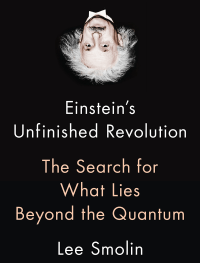 Earlier this month I posted about Quantum Reality (2020), Jim Baggott’s recent book about quantum realism. Now I’ve finished another book with a very similar focus, Einstein’s Unfinished Revolution: The Search for What Lies Beyond the Quantum (2019), by Lee Smolin.
One difference between the books is that Smolin is a working theorist, so he offers his own realist theory. As with his theory of cosmic selection via black holes (see his 1997 book, The Life of the Cosmos), I’m not terribly persuaded by his theory of “nads” (named after Leibniz’s monads). I do appreciate that Smolin himself sees the theory as a bit of a wild guess.
There were also some apparent errors that raised my eyebrows.
Continue reading
6 Comments | tags: Copenhagen Interpretation, Lee Smolin, ontological anti-realism, quantum mechanics, quantum physics, realism | posted in Books, Physics
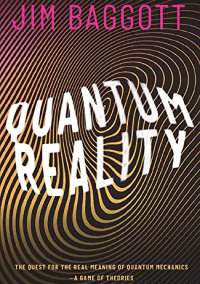 I recently read, and very much enjoyed, Quantum Reality (2020) by Jim Baggot, an author (and speaker) I’ve come to like a lot. I respect his grounded approach to physics, and we share that we’re both committed to metaphysical realism. Almost two years ago, I posted about his 2014 book Farewell to Reality: How Modern Physics Has Betrayed the Search for Scientific Truth, which I also very much enjoyed.
This book is one of a whole handful of related books I bought recently now that I’m biting one more bullet and buying Kindle books from Amazon (the price being a huge draw; science books tend to be pricy in physical form).
The thread that runs through them is that each author is committed to realism, and each is disturbed about where modern physics has gone. Me, too!
Continue reading
24 Comments | tags: Jim Baggott, Lee Smolin, ontological anti-realism, Peter Woit, quantum mechanics, quantum physics, realism, Roger Penrose, Sabine Hossenfelder | posted in Books, Physics
 It’s a New Year, so it’s time for that Janus backward and forward State of the Blog Post. (I did plenty looking back in the previous post, so today I’m looking mostly in the other direction.)
As I’ve mentioned, I framed 2020 as a year for changes. Many of them got sidelined (or outright derailed) but the year did result in some decisions that matter here. I find I’ve gone beyond my rope when it comes to what I’m going to begin always referring to as “fantasy bullshit” (FBS).
That’s not to say fantasy bullshit is all bad (some is fun; some might even be necessary), but I am going to start calling it what it is.
Continue reading
19 Comments | tags: 2021, blog, blogger, blogging, fantasy BS, FBS, Happy New Year, Janus, realism | posted in Life, Opinion, Rant
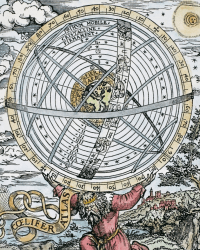 Lately I’ve been hearing a lot of talk about (philosophical) idealism. I qualify it as philosophical to distinguish it from casual meaning of optimistic. In philosophy, idealism is a metaphysical view about the nature of reality — one that I’ve always seen as in contrast to realism.
What caught my eye in all the talk was that I couldn’t always tell if people were speaking of epistemological or ontological idealism. I agree, of course, with the former — one way or another, it’s the common understanding — but I’m not a fan of the various flavors of ontological idealism.
It seems downright Ptolemaic to me.
Continue reading
34 Comments | tags: Cogito ergo sum, excluded middle, idealism, panpsychism, Ptolemy, realism, reality, René Descartes, solipsism, virtual reality | posted in Philosophy
 In debates (or even just discussions) people sometimes ask how we know the physical world is really there. A variation asks how we know that what we perceive as the real world is the same as what other people perceive. (One example of this is the inverted spectrum.)
The most accurate answer is: We don’t. Not for sure, anyway. There is at least one assumption built in, but it’s one we have to make to escape our own minds. According to ancient philosophical tradition, the only fact we know for sure is that we ourselves exist. (Although I think there’s an argument to be made about a priori knowledge.)
But, as with the excluded middle, accepting reality as an axiom seems almost necessary if we’re to move forward in any useful way.
Continue reading
2 Comments | tags: Cogito ergo sum, excluded middle, idealism, realism, reality, René Descartes, solipsism, virtual reality | posted in Philosophy





 Logos con carne