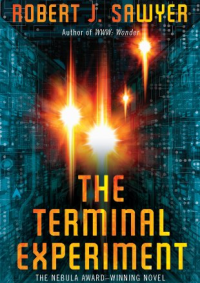
 Last post I wrote about a simple substitution cipher Robert J. Sawyer used in his 2012 science fiction political thriller, Triggers. This post I’m writing about a completely different cool thing from a different book by Sawyer, The Terminal Experiment. Published in 1995, it’s one of his earlier novels. It won both a Nebula and a Hugo.
I described the story when I posted about Sawyer, and I’ll let that suffice. As with the previous post, this post isn’t about the plot or theme of the novel. It’s about a single thing mentioned in the book — something that made me think, “Oh! That would be fun to try!”
It’s about a very simple simulation of evolution using random mutations and a “most fit” filter to select a desired final result.
 Sometimes, when discussing the possible existence of God (or Gods), there is the question: “Where is the evidence God exists?” One problem with that question is that different groups (believers and non-believers) are seeking different kinds of evidence. It’s a bit like how different groups — often the same two groups — get stuck on meanings of the word “theory.”
 One of the things that strikes me about the idea of God is how universal that idea is. To the best of my knowledge, every society in every age has had some sort of spiritual core belief.







 Logos con carne