Tag Archives: Albert Einstein
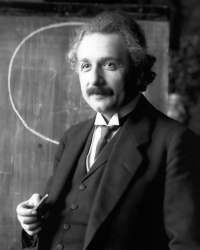 This is a long-winded comment in reply to Mike Smith’s recent blog post (and comments therein), Steven Weinberg’s new book on the history of science. We got to discussing a personal letter written by Albert Einstein about a year before his death in 1955. The letter — which seems to present religion as “childish” — surfaced in the public eye when it was sold at an auction in 2008. Given Einstein’s generally expressed views about religion, the letter appears to undercut those views.
Or does it? Atheists and theists alike have tried to claim Einstein as their own, but his views are complex enough to resist a clear victory by either side. The letter seems a point in favor of atheism, but that may be an over-simplification.
In any event, my reply ran long (and was getting kind of off-topic), so I decided to use it as an excuse to try to get back into blogging again…
Continue reading
42 Comments | tags: Albert Einstein | posted in Opinion, Religion
 No doubt those who regard quantum physics or Einstein’s relativity or even just trigonometry as an impenetrable thicket of unknowable terms and ideas have a hard time believing science could be easy. The lingo alone seems to create an exclusive “members only” club.
The trick is: easy (or difficult) compared to what? Many scientists now disdain philosophy (apparently forgetting what we now call science was once called natural philosophy). They point to the advances of science in the last 500 (or whatever) years and then say that philosophy hasn’t been nearly as successful in 2000 years.
But that’s because science is easy. It’s philosophy that’s hard!
Continue reading
54 Comments | tags: Albert Einstein, CERN, epistemology, fireworks, Galileo Galilei, JFK Rice University speech, John F. Kennedy, Karl Popper, Large Hadron Collider, LHC, rockets | posted in Science
 One of the things I mentioned in my recent Material Disbelief post was that, if you accept everything physics has discovered in the last 100 years or so — and if you believe in philosophical materialism — you are faced with the very strong possibility that all of reality is some sort of simulation or machine process.
Not only does all the evidence, as well as some basic logic, seem to point in that direction, but as a model of reality it provides easy answers to many of the conundrums of modern physics (e.g. Einstein’s “spooky action at a distance” and some basic questions regarding the Big Bang).
Today I want to lay out the details of the arguments for this.
Continue reading
31 Comments | tags: Albert Einstein, Bell's Theorem, DisneyQuest, DNA, EPR paper, Leopold Kronecker, materialism, metaphysics, Philosophical materialism, physicalism, reality, simulations, virtual reality, Zeno's paradoxes | posted in Physics
 Last time I wrote about willful ignorance as one good definition of stupidity. This time, I want to explore some ideas about why there seems a growing amount of it in modern society. Of course that necessitates first addressing the question: Is there a growing amount of it? I believe the answer is yes, but I also believe a lot of the reason for it is the growing complexity of society.
There was a time when a clever person could fix their washing machine or their car. Our machines were fairly simple then: a motor, a few hoses, some wires and belts. It wasn’t hard to figure out. A clever person with experience and tools could even fix their radio or TV. Replacing a burned out “tube” was a common household activity.
Now our machines bear the warning: “No User Serviceable Parts Inside”
Continue reading
25 Comments | tags: Albert Einstein, critical thinking, ignorance, Isaac Newton, stupid, stupid people, stupidity, technology, vacuum tubes, warning labels | posted in Opinion
 Not too long ago my buddy and I happened to talk about how film maker David Lynch turned the book, Dune, into a movie. We’ve discussed it a number of times over the years; we both give it a low score (for reasons), but we also agree the book is a really tough film assignment. What makes me wonder is how, channel surfing that very evening, I stumble on the Lynch film just starting.
More recently, a chain of thought led to thinking about overly pragmatic people (of the sort many would consider ruthless). That sparked a memory of a Justice League of America story about how Batman completely alienates his teammates on the JLA when they find out he has files analyzing their weaknesses and describing ways to take them down. But what makes me wonder is how, channel surfing that very evening, I stumble on an animated movie based on that storyline.
And the thing is: coincidences like this happen to me a lot!
Continue reading
6 Comments | tags: 11:11, agnostic, agnosticism, Albert Einstein, atheism, coincidence, coincidences, David Lynch, deism, Dune, Frank Herbert, gnosticism, God, miracles, theism, water stain | posted in Life, Religion
 You sometimes hear the quote, “The definition of insanity is doing the same thing over and over and expecting different results.” It’s most frequently attributed to Albert Einstein although it is sometimes attributed to Benjamin Franklin or author Rita Mae Brown.
None of them said any such thing. And poor Albert, he gets more silly quotes (incorrectly) attributed to him than anyone else. I suppose the idea is that, if Einstein said it, it must be right. I’m not sure the actual author is known, but the quote is commonly found in Alcoholics (and others) Anonymous where it references the repeated addictive behavior.
I’ve always thought the insane thing was the quote itself.
Continue reading
19 Comments | tags: Albert Einstein, Benjamin Franklin, David Brin, insanity, Lawrence Kubie, Rita Mae Brown., sanity, science fiction, Sundiver, The Practice Effect, Uplift universe | posted in Brain Bubble, Quotes








 Logos con carne