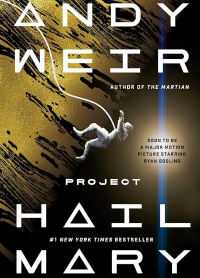
 This past week I read and very much enjoyed Project Hail Mary (2021), by phenom Andy Weir. This is his third novel, his third time with an award-winning bestseller, and the third time Hollywood has acquired the rights for a film adaptation.
All three of his books are what I call “diamond-hard” science fiction — projections of future technology with a bare minimum of gimmes (such as warp drive). Bonus points if there are none.
This story has a somewhat magical material that plays a key role, not to mention an exotic alien lifeform that’s the raison d’etre for the whole story.
I wasn’t as enamored as most were with Weir’s first novel, The Martian (2011). The book was a huge hit. It lingered on bestseller lists and garnered much acclaim. The 2015 film adaptation with Matt Damon was also a success.
[It earned $630 million with a budget of $108 million, so not quite as successful as Gravity (2013), which earned $723 million with an $80-$130 million budget or Interstellar (2014), which earned $774 million with a $165 million budget.]
At the time, Mars was very much in the public mind. There was a fervor — fueled by an insane billionaire — to colonize Mars, like, right now. To me, Mars has always been dry, dead, and in fact toxic. More to the point: boring. And I am well aware of the challenges of getting there and staying there.
If it was something people really wanted, we’d have habitats under the sea and in Antarctica. We don’t because people aren’t that crazy. If anything, The Martian is a good illustration of why Mars is no fun.
So, I had something of a counterreaction to the book (and movie) just because Mars was so trendy back then (and I’m anti-trendy). The fervor seems to have died down now. As fads always do.
There is also that I just didn’t find the book very interesting. It’s a survival tale that, in many regards, could have taken place anywhere hostile. It’s a one-man-against-the-elements story, and I’ve read a lot of those, so it takes something more than being on Mars to make it interesting.
§
I think my lukewarm reaction to The Martian likely kept me from reading Artemis (2017). I liked Project Hail Mary enough that I might give it a try now. The description on the Wikipedia page was new to me, so I never even knew what the book was about. It does sound interesting.
And supposedly going to be adapted into a movie but the last mention of that seems to have been back in 2018.
§
I’m not sure why I decided to read Project Hail Mary. I certainly have lots of other books waiting in various queues. I’d seen some people talking about it, and the buzz seemed good.
And it seemed safe enough back in late November when I put the e-book on hold via my library app. It predicted “many months” wait for it to become available.
But sometimes the library buys more copies of the e-book, and that shortens the wait time. Apparently quite a lot in this case. I got a notification on the 17th that the book was available.
I was hooked after reading just a few paragraphs. The story moves along very nicely. Multiple times, something that raised my eyebrows later turned out to be well grounded. The first chapter is a good example. The memory-loss thing at first comes off as a writing device to create mystery and aid exposition but it turns out to be integral to the story. In fact, integral to the character.
The character arc is interesting all on its own. We’re in the main character’s head throughout — the story is first-person present tense. (As I recall, so was The Martian.) It’s an effective way to let the story unfold with a strong sense of participation, of being there. Here, the character wakes up with amnesia due to the medically induced coma he was in during the flight. So, we learn who he is and how he got there slowly throughout the story as his memory returns.
§
The basic plot — as spoiler-free as possible — is that Earth has discovered a threat to the Sun. Something is causing it to grow dimmer, and this will eventually be catastrophic for all life on Earth.
Scientists determine that whatever is affecting our star is also affecting stars in our local neighborhood. Except one: Tau Ceti, which is 12 light years away. That one star is healthy, so Earth bands together in a massive global effort to build a spaceship that can go there and find out why.
Three astronauts are sent: a captain, an engineer, and a scientist. The ship has engines capable of getting it close to light speed, but the trip will still take four years. To spare the crew from the psychological challenges of staying sane and professional for four years in a cramped space, they are put into medical comas for the duration. They are tended by a robotic system, but only one survives the journey. And he wakes up with amnesia. At first, he can’t remember his own name.
His memory returns gradually. He is Ryland Grace, a high school science teacher. Part of the mystery for both Grace and the reader is how a high school science teacher came to be on a mission to a star 12 lightyears away hoping to save Earth. (The name Grace is interestingly apposite to the character’s personal arc. He comes to have a significant moment of grace that is, again, integral to the plot and not just tacked on. It’s pretty moving.)
He has arrived at Tau Ceti and is trying to figure what to do next when an alien shows up. An alien there on the very same mission — to save his home star.
The story unfolds in the present as Grace and the alien he names Rocky deal with a series of challenges and problems trying to solve the threat. Woven into that are flashbacks as Grace’s memory recovers, so we gradually learn how he came to be on the ship.
Rocky is an interesting character, and I’m looking forward to seeing how they pull it off in the coming movie. Apparently, they’re using a puppet rather than doing it with pure CGI. That can give the character a much stronger sense of actually being there, plus it gives the actor (Ryan Gosling) something to interact with.
[The TV series Farscape (1999-2003) used Muppets to excellent effect. Truly a superior SF TV series.]
Rocky’s homeworld has heavier gravity than Earth and such a thick atmosphere (of hot ammonia no less) that light doesn’t penetrate to the ground. Rocky’s people have no sense of sight. They use sound to perceive the world around them. Rocky’s hot ammonia air has 26 times the pressure of ours and is hundreds of degrees hotter, so the two astronauts must maintain separate environments.
Instrumental to this is a slightly magical material used commonly by Rocky’s people. It’s so strong it can contain the high pressure of Rocky’s atmosphere without needing curved structures for strength. It’s apparently made from xenon, and Grace names it xenonite. Other than the aliens, it’s the one bit of definite science fiction. Xenon is a noble gas that doesn’t interact with much.
Xenonite turns out to be both an enabler and a problem. Yet also responsible for Grace’s moment of grace. (There are a couple points in this book that just might bring tears to your eyes. The final paragraphs especially.)
§
It says something that I was so taken up with the story that I didn’t make any notes. (Well, two screen grabs about minor twitches.) I have no major complaints. I do wonder how Grace’s ship was initially infested despite its nitrogen atmosphere. Unless I missed something, that might be a plot hole.
There was a little bit of headshaking over a common troupe that I’ve always found something of a cheap gag. This bit comes early in the book when Grace has just awoken and is starting to get some of his memory back:
I hold my head in my hands. “Oh God. Where the heck am I?”
I scour the monitors for anything I can make sense of. There’s no lack of information — there’s too much. Each screen has a handy label on the top. “Life Support,” “Airlock Status,” “Engines,” “Robotics,” “Astrophage,” Generators,” “Centrifuge” — wait a minute. Astrophage?
This is essentially a cinematic sight gag. The camera pans across items: “A”, “B”, “C”, “D”, “E”, “F”, … then a wait-a-minute whip pan back to “D”. I think it works better as a sight gag — seeing it in text strikes me as cinematic backreaction. And maybe it’s just me but the gag doesn’t quite work in text. I definitely would have stopped immediately on “Astrophage”.
For some reason, that bit stood out, and I made a screen grab.
The other screen grab involved a childish moment on Grace’s part that also had a cinematic gag feel. He’s unwilling to part with something, whining about it, and a superior has to yank it out of his hands:
“… Taking away two grams now is like taking away four grams next month”
She pulled the container out of my hands and handed it to Dimitri.
But despite a few similar moments of our cultural childishness on parade, I commend Grace and Rocky for their seriousness and lack of childish squabbles and other you-should-know-better bullshit. I’ve long preferred (hard) science fiction in which characters work together towards an end goal without too much of the personal drama people seem to thrive on.
Too much modern writing to my eyes feels like children playing dress up and let’s pretend. (Star Trek has felt that way to me ever since Abrams took over, and it’s apparently completely off the chain now with Starfleet Academy, which sounds beyond dreadful.)
So, I very much enjoyed a story almost entirely free from such noise.
There’s a good blend in the characters. Grace has the science chops, Rocky has the engineering chops. Together they make a fun team even though their mutual atmospheres are mutually fatal.
There’s even something of a twist ending. That darned xenonite.
§
The Martian took place on Mars and is a survival story. Artemis takes place on the Moon (and is apparently a heist story). For me, taking place in deep space, around a distant star, with a first-contact situation all made this third novel work very well for me. More a true science fiction story, so to speak.
In light of my tepid response to The Martian, I’m inclined to give this one a Wow! rating. It kept me glued. It kept me guessing. It kept me charmed, and it touched my heart strings. Some seriously good hard SF.
§ §
I knew this would happen. I had on hold at the library this book, Brass Man (by Neal Asher), and Excession (by Iain M. Banks). They were well-spaced in their anticipated available dates.
As I mentioned, this one became available earlier than expected. I’ve been expecting Brass Man for two weeks, and it became available two days ago (when I was in the middle of reading Project Hail Mary). Excession was also supposed to be a longer wait, and it became available yesterday.
So, now I’m a few chapters into Brass Man hoping to finish this weekend so I can get started on Excession. A wealth of reading riches.
Stay safe, my friends! Go forth and spread beauty and light.
∇







 Logos con carne
February 21st, 2026 at 12:12 pm
Heh. If you append a “d” to Andy’s last name, you get Weird. 😄
February 21st, 2026 at 1:40 pm
Wish my digital library had more Neal Asher.
February 21st, 2026 at 7:20 pm
I can see why. Between Asher, Banks, and Reynolds, I find I like Asher best. Do you mean your personal library or your local online library?
February 21st, 2026 at 7:34 pm
Libby app. Clackamas public libraries.
Sadly, only about 800 SciFi novels are offered through that venue.
February 21st, 2026 at 7:41 pm
Oh, that sucks. My St. Paul library system sometimes disappoints me — I have a number of books in that Libby Notify Me queue. Supposedly that acts as a hint to the library. Some libraries have a webpage where you can request they get a book. Any chance of a county or state library card? I’ve thought about seeing if I could get a card for the Minneapolis library. Not sure if there are residency rules.
February 21st, 2026 at 8:50 pm
No doubt there are other credentials to be had that would expand the repertoire.
Lately I’ve taken to writing a few hundred words of fiction at night. It’s a great way to load my brain with topics for thought while I drift off to sleep.
February 22nd, 2026 at 9:40 am
Sounds like a good writing practice.
February 21st, 2026 at 2:22 pm
It’s been several years since I read Project Hail Mary, but I do recall enjoying it. I’ve had Artemis for years but have never got around to finishing it. It just didn’t hold my interest. But I loved The Martian, so Artemis may end up totally working for you. And I’ll likely try again at some point, particularly if it starts looking like a movie is coming.
One nit I had with the PHM premise is the threat showing up just when humanity is advanced enough to deal with it. If the astrophages had shown up a century earlier, much less during the Pleistocene, we would have been toast. A little too coincidental, but common in sci-fi, and not always easy to avoid in story construction.
I do very much enjoy Weir’s lean writing style. And mostly staying true to the science helps too.
I recently read Excession. I’ll be interested to see what you think. I also tried to start reading Feersum Endjinn and ran aground on the phonetic spelling used for one of the viewpoint characters, at least a quarter of the novel. It makes reading those portions a lot of work and slow going. Might try again at some point, but I think Banks’ editors were too indulgent on that one.
I hadn’t heard they were using a muppet for Rocky. Interesting. The trailers have been revealing a lot of details about him, an interesting strategy.
February 21st, 2026 at 7:36 pm
Interesting that Artemis didn’t really engage you. You say you ‘loved’ The Martian but only recall ‘enjoying’ Project Hail Mary. So, I guess you liked the former better? You may well be right that I’ll like Artemis. If it’s really a heist story, there’s a decent chance. That said, I’ve read that, it’s a heist story with none of the usual heist troupes — the diverse group of charming experts, etc.
As you say, a lot of stories have some huge element of coincidence enabling them. I decided a while back I was okay with it. Stories would be pretty dull if they went the way life usually does. It’s the stunning fact of the coincidence that makes the story worth telling. As you also said, had this happened in history, there wouldn’t have been a story to tell. Heh, there’s almost an anthropic argument there. 😁
I have a sense that Banks is the one most prone to use character names that are so different I’m not sure how they’re pronounced and have a hard time remembering them due weird spellings. If I don’t know how to pronounce a word, I have a hard time reading text that contains it frequently. Seems like Banks is the one that most often forces me to stop and work out what I think the name should sound like. Phonetic text would drive me nuts unless I somehow found the groove of it. I think I’ll leave “fearsome engine” on the shelf.
I really hope the movie is good. 🤞🏼
February 22nd, 2026 at 7:21 am
Sorry. I didn’t mean to imply any significant difference in my enjoyment between The Martian and Project Hail Mary. Honestly I’d have a hard time comparing them now. I read The Martian over a decade ago and PHM nearly five years ago, so memories are a bit hazy.
On Banks and Feersum Endjinn, yeah. Just to give you an idea, here’s a snippet:
I suppose if I fought through enough of it there’d be a groove, but I decided it wasn’t worth it.
Me too on the movie.
February 22nd, 2026 at 9:42 am
Oof! That one paragraph is enough to make me say “No thanks!”
And it adds to my sense that sometimes Banks just likes showing off his writing chops.
March 23rd, 2026 at 5:53 pm
Having now read Artemis, I don’t think it’s a heist story. It’s something of a caper, but while that’s more accurate, I’m not sure that really describes the story.
It would make a good movie, though.
So far, I’ve liked each Andy Weir book better than the last. Wonder if he can keep it up.
March 24th, 2026 at 9:15 am
[…] But we are gathered here today for television, not movies, so I’ll save this for another time. [FWIW, see this recent review of the book.] […]
April 4th, 2026 at 11:17 am
[…] wrote about Project Hail Mary (the 2021 book by Andy Weir) back in February [see this post]. Last month I wrote a few paragraphs about the movie (written by Drew Goddard and directed by Phil […]