 The previous post looked back at 2025; this post looks forward to 2026. As each new year begins, I typically don’t have specific plans for it. This year, though, I am planning three series: two here, one on my programming blog.
Logos con Carne celebrates its fifteenth anniversary in six months. Anniversary years ending with a “5” (other than the fifth and twenty-fifth) don’t seem as big of a deal as ones ending with a “0”, so I’m not planning anything major.
If I make it to 20 years here (2031), that will be a big deal.
Famous Last Words in These Parts: This post should be short. Because it feels like there isn’t much to say. But I’ve started off thinking that before, so we’ll see how it goes.
I think for many there is a sense of bated breath waiting to see if this ship of state rights itself or continues to sink. It occurred to me the other day that the acceleration of the breakdown of traditional social and political values is yet another example of an exponential growth curve. Nothing physical can survive unlimited growth, so unless things change, we’re unavoidably headed for disaster.
Which makes anything I have to say in a blog post seem awfully trivial.
No doubt I’ll post about this culture war, but we seem to have reached the point where there’s little more to be said. Really, now it’s just venting (which, according to some studies, can in moderation be mentally helpful). Words now only signal our allegiance or attack our opponents — no one is being persuaded; we’re too polarized for that.
That said, the transgressive nature of the current administration in contrast to our long-espoused American and Christian values cannot help but be polarizing. (It seems weirdly on point that a once-common epitome of transgressive behavior was child molestation.) Unfortunately, we seem to have come to the end of a long unraveling of the social rope. “Do what thou wilt shall be the whole of the Law.”
So, yeah, there’ll be some venting. (One reason for even having a blog.)
§
I’ll continue with Friday Notes. I enjoy writing them, and a few readers have indicated they enjoy them. It’s a nice place to put little bits and pieces that aren’t enough for a whole post.
No doubt I’ll also continue TV Tuesday posts to record what I’ve been watching. Don’t know how many Book Reviews or Movie Reviews there’ll be. I’ve tapered off on those over the years. Maybe when something strikes me — one way or the other — as especially worth recording.
Not sure if Mystery Monday has much future. I seem, at least for now, through my phase of exploring different (mostly British) murder mystery authors. Lately, though, as a kind of palette cleanser between heavier SF books, I’ve been reading the Miss Silver novels, by Patricia Wentworth (1877-1961). I’ve only mentioned her in passing here, so I might devote a post to her.
Almost certainly there will be Sci-Fi Saturday posts. Science fiction is one of my oldest and most enduring interests. I’ve been reading it since I began picking my own reading material (over 60 years ago).
As to the rest, when the mood strikes me.
I have decided to keep WordPress as my blogging platform and this blog as my main blog. My “home” blog, so to speak. This spring marks two years on Substack, and I’ve decided that I’m “not that into” it.
The social media component (Substack Notes and Substack Chat and now Live Videos) is a central part of the platform but of no interest to me. Their subscription model is aggressive, and that’s not for me, either. Anything and everything I put on the internet is freely available. I am, in fact, opposed to monetized social media. I’m not opposed to sites that sell things, sites one visits explicitly for buying something, but subscription models, no thank you.
It’s basic economics, really. There is a wealth of free reading and interesting information available, so why would I pay for it? Just doesn’t make sense to me. I have yet to find any blog or media outlet I couldn’t (easily) live without.
I’m tempted to disconnect completely, focus all my efforts here (and on the programming blog), but I’ll see how it goes.
§
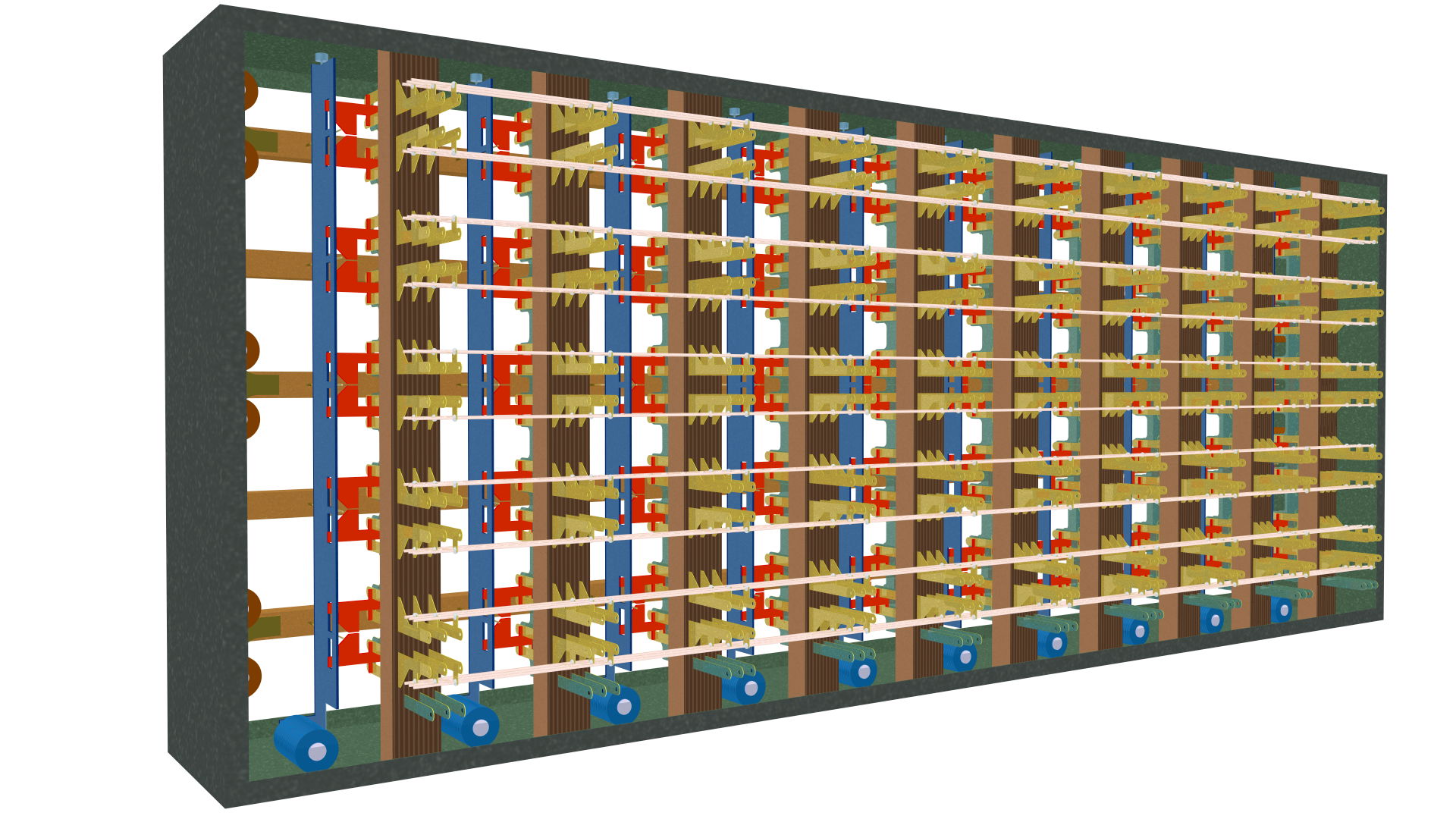
I’ve been putting off starting my planned series about the telephone company crossbar switching system for a long time. At first, it was because I needed to complete my 3D model of a 10×10 crossbar switch for images and diagrams. (Then, it was because I needed to redo it.) That part is done:
I also needed a bunch of wiring illustrations, and that’s done, too:

I’m working on a software simulation of a crossbar switch system, and while I have a version that works well enough to prove the concepts, I want to redo that one, too. (Ancient Fred Brooks advice: “Be prepared to throw the first one away. You will anyway.”) However, it’s not really part of the intended post series, so completing the simulation isn’t required for writing the posts.
What seems now the impediment is trying to organize my thoughts. And trying to find the right cut between explaining and assuming knowledge. For example, how much can I assume the interested reader — one curious about the topic — already knows about electromechanical relays? In part it’s about picking an audience. I try to write for my younger self, the one who hasn’t learned whatever topic I’m writing about but does have my general background.
Which, based on a number of contemporary authors I’ve read (fiction and non), isn’t unique. (Atypical, but far from unique.) This series most likely will appeal only to fans of electromechanical telephone switching gear, many of whom likely know the material better than I do. Perhaps due to having worked with such systems.
Regardless, the Number Five Crossbar Switch is one of the cooler things I’ve encountered. They are possibly the most complex electromechanical machine we’ve created (rocket ships might outdo them but they tend to use computers).
The next step in the evolution of telephone switching was computer control, so the #5 X-Bar switch is the pinnacle of purely electromechanical switching. Everything is accomplished with relay logic (involving thousands of relays).
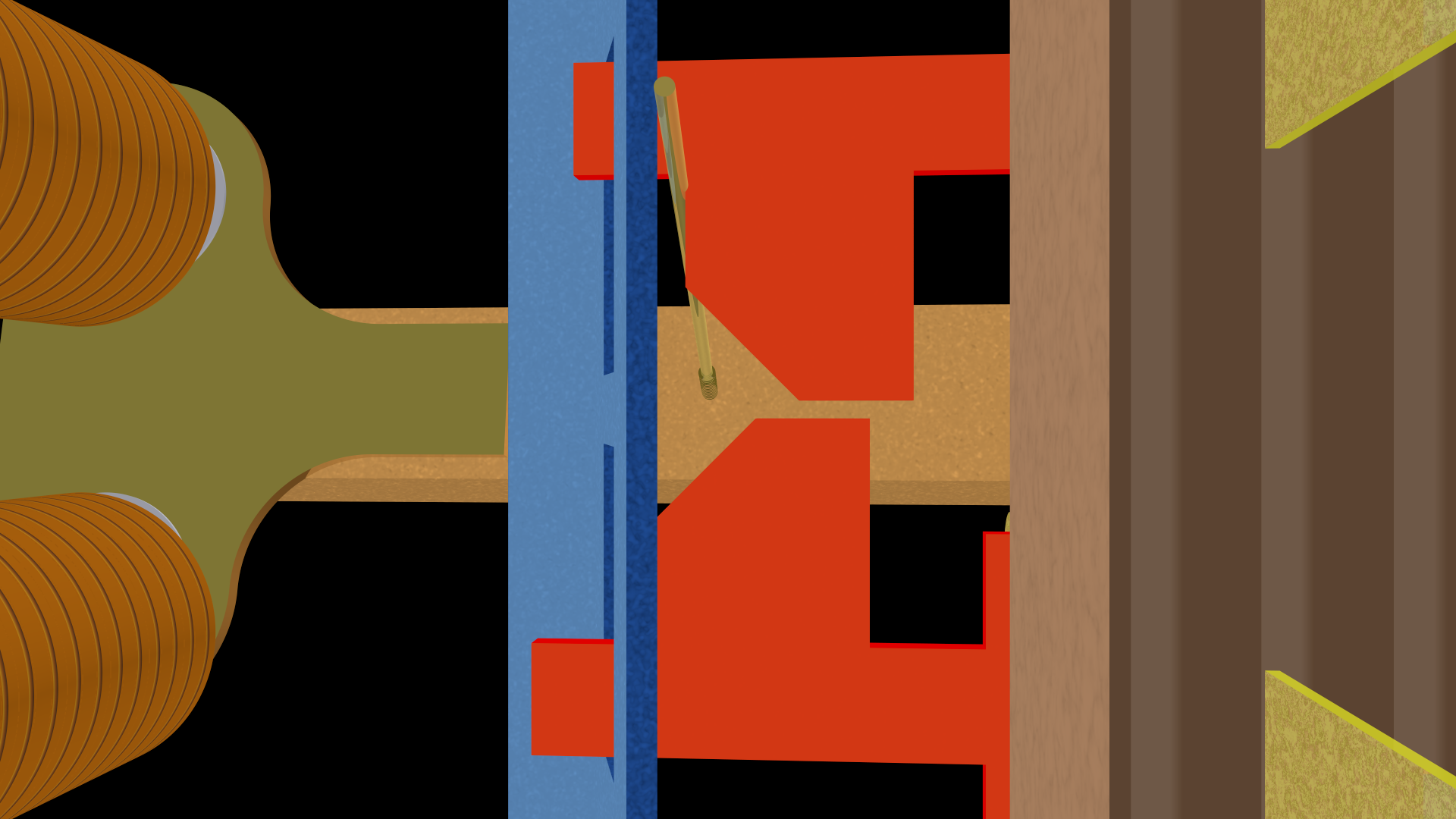
In particular, the way the actual crosspoint switches work is delightfully clever:
So, I want to write about it. I’ve wanted to for a long time but knew I needed some good visuals. To make things clear, I might even need to animate the 3D model and make a short YouTube video.
In any event, it’s time to get going on this.
§
Speaking of making YouTube videos, I’ve been wanting to get back to that. There are some I made long ago that have poor quality, and I’d like to redo those. I’d like to do more Life videos, especially 3D ones. And I have a few other ideas.
On the other hand, animation is a tedious process with the tools I have. I use Python to generate images as well as transitions and titles and ffmpeg to stitch the images into a YouTube video (mpeg file).
Sometimes I consider migrating to more sophisticated tools despite my simplest tools possible bias. Doing that involves a learning curve, and I balance that loss of productivity against what’s possible with the simple tools I have. Simple graphics have sufficed, so the urge to upgrade isn’t strong.
[I’m definitely not one of those people who constantly seeks the best price or deal or who needs things to be perfect. For me, good enough is often good enough. At least when it comes to material things. When it comes to my work, though, perfect is always the (ever unattainable) goal.]
§
One thing I definitely won’t try to animate is Mandelbrot zooms. For one, that space has been well covered. For two, I don’t have the gear.
I am planning a series explaining and exploring the Mandelbrot set, though:
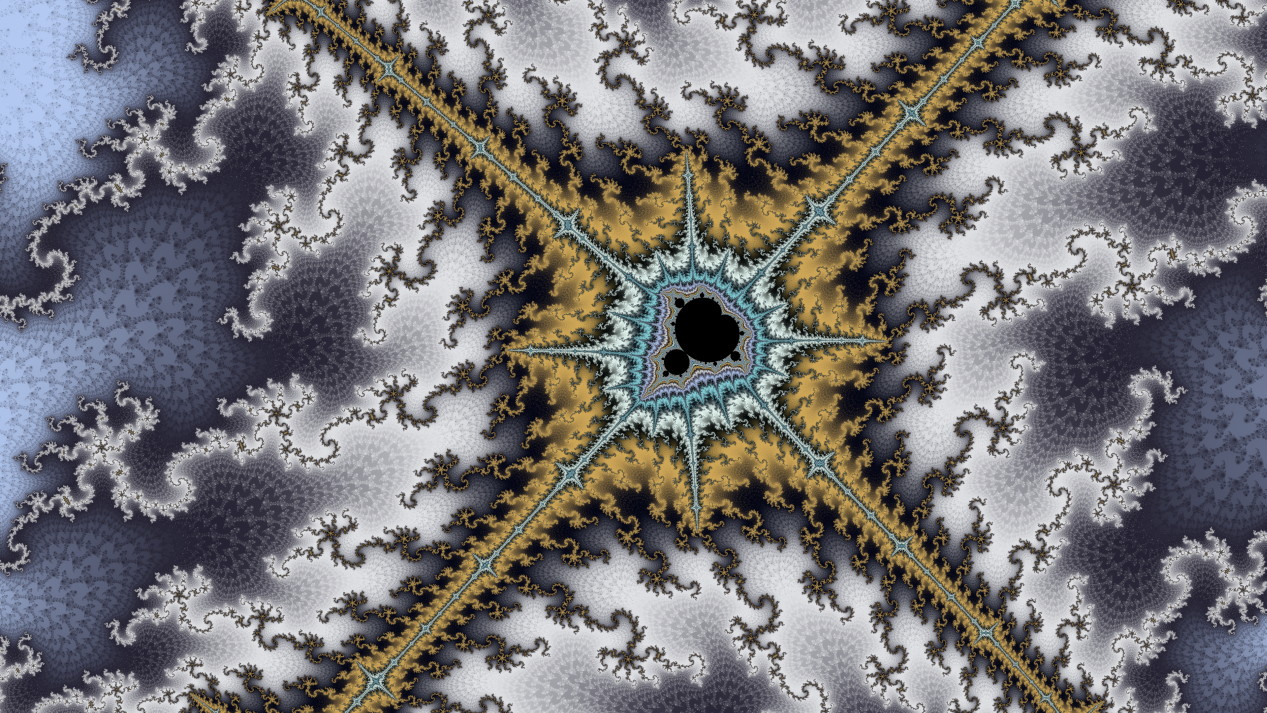
It’s one of my all-time favorite abstract things, and there is a lot that can be unpacked. One tidbit: each point on the 2D complex plane the Mandelbrot inhabits is a Turing Halting problem. Which means the Mandelbrot set is a well-defined computational object that can never be fully computed.
I’m thinking March or May could be Mandelbrot Month. For this one, my intended audience is those who find the Mandelbrot images fascinating and/or beautiful but don’t know anything about how they’re created and who don’t have much math background. The Mandelbrot set a computational (i.e. mathematical) object, so some math is unavoidable, but nothing requires a deep dive down a mathematical rabbit hole (though I may point to some).
§
Lastly, as far as definite plans go, I’m starting an introductory series about Python over on my programming blog. The audience is those who have used a programming language before but are not familiar with Python and are curious about it.
The assumption is knowledge of basic programming language concepts — such as one might get from using BASIC, Pascal, or other simple programming language.
Python supports some fairly sophisticated programming concepts that I’ll explain in detail in later posts, but the first few will be a general overview of the language.
§ §
I guess it turned out to be an almost short post after all.
Stay unbated, my friends! Go forth and spread beauty and light.
∇





 Logos con carne
January 10th, 2026 at 8:32 pm
Looking forward to the sci-fi posts (books, TV, or whatever).
I’ve never been any good at planning my blogging. I just follow my interests and see what happens. The only thing I really do is restrain myself from publishing on the same topic repeatedly in close succession, even when my mind remains on that topic, since engagement tends to fall off without a break (at least in my experience).
My attitude toward Substack remains arms length, for many of the reasons you cite. The other day, one of my subscriptions published a preview to their overall post, with the best part paywalled. I understand people have to find ways to pay the bills, but like you, I rarely come across a blog or newsletter I’d be willing to pay for. They really have to be providing info I couldn’t get anywhere else.
January 11th, 2026 at 9:31 am
I’ve dropped a few Substack subscriptions due to how many of their posts were paywalled. Or if their best posts all seemed paywalled. About the only blog I put up with that on is Curt Jaimungal’s because his free posts are often very interesting. I’ve watched a fair number of his YouTube videos, too — more free(-ish) content. For a while I thought I might migrate to Substack, but I’ve decided to stay here and, as you say, keep Substack at arm’s length.
I also have found readers drop off if I repeat myself, but some of the topics I cover need more than one post. Over the years here, I’ve written quite a few “trilogy posts” and some longer series. I saw recently a text meme to the effect that even if no one reads your writing, there is still value in writing. Clarifies your thoughts, plus the thinking necessary to explain something. Nothing solidifies your knowledge like trying to teach it to someone else.
I’ve been reading and for the most part enjoying Edward Ashton lately. He wrote Mickey 7 and the sequel, Antimatter Blues. I just read two set in the same reality, Mal Goes to War (Mal is an Ai — the name is short for Malware) and End of the Ordinary (in which I thought “sentient (possibly killer) corn” would make an appearance, but it was just something the characters kept mentioning). The Fourth Consort is an alien first-contact book with some vague similarities to the Asher-Banks-Reynolds far future stories. My only complaint is a lack of differentiation in the level of snark constantly expressed by the characters. I found it could get old; everyone talking so clever all the time. His writing is interestingly casual and breezy — easy and fun reads.
January 11th, 2026 at 12:46 pm
Oh I’ve definitely done the series of post things too. And if I need to do it bad enough, I don’t worry about the drop off. It can serve as notes for what I thought at a time, which can be handy years later.
I read Mickey 7 and enjoyed it. You’re reminding me that I meant to get back to Ashton, particularly Antimatter Blues. I do like his writing, at least what I’ve seen of it so far. There’s a lot to be said for casual and breezy.
I just finished Alastair Reynolds’ Pushing Ice. Pretty good, although too much description, as usual. And it reminds me how bleak Reynolds was in his early stuff.
January 11th, 2026 at 6:58 pm
Ashton made a nice break from Banks and Asher while still being SF. Light snack between heavy meals.
I think it might be that bleakness that’s part of why that UK triumvirate for me is Asher, Banks, Reynolds. Some of his books I’ve really liked (House of Suns, for instance) but others I struggled with. Asher so far is batting 1.000 with me, and other than the writing quirks we’ve talked about, I don’t have any issues with Banks.