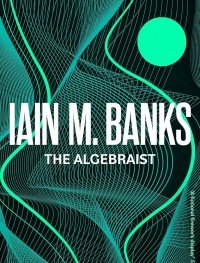
 My reaction to Scottish writer Iain (M.) Banks (1954-2013) is decidedly mixed. On multiple points. His middle initial (for Menzies) being one of the lesser ones. The 14 novels by Iain M. Banks are science fiction — most taking place in the Culture, his far-future backdrop. The 14 novels by Iain Banks, however, are mainstream, not science fiction.
Banks became notable after his first novel, The Wasp Factory (1984; mainstream). His first science fiction book, Consider Phlebas, came out in 1987. That was also the first book in his Culture series.
I recently read The Algebraist (2004), one of his few non-Culture science fiction novels. It reminded me of both what attracts and annoys me about his writing.
The bottom line is that I enjoyed and was impressed by the book. Banks is an imaginative writer, even in the context of science fiction writers, most of whom have imagination. A special attraction for me is the hardness of his science fiction.
I especially like SF authors who honor relativity and the lightspeed limit. That imposes constraints, and I’m a bit impressed by authors who work within them. Banks — in the Culture stories and in The Algebraist — does have instantaneous wormhole travel (but so did Einstein).
The wormholes are a significant part of The Algebraist. Not only important to a galactic civilization for communication, travel, commerce, and defense, they are the MacGuffin in this story.
A wormhole between star systems starts with two adjacent linked portals (black holes are involved). One must be transported (at sub-light speed) to the distant location. A path between systems hundreds of lightyears apart therefore requires — at minimum — hundreds of years to implement (assuming traveling close to lightspeed).
Obviously, a system’s portal to the galactic network is crucially important, all the more when there is only one. For stars in the thick of things, other stars aren’t too far away. Tens of lightyears, perhaps. The loss of a portal can be remedied in a lifetime.
In The Algebraist, the Ulubis star system is on the outskirts of the galaxy and some distance from the galactic plane. They have only one portal linking them to the rest of civilization. That portal has been destroyed in a battle between attacking Beyonders (rebels living outside the mostly benevolent but iron rule of the Mercatoria) and the in-system Mercatoria ships that defend the system but also enforce that iron rule.
Because they involve black holes, portals require flat space. A gravity gradient makes them blow up. The Ulubis portal blows up when the mass of a large Beyonder ship gets too close to it.
The Ulubis system — hundreds of lightyears away from any civilized system — is isolated for as long as it takes the empire to build and ship another portal. Even messages take hundreds of years to travel back and forth, so it will be centuries before the Ulubians know whether a portal is on its way.
Which comprises a good story but is just the background for The Algebraist. The Ulubis system has a gas giant named Nasqueron. (Think Jupiter.) It is inhabited by an ancient intelligent species called the Dwellers, who have been around for billions of years. They long ago colonized the galaxy (multiple times) and currently inhabit nearly every gas giant of every system (except, for some reason, Jupiter).
The Dwellers, supposed supremely powerful, are supremely indifferent to the species they lump under the heading of “Quicks”. Which includes nearly all other galactic species. The Dwellers are “Slows” — they live for millions of years.
For all their supposed (but never yet seen) power, they seem almost foppish. (For instance, staging wars between clubs as popular sporting events.) Many suspect their advertised might is just advertising, and the Dwellers happily agree. Little is truly understood about them due to their utter indifference towards and refusal to engage with other species. A handful, usually in specific gas giants, do tolerate communication with other species. At least sometimes.
Ulubis, an otherwise unremarkable system, has become notable because Dwellers on Nasqueron have, for thousands of years, through the rise and fall of different ruling species, been open to communication. One of Nasqueron’s large moons hosts dynasties of “Seers” — academic researchers who study the Dwellers using slow-down technology (and Dwellers willing speed themselves up a bit).
The main character, Fassin Taak, is a rising-star Seer in one of the dynasties. Without realizing it, he stumbled over a minor bit of information that hints at a (possibly mythical) galactic holy grail: a completely unknown and heretofore hidden ancient wormhole network created, used, and maintained by the Dwellers. Who, of course, deny any such thing. Totally a myth. No idea why anyone would think such a thing. I mean, come on, if we had a portal, wouldn’t it be obvious? It’s not like you can hide a black hole and its associated radiation and gravity A portal would be quickly noticed, ya know?
[Banks provides all the clues needed early on. I didn’t tumble to it, but he puts it in plain sight. Almost mockingly so.]
Known for a long time, a list of coordinates for the (possibly mythical) Dweller wormhole network, but these coordinates are just for the gas giants the Dwellers inhabit. Taak is given the task of returning to Nasqueron and finding the key that unlocks the list. (He resides in a person-sized ship that encloses him in gel and biological stasis to protect him from the gravity and time. He can survive more-or-less indefinitely in the ship, which has a variety of sensors, manipulators, and weapons.)
This key is called The Algebraist and is thought to be an ancient alien algebra that transforms the gas giant coordinates into the coordinates of the Dwellers’ wormhole portals.
[Which, in fact, it does, though at first it seems a null result.]
The Mercatoria want it; the Beyonders want it; Archimandrite Luseferous, the merciless tyrant of the not-all-that-far-away Starveling star cluster, also wants it. A large Mercatoria war fleet is escorting the new portal to Ulubis as fast as they can manage. Another huge war fleet headed by Luseferous is coming from the Starveling cluster as fast as they can manage.
Which in both cases is close to lightspeed, which makes navigation and space battles interesting. Especially space battles.
And it looks like Taak might be working with the Beyonders.
§
That’s as much plot as I care to hand out. Most of the above is setup and context. It all comes out early in the story.
This so far expresses why I like Banks. His ideas are tasty, and his stories are engaging. I read The Algebraist in big chunks because it was hard to put down. There is no question I’d recommend this book to any science fiction fan, especially those who like far-future space adventure. It comes close to a (weak) Wow! rating but because of the things that annoy me about Banks, I’ll give it a strong Ah! rating instead.
For whatever it’s worth, I have read the first three of his Culture books and, while enjoying the imagination and storylines, found his writing there more annoying than in The Algebraist. He wrote those books between 1987 and 1990, so his writing here had over ten years to evolve.
[Unsuspectingly, I read The Quarry (2013), his last non-SF book. I liked it but was waiting for the science fiction to show up. About two-thirds through I did the research and discovered the significance of his middle initial.]
Suffice to say I began The Algebraist expecting the writing to seem as off-putting as in those Culture books and was surprised to find it more palatable. I’m more inclined now to give his later Culture books a try.
§
My main complaint with Banks’s writing is that he never says in 20 words what he can say in 200. Or 2,000. His books are long with lots of description, digression, and texture. It means the reader stays in an interesting world longer, and I know many people thrive on the description and texture, but I do not.
Did you notice above I didn’t describe how the Dwellers look? Would it make a difference in your interest or just make the post longer? I think there is no fact of the matter. It’s down to what one likes, and I fear I’m in the minority in finding description and digression distracting.
That said, some examples:
There was no specific reason for Dwellers to band together at this point in their lives, they just in general enjoyed joining clubs, sodalities, orders, leagues, parties, societies, associations, fellowships, fraternities, groups, guilds, unions, fictionals, dispensationals and recreationalities, while always, of course, leaving open the possibility of taking part in ad hoc non-ceremonial serendipitous one-time gatherings as well.
That’s one sentence with 15 types of organizations listed not to mention the many adjectives for “gatherings”. This is texture to support the passing fact that Y’sul (a Dweller) invited them (Taak and a Mercatorian agent) to a private library room at his club.
On one level, it’s awesome. It gives a sense of a narrowly focused diversity, and I see why people regard his writing. On another level, the writing calls attention to itself, becomes non-transparent. At the least, for me it distracts from the story. When I’m feeling grumpy, it seems like authorial showing off and makes me grumpier.
That wasn’t a one-off example. Another bit I saved (by the time I’m saving bits, I’ve already noticed and been annoyed by something):
The warships, support craft, troop carriers, landers, bombardment monitors, harrier drones, missile carriers, scout and surveillance machines and other vessels plus miscellaneous heavy devices he could discern — stretching as far as the unaided eye could see into the distance — were just projections.
Another single sentence, and I get the feel of bigness the author is communicating, but it still took me out of the story by being a bit much. At least for me. Tastes vary, of course, but my eye tends to skim over such lists. Lots of stuff. Got it. Move on now.
One more example to illustrate how much he likes listing things:
…point in having a network of superfast travel connections scattered throughout the galaxy if your ships were too fat to fit, and so the proportions of war craft — the ultimate levers of power for the Mercatoria, just as they had been for all earlier imperia, semimperia and others who had thought to enforce their peace or impose their will on the galactic community over the aeons — were derived from the width of the channels they would have to negotiate.
Once again (part of) a single sentence. Never says in 20 words what he can say in 200 or more. All to state the obvious fact that wormhole portal size limits ship size. Tunnels always have. (Though one might think they would have long ago settled on ships that can quickly and easily disassemble and reassemble.).
Another thing under texture and feel are the character names: Mercatoria, Ulubis, Nasqueron, Qua’runze, Hatherence, Seer Fassin Taak, Seer Yurnvic, Ganscerel, Y’sul. It slows me down a bit because I need the sounds in my head to make the names stick. For example, the gas giant Nasqueron was a vague blog of letters starting with a capital N until I stopped and sounded it out. (“Nass-cur-on” … I assume, and that’s the problem: is my guess correct? Is Fassin’s last name like “Take” or “Tack”?)
It’s cool, but I wish there was a pronunciation guide.
Banks is one of those writers who in mid dialog spends several pages digressing into some aspect of what was just said. As one example, he spends five pages exploring a “religion” (“The Truth”) mentioned in the dialog. My short-term memory isn’t good, so I invariably have to go back those many pages and re-read the conversation to get back into its flow. It’s not a style of writing I love.
Nor am I a big fan of lots of scene jumping. Banks (and others) have a style that takes the reader to a “wow”, “huh”, or “oh, shit” moment — a mini cliffhanger of some sort — and then jumps to a different plot thread. Sometimes very frequently. It has a strong cinematic feel — one can sense the camera holding for a moment and then cutting to the new scene.
I don’t know how the paper versions do it, but ebooks often don’t give any indication of the scene change. No blank line, let alone any typography. Suddenly, you’re reading a different plot thread. Usually, or at least often, a name in the first paragraph is a clue, but sometimes there is a paragraph or three of text that could apply to the previous scene (although usually in a jarring way that makes one wonder what’s going on).
It seems part of the science fiction ethic of keeping readers in the dark as much as possible pending some reveal. Some of the best short stories don’t show their hand until the last sentence. (A long-time favorite: “…overhead, without any fuss, the stars were going out.” In high school I wrote a short story with something of a similar ending, but my English teacher didn’t like it.)
I find that modern SF authors can take the “keep secrets” ethic to extremes. I like a challenge, but I don’t need to be constantly guessing at what’s going on. I don’t need, or much like, being that much in the dark.
Banks gets rightful credit for his alien species, though I notice they all sound alike when they speak. Everyone seems to use the same modern (to us) often crude vernacular:
But now the fucking Mercatoria, the fucking Ascendancy or fucking Omnocracy, or whatever they fucking were, the fucking Heirchon (more likely, one of his new rotational crop of advisers who saw a way to make some money and gain some extra power), or the Peregal below him or Apparitor below him or just the Diegesian gimplet who was actually nominally the governor or mayor or whatever he was supposed to fucking be (his post, his presence and his protecting bully boys only here at all thanks to an earlier dispute over who controlled what, resulting in a grubby, century-old compromise), anyway the fucking big boys, the fucking people who owned fucking everything or thought some fucker ought to own fucking everything had decided, decreed, deemed that proprietorship of the whole fucking place — and that of lots of other similar habs in similar…
Whew. From, if I recall, a rumination by tyrant Archimandrite Luseferous on his way to conquer the Ulubis system. That’s all the screengrab had room for, and it’s one sentence with a lot of clauses and parentheticals to wade through. And the string “fuck” twelve times in 143 words.
While the above is an extreme case, all Banks’s characters speak in an often vulgar but always colloquial vernacular.
Which is fine, I don’t have a problem with it, and I certainly can’t point fingers. My language gets like that when I’m in certain moods, but I find it detracts a bit from a sense of the far future, let alone a sense of alienness in other species. The Dwellers, for instance, speak like everyone else.
Which makes a good counterexample of the power of vagueness and mystery possible in writing. By under-describing, an author leverages the reader’s imagination (think Lovecraft). The more the Dwellers are ordinary characters in the story, the more they seem like humans in costume.
Which perhaps shows the difficulty of writing good aliens. (C.J. Cherryh has long been my canonical example of excellent and alien aliens.)
§ §
It has been a while since I posted about a single book (or author). I just today updated my out-of-date Book Posts page, and now I have to do it again.
Stay dwelling, my friends! Go forth and spread beauty and light.
∇








 Logos con carne
December 13th, 2025 at 7:40 pm
I only read The Algebraist this year myself. Loved the story and ideas Banks kicks around in it. But I have the same issues with his writing. It’s a lot of work. Wish I could tell you it’s better in later books, but I still struggled in a similar manner. I do recall him being a little more willing to bow to commercial realities in the later books, so they’re not as bleak as Consider Phlebas or Use of Weapons.
I think it’s interesting that the Dweller society is anarchist but still manages to somehow act like it has a functional government. The Dwellers seem to end up playing a similar role to the one the Culture does in his Culture novels, acting as a comparison with other less enlightened societies.
I did love the fact that the answer to the wormhole locations is dropped so early in the story. Also loved the relativistic space battle logistics.
I think it was mentioned that the Dwellers didn’t settle on Jupiter because for them it was a desert. Although I don’t remember what the specific missing or low chemical was.
I do think authors who write tighter prose are preferred by readers. It’s why you see John Scalzi and Andy Weir as NY Times Bestsellers. I don’t know why it is that so many writers with good ideas write in a way that’s so hard to deal with.
This year I discovered (well, really re-discovered) Robert Reed. Awesome hard-SF idea, but writing that is often awful. His favorite form of dramatic tension is not letting the reader know what’s going on. I’m fine with that if the viewpoint character doesn’t know anymore than I do. But when everyone in the story knows what’s going on and I don’t, I get impatient fast. Banks sometimes does that for stretches in his stories, and it tests my patience every time.
Some of Banks’ books that I haven’t read yet are due to come out on Kindle soon. Excession, which I’ve heard good things about, I think is coming in January. And a non-Culture one, Feersum Endjinn, which sounds interesting, is coming in February. At least if the publisher doesn’t delay them again. I’ve had them pre-ordered for a while.
December 14th, 2025 at 9:31 am
Looking at my library app, I see I read Transition and Against a Dark Background back in 2023. Which lead to Consider Phlebas, The Players of Games, The State of the Art, and Use of Weapons (first four Culture books). And now The Algebraist. My library doesn’t have Culture books #5, #6, or #7, but I have Matter, Surface Detail and The Hydrogen Sonata in one of my queues. I’ve put off reading them because I was uncertain how much arc there was between the ten Culture books. I think I figured out after Use of Weapons that they take place in the same reality but are (mostly?) standalone stories.
It’s tempting to sign up for Kindle, but I’m trying to disentangle myself from Amazon. OTOH, I subscribe to their music and love having access to any album or artist I can name. I wouldn’t at all hate having that kind of access to books. (Though from what you’ve said I’ve gotten the impression Kindle doesn’t have all the books the same way Music has all the music?)
Me, too; I got a big kick out of Dweller society (though as I said in the post, behaviorally they end up coming off like humans in costume rather than truly million-year-old beings). That’s a good observation about their apparent anarchy yet ability act in a unified manner when necessary. IIRC, Banks compares it to volunteer firemen. I can suppose a society billions of years old would have a lot down pat by now. I especially enjoyed the Dwellers’ reactions to being attacked.
Ah, yes, now that you mention it, I do recall they said Jupiter was a desert somehow. That’s how my memory works. Can’t remember shit but often a reminder brings it to the surface. Or not. I tend not to remember stories; I had to look at the Wiki articles to remember anything about Transition or Against a Dark Background. I wanted to use the name of the moon around Nasqueron that had the Seer dynasties but could only remember that I thought it started with the letter E. By the time I wrote the post I’d returned the book to the library and couldn’t access it. The Wiki article didn’t mention the Moon’s name, so I didn’t have it for the post (I was glad to get the star and gas giant’s names).
Ah, well. OTOH, it makes it fun to re-read and re-watch things. 🤷🏼♂️
I’ve liked some of Scalzi but haven’t read that much. Redshirts was a delight on multiple levels. (You likely remember my post about it in 2019. You’re in the comment section there.) And I really liked The Android’s Dream. (You’ll likely remember this post that mentions it along with some other books I liked.) But The Interdependency kinda turned me off to the guy, at least for now (another post you’ll remember). I’ve been dithering about whether to get into Old Man’s War (for one thing, it has had a long wait time for all the years I’ve had it in my Possibles queue.). I haven’t been as grabbed by Weir as many seem to be, though I do have Project Hail Mary on hold with the library (13 weeks estimated). I’ve heard good things.
Also on hold at the library, Agency (second book of The Peripheral). 14 weeks, and I’ve had it on hold since August. And Gridlinked. 8 weeks wait (also since August). Also Invincible Compendium Three. “Several months” is all it says. Since last June. Don’t really care that much about Invincible, though. The comic is lame and derivative (and kinda dumb), whereas the adaptation on Prime is even worse.
Don’t know Robert Reed (other than the actor 😁). I may have encountered some of his short stories in various collections. The name rings a faint bell.
Heh. I read recently a theory that birds sing so much in the morning (more than normally during the day) because they’ve been quiet all night, and the song just bursts out of them. I’ve noticed that whatever I write first thing in the morning, be it comment or post, tends to be loquacious. I guess the words just burst out of me. 🤪
December 14th, 2025 at 11:28 am
Definitely all the Culture books I’ve read have been standalone. Although they do sometimes have easter eggs you only get if you’ve read the earlier books. Which means I’ve probably missed some from the books I haven’t read yet.
Yeah, Kindle Unlimited is…limited. None of Banks’ books, for instance, are in there. A lot of it is self published and small press books, although there are a few big names, like Dean Koontz. (Which did lead me to try a couple of his books. Not for me.) But most big name authors aren’t, except for some of their older stuff. There’s always plenty to read, just usually not the big name stuff.
I have to admit I haven’t enjoyed Scalzi’s more recent work as much as his older stuff. I don’t know if that’s a shift in my tastes, his writing, or some combo. And some of it, like When the Moon Hits Your Eye, I’m just repelled by. I still like the way he writes, but most of his stories haven’t been enticing. I do remember the early Old Man’s War books being pretty good. But the latest is just mildly entertaining. It just doesn’t feel like he’s been trying that hard in recent years.
On Weir, The Martian and Project Hail Mary are both excellent, but they’re similar in a lot of ways. He tried to break out of the mold with Artemis. It isn’t bad exactly, but it doesn’t hold my interest. Although it might if I ever got back and pushed further into it.
Those library wait times remind me of the old Netflix DVD queues. I remember going through shows and then inexplicably hitting a wall where someone seemed to just be sitting on the next DVD. A couple of times I got exasperated and just bought the show.
Reed is a prolific short story author, so you probably have at least seen some of his stuff. And it’s in novellas and novellettes that he (mostly) shines. But his novels are uneven. They’re great in terms of ideas, but the writing often makes me want to put my head in a blender. Still, the ideas keep drawing me back.
I know what you mean about stuff bursting out. That’s pretty much what happened on comment above.
December 14th, 2025 at 7:35 pm
Well, that — and trying to disentangle from Amazon — pretty much kills my interest in Kindle. At first Amazon Prime offered a decent selection of books but now it’s almost entirely stuff I’ve never heard of (new authors, I imagine) and first books of series.
The library app gives me access to a much better selection, though the wait times can be disheartening. I never had Netflix back in their DVD days, but I know what you mean.
I thought The Martian was okay but never read Artemis (nothing I heard about it encouraged me). I’m kind of looking forward to reading Project Hail Mary, though. But fingers crossed.