 It has been well over a year since the last explicitly named TV Tuesday post. There were only two posts after it in 2024 — Good to the Last Drop, about great shows, and Change Winds Blowing, which was more about blogging but did mention Mr. Robot at the end.
This year the only post so far was about the Amazon Prime adaptation of the William Gibson 2014 novel, The Peripheral. I hadn’t seen the whole thing when I wrote about it but was so disappointed by it that I had to vent. I can say now that it never got better — quite the opposite, in fact.
In any event, high time for a rundown on what I’ve been watching.
My mind seems weirdly inept at (or perhaps uninterested in) remembering events from my past. I tend to only remember what I take away from things, be they real life events or stories I’ve read, seen, or heard. I think I’ve always been like that, but the notion was amplified by the first Sherlock Holmes story:
“You see,” he explained, “I consider that a man’s brain originally is like a little empty attic, and you have to stock it with such furniture as you choose. A fool takes in all the lumber of every sort that he comes across, so that the knowledge which might be useful to him gets crowded out, or at best is jumbled up with a lot of other things so that he has a difficulty in laying his hands upon it. Now the skilful workman is very careful indeed as to what he takes into his brain-attic. He will have nothing but the tools which may help him in doing his work, but of these he has a large assortment, and all in the most perfect order.”
It’s as if I’ve had that point of view all my life. Kept what was useful but threw away the wrapping paper and box. It makes it fun to reread and rewatch things. I can reexperience a whodunit because I never remember whodunit.
There is also that, for me, reading and watching fiction are almost entirely for escape. I have no intentions towards being a writer — no desire to be in any crowd — so I’m immune to allegory, metaphor, and writing skill (often in what seems a dull story — Infinite Jest, got you in my sights). I’m all about, “can you take me somewhere new and interesting?”
All of which is to say that I’ve often found it useful to treat this blog as a Dear Diary. A way of recording details my brain tends to watch pass by. I find myself sometimes reading old posts and being reminded. It’s like rereading a whodunit. “Oh, yeah, now I remember”
Long-winded intro aside, Dear Diary, here’s what’s been on my TV lately…
§
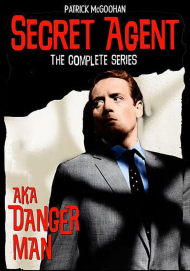 I’ve mentioned Danger Man (1960-1968; Amazon Prime) several times. Recently, I finished the series. The final season — only two episodes — is in color and was later released as a movie. Patrick McGoohan quit the series after two episodes to produce and star in The Prisoner (1967-1968).
I thought Danger Man was an excellent show from start to finish. The stories are generally captivating and well executed. Fight scenes (such as they are) tend to be rough, rude, realistic scuffles, and the spy gadgets are plausible. The show is grounded in how people behave and in how things work.
And, wow, is that refreshing in a world that’s so lost touch with physical reality.
Every once in a while, I watch an episode of The Prisoner, because that was also a very good show. Surreal and weird, but interesting and surprising.
There is also the British animated series Danger Mouse (1981-1992) — which I love and am watching on Netflix; it’s delightful and very meta. It’s a parody of Danger Man and other spy shows. The same-named 2015 reboot — also on Netflix — is fun, too. Definitely worth checking out.
§
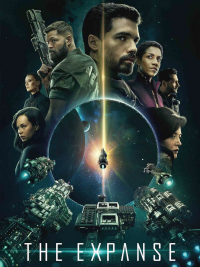 Really good TV science fiction is so rare that I decided to rewatch The Expanse (2015-2022; Amazon Prime) and enjoyed it as much, if not more than, when it came out.
First time through, I didn’t enjoy seasons four and five as much as the others, especially the first three. I posted about my disappointment with season four. And how I didn’t like the fourth book, either.
I’ve found that, when a book or show disappoints me, sometime if I come back to it later — knowing what I’m in for — it’s easier, possibly even enjoyable. On this viewing, I enjoyed seasons four and five. I still get testy at millions of civilian deaths for my entertainment, and Marco Inaros (Keon Alexander) seriously rubs me the wrong way (yeah, I know that’s the point, but I don’t like being rubbed the wrong way).
It’s possible that it’s time to reread the (nine!) books again. I’ve read the short stories now and also the graphic novel with character origin stories.
On the other hand, when it comes to reading space opera, I’ve begun exploring and rather like Neal Asher. I thought that about Alistair Reynolds at first, and I like some of his stuff, but I ultimately found his characters unlikeable and his writing overly descriptive (something I have less and less tolerance for). Asher can go on and on, too, but I like his characters more. Reynolds’ writing seems to have negative energy to me whereas Asher’s seems positive.
Fiction=escape. I don’t like being rubbed the wrong way; I don’t like highly flawed characters (see enough of that IRL); and I don’t like negative/dark energy.
§
 The Dinner Table Detective (2025; Amazon Prime), as is often the case with anime, is also a manga. It started as a Japanese light novel.
It’s s single season involving a wealthy heiress who secretly works as a police detective. She’s a wannabe Sherlock Holmes but it’s her butler who solves most of the cases (while insulting her intelligence — it’s something of a Holmes/Watson reversal). Her police detective boss (who doesn’t know she’s wealthy) is hysterically narcissistic and vain.
It’s cute and fun. The thing that stuck with me is how they drew spectacles on people. The front frame and lenses and the back half of the temples but not the front half. Done (I imagine) to show the eyes of the characters in side views, but distinctive.
I’ve seen that with eyes in anime. The hair covers the eye, but the eye is visible. Part of the fun of anime for me is the creativity of expression. The little details and differences between how shows are presented.
§
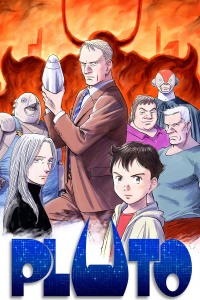 Pluto (2023; Netflix) was interesting in that all the main characters are sapient robots. It’s based on a manga series, which is in turn based on a story arc from the Japanese manga, Astro Boy.
The primary character is the robot Gesicht, who works for Europol and is trying to solve a string of human and robot murders. He is helped by Atom, a Japanese boy robot.
In particular, the robots being killed are the most advanced ones — robots capable of becoming weapons of mass destruction (Atom is one of the seven). The humans being killed are all associated with preserving the rights of robots.
The case becomes complicated when it appears a robot is responsible. It has been eight years since any robot killed a human, and it should be impossible. Of course, that killing, and the robot responsible, are part of the equation.
Worth checking out. Standalone story; eight episodes.
§
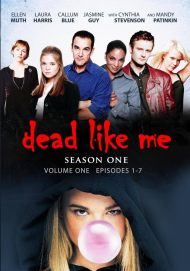 I thought I’d written about Dead Like Me (2003-2004; 2009 movie; Amazon Prime) before, but I don’t find mention of it in past posts. As I recall, it was appreciated by both critics and audiences.
I liked it a lot on the Take Me Someplace New axis, but I disliked the main character (and narrator), Georgia “George” Lass (Ellen Muth). She’s a highly disaffected, bratty, ignorant eighteen-year-old who is killed by a space toilet seat on her first day at work. The space toilet seat came from the deorbiting Mir space station.
In the reality of the show, when people die, they are ushered into their personal vision of the afterlife by Reapers — people like George who died and, for reasons never explained, don’t pass on but become Reapers.
Reapers act as ushers for some unspecified (and differing) number of souls until they, too, are allowed to pass on to their afterlife. The disaffected George has considerable trouble accepting her fate. Mandy Patinkin plays the boss Reaper for their small group which, to my delight, included Jasmine Guy (an old crush from her role on A Different World).
The show only lasted two seasons. They released a TV movie in 2009 that wrapped up various loose ends. Patinkin isn’t in the move; they have a new (obnoxious, difficult) boss.
Interesting show, and recommended, but George’s disaffection and negativity got old for me. If I’m going to hang out with virtual people, I want them to have at least few clues.
§
Quick mention: Alien Hunter (2003; Amazon Prime) stars James Spader and was much better than I thought it would be. The writing and plot left a bit to be desired, but for a “B” movie, I’d recommend it. Especially if you like James Spader.
§
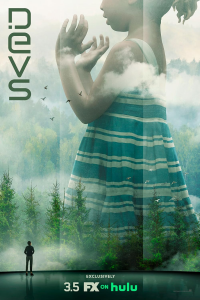 The eight-episode miniseries Devs (2020; Hulu) was a critical and audience success. It was one of those “water cooler discussion” shows. It purported to deal with free will and determinism (but did so on fairly shallow levels).
In particular, it dealt with the Many Worlds Interpretation of quantum mechanics that suggests every possible world exists in parallel with the one we know. As I’ve written here many times before, the MWI is a non-starter with me.
In any case, the show confuses it with being able to predict the future through computation. I don’t think the writers had a good grip on the science.
Devs (starring Sonoya Mizuno and Nick Offerman) is moody and visual. I have mixed feelings. I found it slow and an exercise in style over sense. Offerman’s character is seriously broken; obsessed with the past and a dead daughter. The ending is a bit pat and out-of-left-field. A happy ending tacked onto a mostly depressing piece.
Scientifically, the show has a lot of gibberish and a confusion between the MWI, determinism, computability, and prediction. As an example of the FBS, the name Devs (both the show’s title and the name of the group doing the doing) uses the Roman form of spelling, so it’s really DEUS (ha, ha, sigh).
In fact, the show actually shows why prediction is BS. Assuming a prediction, just don’t do it.
I’m glad I finally saw it but wasn’t much impressed by it.
§
Key the Metal Idol (1994-1996; Amazon Prime). Interesting show, but I couldn’t get through it. About a girl who believes she’s a robot who needs 30,000 followers to become human. And she has some kind of mystical power.
One of those shows that was appealing on some levels but which kept raising the question why am I watching this? Not having a great answer, I stopped. Might pick it up again to see how it ends, but probably not.
§
Also didn’t make it through UFO Ultramaiden Valkyrie (2002-2006; Amazon Prime). Kind of a kid’s show. I was looking for something different in an anime, but this was a bit too twee for me. Bailed pretty early. No intention to return.
§
The Party (1968; Amazon Prime), directed by Blake Edwards and starring the inimitable Peter Sellers. It … has not aged well. It’s a loose romp featuring considerable physical improv by Sellers. Kind of a cultural mini touchstone but not one to be particularly proud of.
Fun to see Claudine Longet, though. Yet, this one can’t help but wonder what she saw in “Hrundi V. Bakshi” (Sellers’ character).
§
Much more interesting (and very surreal) was Putney Swope (1969; Amazon Prime). It was directed by Robert Downey, Sr (yeah, Junior’s dad) in what was apparently his cinematic style — rough, quick, guerrilla style filmmaking.
Highly recommended if you’ve never seen it just because it’s so different and very reflective of the times.
§
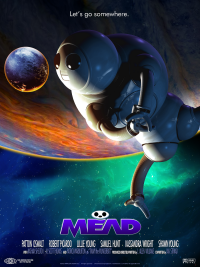 In the So Bad It’s Actually Fun category, and also the Obviously Made with Some Heart category, MEAD (2022; Amazon Prime). In many ways, it’s remarkably awful.
It stars a largely unknown Samuel Hunt as Fritz and his Ai spaceship (MEAD — Mobile Extrasensory Autonomous Deceptor — voiced by Patton Oswalt). They are on the run from the military and being chased by bounty hunters.
Fritz and MEAD are linked mentally; both were developed and intended as weapons of war. But the pacifistic inclinations of MEAD’s programmer passed on to MEAD, who refused to fight. The Admiral in charge intended to destroy the ship and imprison Fritz. They decided running away was a better option. (Admiral Gillette is played by Robert Picardo, who, among many roles, I remember as the Ai doctor in Star Trek: Voyager.)
Patrick Warburton, who I loved as The Tick (2001), voices Timmy the Wunderbot. [FWIW, the Amazon Prime version of The Tick (2026) is just as good as the 2001 version or the 1994 cartoon.]
It’s clear some heart and love of detail went into MEAD, but I found it hard to really enjoy. Some nice bits, but ultimately storytelling at a high school, or even grade school, level. Worth seeing, but don’t expect too much.
§
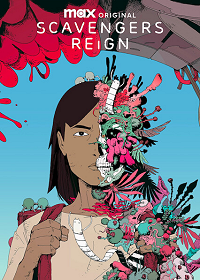 Lastly, Scavengers Reign (2023; Netflix), an animated surreal visual treat serving an interesting story. It was released on HBO Max, where it received critical acclaim for its art and execution.
As often happens with the best shows — their appeal being limited to those with intelligent and critical taste (a minority) — Max cancelled it after one season. It was picked up by Netflix. Who also cancelled it.
The story is about the survivors of cargo ship that suffers an accident while in flight. Most of the crew is still on the ship in hibernation pods. Only a small group managed to reach escape pods and land on a nearby planet (some escape pods burn up in the atmosphere).
The planet turns out to be a huge challenge for the survivors due to its wildly varying, often aggressive and dangerous, flora and fauna. One animal in particular, a telepathic and telekinetic creature named Hollow, nearly dooms them all.
I liked this one enough to keep it in my Watch List for a rewatch someday. It’s worth seeing again just for the visuals.
§ §
Stay animated, my friends! Go forth and spread beauty and light.
∇







 Logos con carne
October 7th, 2025 at 4:52 pm
I think I mentioned the other day that I enjoy Neal Asher’s later stuff (Dark Intelligence and Rise of the Jain trilogies), but found his earlier books (Agent Cormac, etc) uneven, mostly because of excessive descriptions and snail pacing. I feel it with Reynolds, and the negativity, but it doesn’t seem to affect me as much with him.
I also was delighted to find out that Peter Hamilton’s writing has tightened since I last tried him. Exodus: The Archimedes Engine was pretty good. At some point I’m going to have to start working through his series backwards until I get back to the stuff I can’t read. (Who knows? Maybe I’m more able to tolerate it now.)
I’ve also been reading Robert Reed lately. Lots of interesting ideas. Unfortunately uneven writing, which seems exacerbated in recent years after he went self published sans an editor. Still, it’s holding my interest, although I’m skipping the lowest rated books.
I enjoyed Pluto. There were a few things about it that didn’t seem to make sense. (Robots can be killed? And have to eat their veggies?) But it worked. Also enjoyed Scavenger’s Reign. I recall liking Devs, but don’t remember much from it.
October 7th, 2025 at 6:14 pm
I haven’t yet read enough Asher — just the Dark Intelligence trilogy — to have much opinion. I was planning to read the Agent Cormac series (I usually like the sort of thing it’s described as), but maybe I’ll try some of the later work. There’s still a four-week hold on the first Cormac book at my library.
I’ve been reading a lot of manga lately, especially manga of anime I’ve seen. I like how in such cases anime usually is a faithful adaptation of the text. So many western adaptations seem not to see any value in that. Just finished the long running Fairy Tale manga (63 volumes). The anime was long, too; 256 episodes, I think. Very shonen and something of a guilty pleasure, but who can say why something grabs one or doesn’t.
I think I’ve encountered Hamilton in SF short story collections; the name rings a faint bell. Not familiar with Reed.
Yeah, Pluto was … metaphorical, I guess? Engaging, for sure. Scavenger’s Reign was quite the ride. Definitely want to watch that one again. I’ll say this for Devs: lots of visual style. I liked those outdoor circular lights hanging from the trees. Somehow eerie and spooky. But I did a lot of headshaking at the science and the levitating gold room. Since the early days of TOS, I’ve never understood why TV SF writers can’t honor the science better — it’s half of science fiction. I’ve never seen why being correct (or at least less silly) would impact the drama. The Expanse is a great example of bang-on science (with just a tiny bit of SF magic). I wish they’d gotten a chance at the last three books.
October 7th, 2025 at 7:09 pm
I will say the Cormac books, 2-4 were pretty good. It took work for me to get through the early part of each book, but the payoff was worth it. The first book didn’t work well for me. Book 5 was good, but that work part felt longer. All that said, I could be an outlier. You might love the whole series.
I went on a manga kick a few years ago. I still check for updates on the Alita franchise. Manga has its own tropes, but their stories are a lot more diverse than American comics. I agree it’s pretty cool how faithful the anime adaptations are. I finished Attack on Titan with the manga, and had no trouble switching for the final chapters, even though I’d only seen the anime up till then.
On the one hand, I can understand why shows are loose with the science. Clinging too tightly to it does constrain story options. (It’s a lot harder to come up with a plot in hard sci-fi.) I agree that the Expanse shows there’s room to stay closer to the science without doing being too stringent. But producers seem too lazy to care.
October 8th, 2025 at 8:51 am
I remember exceedingly slow starts in some of Tom Clancy’s thicker books. Red Storm Rising was a major offender. It spent about a third of the book setting things up. I couldn’t stay with it the first try. Enjoyed it on a second try once things picked up, but so much of nothing much happening to begin.
I think sometimes it can be deliberate. Recently I read a book where the writing bogged down, and I realized the author was trying to set the pace for the reader because the characters were bogged down at that point in the plot (on a long journey, as I recall — this being another example of what I wrote in the post about not remembering details, just what I took away).
I’m not tempted by Paramount+ or HBO Max or Apple TV, but I am seriously tempted by CrunchyRoll (or other anime outlet). I can get a lot of manga through the library. Hollywood has a hard time catching much interest from me these days — I’m especially checked out on superheroes and the usual mindless “noise and fury” stuff. And the pretentious Oscar-grabbing stuff. There seems little love or joy in any of it. But Japanese storytelling (Asian storytelling in general) is thriving and filled with creativity, love, and joy. The diversity in the stories is delightful!
Agree. The other half of science fiction is the fiction, and there is a balance between story and accuracy. Warp drive is probably the canonical example. (Or transporters.) They’re “gimmes” that allow the story. Can’t do Kirk without warp drive. I’m fine with all that. It’s hard to define exactly, but there’s a (probably fuzzy) line between palatable and silly. A good example for me was that space comedy by Becky Chambers where the ships are powered by algae.
October 8th, 2025 at 2:02 pm
I remember trying Clancy a few times and never being able to get past the opening chapters. I gave up on him in the 1980s and tried one or two other times after some of the movies came out, but no dice. There’s a lot of handwringing about men not reading anymore, and every time I hear it I think about these books with the pacing of molasses in winter.
Certainly there can be times when it makes sense to do it deliberately. But it seems more effective once we’re deep in the story, and as you say, when the characters themselves are struggling to move forward. When it happens in the opening pages, it’s usually because the author is infodumping, something SF/F authors catch a lot of grief about, but they seem far from alone in that sin.
I have Crunchyroll and they do have a pretty good selection. The service has improved a lot since the merge with Funimation. Although I wish their navigation for older material was better, at least on the Roku app. Funimation also had a larger dubbed selection, which Crunchyroll only partially maintained.
On the gimmees, a lot to me comes down to how difficult it would be to do without it, in other words, what does the gimmee really provide? Warp drive, transporters, pervasive artificial gravity, etc, I’m all willing to live with since they largely make a space show possible. But when Star Trek can’t decide whether the Enterprise can fly tens, hundreds, or thousands of light years in a day, that’s just laziness. If you’re going to spice your dialogue with numbers, at least make them consistent. And if you put on airs about being “serious science fiction” (cough)Interstellar(cough), I’m going to hold you to a higher standard.
October 8th, 2025 at 6:24 pm
I might have gotten as far as Executive Orders (1996) but was already losing interest by then. I enjoyed his first half dozen okay, though. Definitely beach reads. As far as men not reading, my wild-ass guess is it’s another product of the times. Many consider blogging, even short form, over. It’s all video now. Recently it’s all video shorts. Our collective attention spans have become miniscule.
Funimation, yeah, that’s the other one I was trying to think of. I’ve been hearing about streaming “bundles” that let one pick and choose. I’m missing out on baseball postseason because the games are aired on channels like TBS, ESPN, or FS1 — none of which I have. Be nice to have a bundle and pay for just channels I actually watch. Including streaming services.
Heh. Interstellar. Finally saw that a while back. The first half wasn’t too bad, but oh, dear, the ending. Lost a little respect for Nolan after that. He’d basically batted 1.000 with me until then.
October 9th, 2025 at 8:04 am
I guess someone could argue that our low tolerance for slow pacing is also an effect of the attention economy. Classic novels, after all, started with the protagonist’s family lineage and life history. But it seems like novels in the 1920s to early 1980s had achieved a type of prose economy (largely influenced by Hemingway) that started slipping with the introduction of word processors.
Agreed that the ending of Interstellar was hot garbage. But I actually thought the movie overall was a substantial improvement over the typical space movie. When I made my comment above, I said “Interstellar” but was actually more thinking about Ad Astra. Which itself has its good qualities (I thought the silent moon sequence was pretty cool), but is far from the high standard sci-fi it puts on airs about.
October 9th, 2025 at 11:04 am
There are some series authors I read whose work spans the period from the 1970s to the 1980s, and I watched the thickness of their books increase during that time, so I know what you mean. It makes sense word processors, and then PCs, would make it easier for authors to wax prolific. I’ve long suspected editors wanted longer manuscripts to make the books fatter. Prices rose a lot during that time, too, and my guess was that thicker books gave buyers more of a sense of value for increasingly expensive books. I assume there’s a minimum cost to put any book into production, so the higher the unit price, the better for the sellers.
I just grabbed an illustrative example off my shelves. Robert B. Parker’s first Spenser novel, The Godwulf Manuscript (1973), weighs in at 188 pages. His 33rd Spenser novel, School Days (2005), weighs in at 291. Looking at them lined up on my shelf, the progression of thickness is obvious. And Parker was a sparse writer. Other writers turn out much thicker paperbacks.
It’s an interesting idea. Have fiction books become so fat with descriptions and the trivial that they’ve put themselves beyond the kin of modern readers? (What’s scary is the notion from Idiocracy that we’re forsaking literacy because it’s too hard — not unlike many forsook math because it was too hard. Many seem proud to be innumerate, as if it somehow made them more human. Will the modern anti-intellectual currents lead to a similar pride in being illiterate?)
I give Interstellar props for not just including time dilation due to gravity but making it a plot point! I may have lost a little respect for Nolan over the ending, but I still regard him highly. I’ve never seen Ad Astra, so have no clue. Word seemed a bit mixed. I had it on a watch list somewhere, but it expired before I got around to watching it.
October 9th, 2025 at 1:06 pm
My book bloat theory is computers just made it easier to make several editing passes, adding just a little bit extra description, interior monologue, or other clarifications each time. Previously such passes involved retyping whole pages (at least) in a typewriter, so they more restrained. Unless a cutting pass is made (which probably only happens with a word count limit), the result is a thicker slower book. And publishers didn’t resist because thicker books do look like you’re getting more.
That happened at the same time that we got a lot more entertainment options: VCRs, video games, and cable channels. Competition has only increased since then. At a time when they had increased competition, books became more work to read. It didn’t help that, prior to the Kindle, publishers had consolidated to only an insular few large houses in New York.
At least, that’s the way it’s looked to me for the last few years.
October 9th, 2025 at 5:18 pm
Makes sense. Another victim of the computer revolution.
October 8th, 2025 at 7:26 am
Great recs! Thank you, also, for including pictures so I can remember these visually when I can carve out time to watch some tv.
October 8th, 2025 at 8:26 am
Thank you, glad you found it useful! There will be another TV Tuesday post next week (or the week after) because the ones listed here are only about half the list (I try to keep posts below 2,000 words — this one was over that limit as it was).
October 14th, 2025 at 9:15 am
[…] is a continuation of last week’s post. The list of shows I have is too long for one post, so this picks up where it left off (even so, […]