 Maybe this is on me; maybe I lack proficiency with English grammar. That’s always possible. I certainly have no pretension of being a grammarian, but I like to believe I have some grasp of it. In any event, lately I’ve found myself bemused by the Microsoft grammarian embedded in Windows™.
It seems to have gotten weirder. That, too, could be on me; maybe I just don’t remember it being this amusing (which is one way to put it). In the past, even though we sometimes disagreed, I seem to remember it as being more useful than distracting.
But recently it seems to have become a lot less helpful.
So much so that I went through a period of saving screen captures of examples that gave me pause. Between April 22 and May 23, I collected 27 (close to one a day). At first, I had in mind combining them into a single image (or small set of large images) to send to Microsoft along with a complaint about their auto-grammarian. I’ve complained once already and sent them some samples. I intended these screen grabs as more evidence.
I may yet send them another complaint (possibly linking to this post). Or not. At some point, one gets weary of being a single voice amid millions when dealing with these big companies. They have no reason to care about individuals, and they clearly don’t.
[In my experience, the more a company has to tell you how customer-oriented they are, the less true that seems to be. The notion of “show don’t tell” extends beyond its importance in storytelling.]
There is also that, because having it on my right-click context menu annoyed me, I uninstalled Microsoft Copilot™ (their consumer Ai software), and since then the grammarian seems stilled. I still get jagged red underlines for unknown words, but it seems to have stopped being picky (and in my opinion frequently wrong) about grammar.
Regardless, the collection makes for an amusing blog post.
In chronological order:
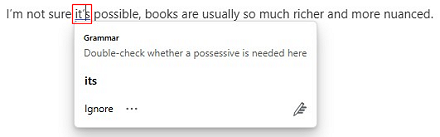
From the sentence structure, it’s obviously the contraction of “it is”, but it seems not to know that “it’s” is, in fact, a contraction, not a possessive. Weirdly, it’s right that a possessive isn’t needed there (or even sensible), but — again — “it’s” is a special case. How does a grammar checker not know this?
I meant to go on to say that it’s especially bad if Microsoft’s Copilot™ Ai is behind this, but the grammarian reared up while I was writing the previous paragraph:
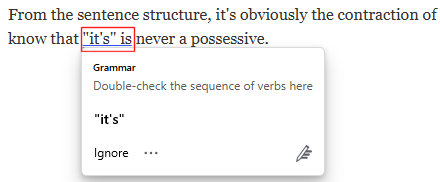
I’m sure I recall it being more aware that text inside double quotes is special and can be outside typical grammatical flow (as of this editing session, it’s now recommending “i is” (yes, lowercase “i”), and what kind of faith can you have in a grammarian that thinks a lowercase “i” is grammatic?
Meanwhile, back in the chronological flow:
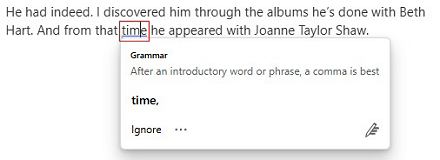
Um, no. Just no. I can maybe see: “And from that time, they lived happily ever after.” But that sounds tortured to me, whereas: “And from that time on, they lived happily etc.” sounds better. Though I’d usually expect: “And from then on, they etc.” But as written above, there’s just no way.
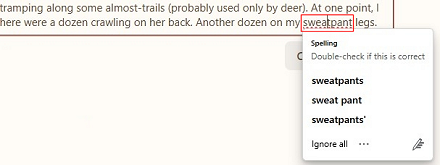
I’m quite certain one refers to one’s pant legs, not one’s pants legs. Though I suppose there is some wiggle room. They are called pants on their own (which is a bit weird when you think about it). But when referring to the legs (both of them), the plural is present, so therefore “sweatpant legs.” If I meant one leg, I would move the plural back and say pants leg.

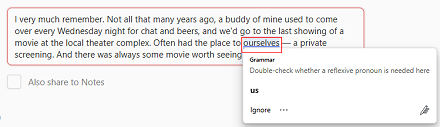
In what reality does “Often had the theater to us” make sense? I notice now that I forgot a comma for the clause “and we kept an empty seat …” — the grammarian completely missed that. I wish the Ignore option stuck, but it only applies while the document is open. Even refreshing the window make it forget about stuff you’ve told it to ignore.

Here’s it’s right about the possessive, but of course it doesn’t apply here. Pretty obviously noun-verb, and a past-tense verb at that. Had it been noun-noun, then a possessive for the first one would be natural. But it’s glaringly wrong for the sentence structure above, and that’s what I seem to be noticing more and more — it being glaringly wrong.
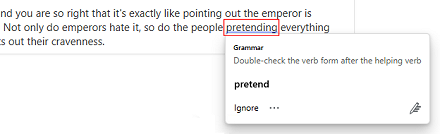
Yet another example of being glaringly wrong. The sentence structure, “so do the people” almost demands a gerund there. Just try to form a rational sentence from “so do the people pretend something something something.” At best, it sounds horribly pretentious or archaic.

Another gem. “Where I king,” doesn’t make much sense. On the other hand, sentences that begin with “Were I fillintheblank, …” or “Were I to fillintheblank, …” aren’t uncommon and should have trained the grammarian to recognize the construct.
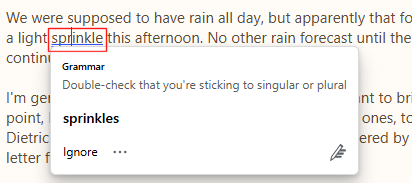
Again, it’s hard to understand why it gets seemingly simple constructs so wrong. A lot of its apparent confusion seems to involve singular versus plural cases. But “a light sprinkles this afternoon” is another glaring mistake.

I’ve also noticed that it seems to have a harder time than I recall with simple spelling errors. It seemed more useful in finding the word I meant. Now, it frequently gives me the “No suggestions” response. Is “bargained” really that hard to come up with given “barganed”?
Interestingly, in the above paragraph, it red-jagged “barganed” but now it offers “bargained” as the (one and only) suggestion.
The next two go together and reflect something I’ve had happen more than once:

And:

Ai often has no persistence, no ability to remember previous interactions, but apparently here the suggested fix doesn’t pass muster when taken. There seems some general confusion with regard to the prefix word “mini”. Sometimes it stands alone, (“mini car”) sometimes it’s connected with a hyphen (“mini-USB”), and sometimes it’s part of the word it modifies (“miniskirts”).
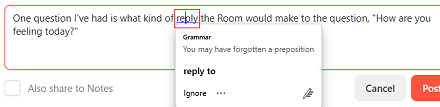
The grammarian apparently doesn’t pay enough attention to what surrounds the word, although it seems to vary in whether it ignores the parts before or the parts after. Here, “what kind of reply to …” might make sense in a different context (though the construct seems tortured to me), but given that what follows, the “to” seems wildly out of place.
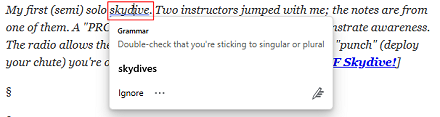
Again, it seems to have trouble with singular versus plural cases. Nothing in the sentence, “My first (semi) solo skydive,” implies any kind of plural. It was the distraction of these increasingly common off-the-wall interruptions that drove me to making screen captures. That’s what seems to have changed. It has become more annoying.

Another case of not being able to figure out a simple misspelling (due to a typo — I usually know how to spell “usually”). Another thing to notice here is that the highlight — the darkened block around “d most v” — is far to the left of where it should be. Look above at the misspelled “bargain” to see what it should be. Not sure why it got the highlight wrong, but I’ve seen that more than once (though it is rare).

I mean, yeah, I suppose. I can’t call it wrong in this case. But “more clear” over “clearer” and “more true” over “truer” have a better rhythm and sound, and I think rhythm and sound matter in writing. (Say them all out loud and see what you hear.)
That last sentence offended the grammarian:
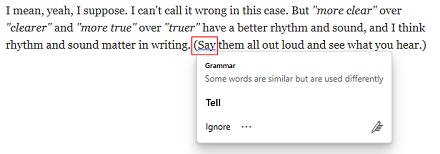
“Tell them all out loud,” is hysterical and not at all consistent with what the sentence means. It’s all about the saying. You probably wouldn’t want to be saying grammar phrases out loud with anyone around (unless you’re an English teacher), so there’s no one to tell anything to.
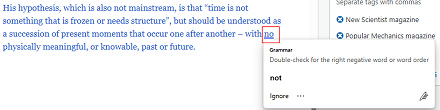
I can imagine maybe “with not a care in the world,” but the adverb after “no” makes it pretty clear “no” is correct. (I would think one needs an article after “not”?) In the past, it was far more likely the grammarian had a point, but lately there seem an awful lot of false positives.

But “whereas I live in a condo in part,” isn’t a rational clause. I can see, “in a condo in Minneapolis” or “in a condo in luxury” (or “in a condo in sin”). But “part” isn’t a noun. It belongs to the modifier “in part so”. Add the suggested comma, and the sentence makes no sense.

One missing letter, and it can’t come up with “meteorology”. Wikipedia knew what I meant (and their search engine isn’t the greatest).
Here again it seems it shouldn’t have had so much trouble figuring out what I meant. Just about every spellchecker I’ve used would have gotten both of these right.
Oh, good heavens:

That’s three interruptions just writing this post. That is, three worthy of including in the post. There have been other minor ones. (For instance, the second sentence of this paragraph originally began, “Three worthy of including …” But the grammarian suggested “worthies” until I added “That is,” in front.)
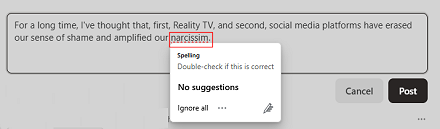
That interruption broke the flow of two seemingly easy to correct spelling issues the grammarian just threw its digital hands up at. “Narcissism” is one of those words I never seem to spell right. (“Occasionally” is another — I always think there should be a double-s.)

No, once again it has singular and plural confusion.

And again. I can see a sentence starting, “So many thoughts about“ but as written it seems clearly correct. The construction, “So many thought something something something,” seems a common enough one that it shouldn’t have been fooled.
Here’s another two-part loop:
And:

I was pretty sure “ourselves” was correct — using “us” makes no sense. But I thought maybe I had singular-plural confusion myself and tried “ourself” (which sounds wrong to me, and I’m pretty sure is wrong — singular: “place to myself”). Then it suggested what I’d originally written.

Neither suggestion makes sense. “This one lead back” is obviously wrong. “These leads” is just as bad. Another pointless interruption because it’s very confused about singular and plural cases.
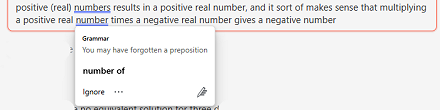
It’s bad enough that terms like “positive numbers” sometimes throws it (referring to just “the reals” usually does, though it seems happy with both in this sentence). Yet in this case it thinks I forgot a preposition. Here again, I would think that “number times a number” was such a common construction that an Ai trained on text would recognize it readily.

That one is baffling but is yet another S-P confusion. The “it” following “doesn’t” should make it pretty clear. Had it been “doesn’t they”, then grammarian would have had a point — “don’t they” is correct in that case.
Last one:

Another spurious comma. It’s as if grammarian fixates on the word “actually” and doesn’t see it in context. Maybe it was trained on too many internet comments that begin, “Actually, blah blah blah.” It’s a common construction (one I’ve tried to eliminate from my vocabulary). But it’s something else to say that something is actually something — actually true, for instance.
§ §
In general, I wonder (assuming grammarian actually is an Ai) if it was trained on too much bad writing from the internet — the key free resource used to train linguistic Ai models. Is it possible there is so much half-assed grammar in common usage that using the internet to train a grammarian results in a very lame grammarian?
Stay grammatic, my friends! Go forth and spread beauty and light.
∇







 Logos con carne
June 7th, 2025 at 12:07 pm
Now I can file all those screen grabs away! They were taking up a lot of display space in my “staging” folder.
June 7th, 2025 at 1:55 pm
I didn’t read all the snippets. But I’m glad to know that it isn’t just me. I also resent the grammatical corrections that are technically correct but destroy the flow of a passage.
June 7th, 2025 at 5:38 pm
A big part of the writing is that flow.
June 7th, 2025 at 4:26 pm
Yes! Thank you for voicing all my complaints so beautifully! And what I’m seeing way is that people who accept these “suggestions” wind up with bland, slightly “off” prose that is flagged as AI-written by the plagiarism/AI-detecting software and reads like some kind of corpspeak pablum.
June 7th, 2025 at 5:40 pm
If they followed some of these suggestions, it would be more than a bit “off”! I just wish I knew why it has gotten worse lately (assuming it has, in fact, gotten worse; maybe I just started noticing it more).
June 7th, 2025 at 4:32 pm
It’s almost like there’s a plot to reduce everyone’s writing to all the same voiceless, featureless text. And the only thing needed to effect the change and keep us in line is a bunch of little red squiggles on our screens😂
June 7th, 2025 at 5:43 pm
I’ve been in so many meetings seeing PowerPoint presentations with misspelled words — which is bad enough — but also with jagged red underlines pointing out the misspelled words. I never understood why managers didn’t either [A] (preferably) correct the misspellings or [B] turn off the spelling warnings.