 My usual breakfast — literally breaking the short fast that begins for me before midnight — isn’t until at least noon to ensure a minimum of 12 hours without food. If I get busy doing something in the morning, I might not break-fast until much later. “Lunch” therefore takes place around 4:00 or 5:00 PM, and “dinner” somewhere around 9:00 PM. I try to not eat after 10:00 PM, but definitely not after midnight.
Which isn’t particularly relevant here, but what does apply is that I typically read while I eat my two slices of breakfast toast. What I usually read is the latest issue of New Scientist or, more recently, Popular Mechanics (which is where Popular Science went when it died).
All of which is to say, here’s another issue of Science Notes.
As I said last time, while reading, sometimes a bit really catches my eye, and I want to save it so I can remember and think about it later. I copy the significant text to a Science Notes page in Apple Notes (because I use my iPod to read these magazines). At some point, I realized that page would grow endlessly, so I started this series of Science Notes to off-load them (and share them).
The slight problem is that I don’t record anything but the bit that caught my eye (and don’t intend to start — copy-pasting the relevant text is more than enough work while munching my toast). Links to the articles wouldn’t help, because reading the magazine online requires a subscription (last time I checked). I read them through my library app, Libby, which offers hundreds of magazines (of which only three have so far interested me).
That’s enough build up. Let’s jump right into the bits and pieces.
Social Media
A survey of more than 1500 children suggests smartphones can be beneficial to their mental and social well-being – unless they start using social media.
Justin Martin at the University of South Florida surveyed 1510 kids between the ages of 11 and 13 in the state as the start of the 25-year nationwide Life in Media Survey, which will explore the link between digital media and well-being.
The researchers found that 78 per cent of the children surveyed owned a smartphone. Of these, 21 per cent reported symptoms of depression and anxiety, compared with 26 per cent of those without a device. The children with phones were also more likely to report spending more time in person with friends.
…
However, the researchers also found that children who said they often posted on social media were twice as likely to report sleep issues and symptoms of depression or anxiety, compared with those who never use these platforms. That said, the survey wasn’t able to identify if increased social media use led to mental health and sleep issues, or if the reverse is true, says Martin.~New Scientist
There is, at least to me, kind of a “Well, duh!” aspect to this. Of course, it should go without saying that our intuitions and observations need evidence to support them no matter how “obvious” they seem. That said, “Well, duh!”
It does seem pretty obvious that the usual type of social media turns brains to mush, but we are seeing an increasing amount of data backing that up. What’s interesting is that smartphones themselves aren’t the issue — in fact, they provide a benefit. It’s a huge advantage to be able to search for that actor you’re trying to remember by looking at the cast list of any movie you can recall the actor being in. Or to show the picture to your dinner companion who doesn’t know the name but recognizes the face (“Oh, yeah, that one.”).
Or to have instant access to a stopwatch, timer, calculator, or notepad. Or to all your music and ebooks. Not to mention the benefits of instant communication with friends. (“Stuck in traffic. Be there ASAP.”) Just last week, at a small social gathering, I was able to show a friend the exact value of 6¹⁸ (101,559,956,668,416).
[It wasn’t until the next day I realized we should have been talking about 18⁶, which is a mere 34,012,224. I’d gotten it backwards. We were talking about Medeco locks, formerly thought hard to pick (not quite true for experts), and my friend was saying each of the six pins had 18 possible positions, and I got it backwards about how one calculates X number of objects with Y number of possibilities. Oddly, the Wiki page says the six pins have “six heights, three rotational positions, and two pin tip angles.” Maybe my math is way off (again), but that seems to be (6×3×2)⁶, or 36⁶, which is over two billion, whereas Wiki says, “The theoretical number of unique key combinations is over two million” — wrong “-illion” there, I think.]
So, smartphones are wonderful tools. But social media is problematic for all the obvious reasons (FOMO, self-image, jealousy, doubt, and hateful attacks).
Cognitive Decline
An analysis of nearly 60 studies involving 410,000 people in this age group has found that those who spend more time using smartphones, computers and the internet are less likely to have cognitive impairment – and more likely to have slower cognitive decline – than people who spend less time using these technologies (Nature Human Behaviour, doi.org/g9fhw4).
~New Scientist
Use it or lose it. In general, constantly learning new things tests and exercises your brain.
As my hearing — which was bad from birth — gets even worse with aging (and the loud volume I need in headphones to hear music properly), friends have been mentioning the connection between poor hearing and dementia. Which is apparently legit, but I suspect my intellectual hobbies offer the same benefits as suggested by the article above. Just writing blog posts like this is one form of exercise. An even better one, I think, is writing code, which I still do a lot of.
And I’ll sure as hell never ever resort to letting an LLM do any work of any kind for me. I’m just flat out against them, and — to be very blunt — I lose a small bit of respect for people who are into them. For multiple reasons, I suspect there is an LLM-crash looming down the road as their weaknesses and outright flaws become more apparent. I steadfastly maintain they’re a Bad Idea and should be shunned.
FWIW, I am seriously considering getting hearing aids again. I had them many years ago, but firstly, they didn’t help as much as I wanted them to, and secondly, having a thing stuck in my ears all day caused moisture to accumulate, resulting in chronic ear/sinus infections that still occasionally plague me. But I’m really tired of hanging out with friends and seeing people on opposite ends of the circle apparently easily hearing each other when I, in the middle, can’t hear a damn thing.
Quantum Brain
A recent groundbreaking experiment in which anesthesia was administered to rats has convinced scientists that tiny structures in the rodents’ brains are responsible for consciousness. Experts believe that these microscopic hollow tube structures — called “microtubules” — perform incredible operations in the quantum realm. Citing the work of earlier researchers, the researchers behind this new study infer that the same kind of quantum operations are likely happening in human brains to create consciousness.
…
This new study is a major step toward verifying a theory that our brains perform quantum operations, and that this ability generates our consciousness — an idea that’s been gaining traction over the past three decades.~Popular Mechanics
The Roger Penrose–Stuart Hameroff theory that consciousness depends on quantum effects in those microtubules has been widely dismissed by experts in the field. Usually because the idea of quantum effects in the messy, hot macro-world is deemed “impossible”. This seems to me to ignore that all chemistry is quantum — something that’s easy to forget because chemistry is so ancient.
For that matter, polarizing sunglasses also depend on quantum effects. (If you have three polarizing filters, you can demonstrate a weird quantum effect for yourself. See this YouTube video for a demonstration or Photon Spin and Fun with Photons for a deep dive.)
All of which is to say that I’m laughing my ass off that Penrose and Hameroff may turn out to be right. I, too, have been dismissed for thinking they might be. Good to see that the idea is “gaining traction”. [See my Brains Are Nothing Like Computers and Brains Are Not Algorithmic posts on my Substack blog for recent posts on this.]
[I mentioned that break-fast can come late if I get into something. I started writing this post around 10:30 AM. It’s now just after 1:00 PM, and I’m hungry. BRB]
Betelbuddy
In other words, Betelgeuse is actually two stars. This hypothesized second star — excellently nicknamed Betelbuddy — is likely at least two times the mass of our sun. The team behind the paper argues that when Betelbuddy passes within view of Earth, the star disrupts the gases that usually obscure light from reaching our planet, so Betelgeuse appears brighter. While this idea has yet to be confirmed with direct observation, a star like Betelgeuse having a stellar companion is actually pretty likely. After all, an estimated 85 percent of stars are actually binary systems.
~Popular Mechanics
Betelgeuse is a red supergiant in the Orion constellation. In recent years, it was in the news because variations in its brightness were thought to signal its impending supernova explosion. In some media, this is viewed as Bad For Us, but at roughly 475 lightyears distance, its explosion poses no threats to us.
True science fiction fans know it as the home star of Ford Prefect (or possibly just close to his home star — the exact quote is that he is from “a small planet somewhere in the vicinity of Betelgeuse.” (A good test of whether you’re a True SF fan is knowing what I’m talking about.)
Movie fans know it as the inspiration for the movie title Beetlejuice (though, from what I recall, the star plays no role in the movie). Long ago, I posted a bit about Orion and how, once you know the constellation, you can’t not see it.
Biggest Prime (so far)
Amateur number detective Luke Durant (a researcher and former employee of the software company NVIDIA) recently found the biggest prime ever discovered: 2136,279,841–1, now also known as M136279841. According to a press release, the find was made on October 11, 2024, and confirmed on October 12, and the number is over 40 million digits long—more than 16 million digits larger than the next largest prime.
~Popular Mechanics
I don’t have anything to add but found it interesting. Over 40 million digits long. And quite a distance from the next lowest prime (That “next lowest” seems odd phrasing; I think I would have written “next highest”.)
Time & Space
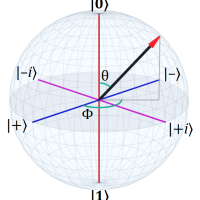
For years, physicists have found the mathematics of qubit states to be “extremely suggestive” of some deeper connection to the geometry of space, says Vlatko Vedral at the University of Oxford. Now, he and James Fullwood at Hainan University in China have made a mathematical argument for how the geometry of space may be encoded in a qubit’s behaviour in time.
[…]
There are, though, other researchers who argue that space and time should be separated. For instance, Lee Smolin at the Perimeter Institute in Canada says that, in his view, time is more fundamental than space. However, he doesn’t think of time existing in a way that can be captured with the equations in the new study.His hypothesis, which is also not mainstream, is that “time is not something that is frozen or needs structure”, but should be understood as a succession of present moments that occur one after another – with no physically meaningful, or knowable, past or future.
~New Scientist (I think; didn’t record the source)
Someday soon I need to post (rant) about how science itself has become broken in modern culture. Partly due to the abject stupidity that infests modern culture, which isn’t science’s or scientist’s fault, but also partly due to some abject stupidity and cravenness on the part of scientists (cf. “publish or perish”; also “getting grants” and “becoming famous like Einstein”).
So, my first reaction to the first paragraph above is that this is more FBS from scientists hoping for a score. What caught my eye was the other two paragraphs. Lee Smolin, a scientist I respect, has the view that time is fundamental — a view I very much share [see Smolin: Time Reborn]. So, there’s no point in deriving time from something more fundamental, especially with so much speculation and no experimental evidence (the primary problem with most scientific FBS).
[For some older posts of mine about time, see Thinking About Time (2015) and Got Time? (2018). It’s a topic I’ve posted on a fair bit.]
I’ll end with a video from Dr. Sabine Hossenfelder about how broken science is:
She’s very unpopular for her view here, but I think she’s right on the money. As with racism, self-interest tends to blind people to the truth.
§ §
Stay mentally active, my friends! Go forth and spread beauty and light.
∇






 Logos con carne
And what do you think?