 It’s funny, sometimes, the twists and turns of life. When I first heard of The Three Body Problem (2006), a science fiction novel by Liu Cixin, it didn’t grab my attention because I’m a little weary of “alien invasion” stories. But I’d read and enjoyed Ball Lightning (2004), so I watched Three Body, the Chinese adaptation of the first novel.
I posted last year about how much I liked it. So much so that I recently watched and posted about it again. And re-read the first novel (I read the trilogy last year). I even watched the first season of the Netflix adaptation.
To my eyes, it demonstrated everything that’s gone wrong with modern writing for TV and movies. The contrast between the Chinese adaptation and the Netflix one is stark and revealing.
I tried to watch it with an open mind. I’m not sure I succeeded. It’s a challenge trying to step outside one’s biases and viewpoints. They are so fundamental to who one is. That said, take this with salt, but I believe the Netflix version is objectively bad, especially in comparison to the faithfully done Chinese one.
Once again, with adaptations, three questions:
- What was removed?
- What was changed?
- What was added?
With the last one taking us into the Extreme Danger Zone in terms of turning out a bad adaptation. If for no other reason than how the challenge of fitting a text into the visual medium almost always requires removing material. The presumption of then adding new content puts one on very thin ice. If the intent is to adapt the text, then it seems arrogant to think it requires new material, especially material with significant changes.
Extra especially when those additions or major changes are motivated by strong ideological views. All storytelling is ideological to some extent — all stories have a point of view — but when the ideology is front-and-center, it becomes part of the story. It becomes the elephant in the room distracting from the story. Ideological points should be subsumed and supported by the story, not rubbed in viewer’s faces.
I found it hard to watch the Netflix series because of the constant nagging question of why the writers needed to play a game of musical gender chairs with the roles. And worse, one of the main swaps is such an asshole. Bottom line, I’m two thumbs down on the Netflix version, give it a strong Nah! rating, and can’t believe it was renewed for two more seasons. Considering that the first season got a good way into the second book, I have to wonder what they have planned. I suspect they’ll be going seriously “off book”.
In any event, as usual, I have notes. (They really help vent my frustration when watching something frustratingly bad.) I’m going to mostly just dump them in raw form so I can throw away the paper but still retain a memory of what I saw. (The pages got out of order, so things might jump around a bit.)
§
To begin on a positive note, I’ll repeat the note about how casting Benedict Wong as Shi Qiang (“Da Shi”) is one of the most faithful-to-the-book elements. (What isn’t as faithful is the degree to which they softened his importance in the story. Because the truly masculine must be toned down. That reek permeated the writing. Topping it off, they gave him a gay son and some father-son angst because … well, I have no idea.)
And I continued to be impressed (albeit not in a good way) at how much compression of the story there was. Eight episodes to cover the first book and get into the second. The pace made a mockery of the story. No nuance or sense of time at all. Compare that to the 30 episodes of the Chinese version (which covers only the first book).
Eight episodes, a book-and-a-half, and they add a ton of egregious personal dramatic baloney with no connection to the story because, I guess, the story is really just a science-fiction flavored background for this story about a bunch of friends.
And that’s another thing, this silliness of having all the major characters be friends (except for Shi). Included: personal anxiety and psycho-meds plus unrequired love and dying of cancer. None of which add anything (or have any connection to the text). In trying to make the story more relatable, they made it feel claustrophobic and small. One might even say liberal-bubble-like.
The story compression means a lot of telling, not showing, which makes the story feel thin. One of the most climatic scenes fell flat because it came and went so fast. The tension in the Chinese version was palpable. It’s just one more scene in the Netflix version.
The aliens with superior technology apparently reject us because we’re such awful liars. They were benign and friendly until they learned how nasty humanity is. It’s a trope: “the monster is actually us.” (Despite the author’s explicit protestations, I’m seemingly not alone in reading the story as very negative about humanity. And while I tend to share the view, it’s not what I read fiction for.)
§
I seem to have reached a point in life where a thorough and detailed trashing of something that got on my bad side no longer holds the appeal it once did. With that in mind (and my more informal approach to blogging here now), here are some of the raw notes from the four pages I filled while watching episodes 3–8. Any added annotations are in italics.
• The music has kind of an HBO’s Westworld vibe. Kind of ethereal.
• I hate Aggie (Eiza González). Bleeding-heart head-in-the-sand academic. She’s an asshole. All her handwringing over the nanofibers. What part of the human race is under existential threat do you not get, you self-centered narcissistic asshole? (WTF with these a-hole characters?)
• The light sail is way, way, way too small. The whole sequence is an example of the extreme compression. It all seems to take place over a matter of minutes!
• Sophon BS. The sophons have way too much power. More Hollywood BS.
• Human computer; no lead up; no sense. Tells, doesn’t show. The “shut up troll” comment made me smile.
• Killing of Jin and Jack is dramatic BS. Killing Jack, ugh. (the unwoke slob; he deserved it).
• The game avatar woman and the little girl. WTF? Once again, the intellectual isn’t seen as enough. (Don’t remember exactly what that last line is addressing, but it’s a common complaint I have about modern storytelling.)
• Almost aggressively not Chinese. A dishonorable adaptation.
• Ye Wenjie approaches Evens because she’s a power woman. And she’s not the villain. That was all his fault. She was just naive. (I’ve always been in favor of gender equality, it’s how I was raised, but what I’m seeing in stories these days feels more like payback or even revenge, not equity. Why would I want to watch that?)
• So much personal static. Yet the compression means a lack of context, which makes these characters utterly forgettable. I didn’t care about any of them.
• The big arrest scene reeked of wokeness. (But I forget why now. Such a forgettable series.) Hollywood gun battle because we gotta have guns going off — lots of them. And no 3-body sculpture or bomb (or Shi being the hero). Also, no Pan Han (the eco-terrorist).
• Ugh. No setup on anything. The big nano wire scene, Ye Wenjie’s feelings, nothing has context or depth.
• Such a shift in … so many things. Wenjie, Evans, the nanofibers (now a one-person operation because power-woman Auggie gets all the glory).
• The big nanowire scene lacked suspense (or interest). The text makes clear that the people on the boat were bad people. The Chinese adaptation makes that point even more forcefully. The Netflix version not only doesn’t, but implies good people are on board, and if that isn’t enough, also children. Hence Auggie’s highly dramatic handwringing.
So, think about this. Netflix has the good guys slicing non-villainous children to death for our entertainment. They coyly cut away from actually showing it, but it’s clear that everyone on that ship is killed. By the “good guys”.
• The 400 years of travel time isn’t explained. This adaptation makes up the name “San-Ti” for the Trisolarians.
• They really put a Hollywood spin on the sophons. Which manifest as a woman, of course. So much outright stupid and ignorant Hollywood BS.
• Global media takeover announcing we’re bugs. WTF? Too much Hollywood magic. This notion that, because it’s SF, the normal rules don’t apply at all. Anything goes.
§
I should probably give the Netflix adaptation an Ugh! rating (rather than Nah!), but that would leave no room of the truly egregious stories (like that godawful quickly canceled Netflix adaptation of the anime classic, Cowboy Bebop).
I did read somewhere the writers deemed the original text sexist, which — having read the novel twice and seen the Chinese adaptation twice — bemuses me. Why? Because Ye Wenjie is the villain? I don’t really understand why they felt the need to make such major changes to characters and story points.
If the text is problematic, why adapt it at all? What is this need to put a big ideological frame around everything? To reframe a well-told story because it doesn’t fit your conception of how it ought to be told. Why can’t a story just be what it is, as told by its author?
The text has endured since 2008. I’m sure it will endure for many more years. The Chinese adaptation will be remembered as faithful and detailed — worthy. The Netflix adaptation, on the other hand, is just more ephemeral fluff of no account that will be washed downstream and forgotten within a year or two.
It was nothing but another shovelful of scantly nutritious Mind Chow™ — ultimately largely indistinguishable from any other shovelful. Just more content to feed the beast.
§ §
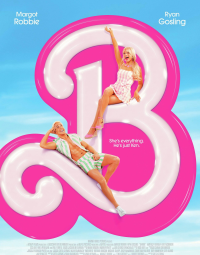 To end this on a more positive note, I saw and rather enjoyed Barbie (2023, directed by Greta Gerwig) recently. It was generally clever, fun, and it had some unexpected depths. It has some tone shifts I found jarring, and Ken’s song is weird. The war seemed cartoonish even beyond the generally cartoonish nature of the whole.
Margot Robbie is almost always good, it was fun seeing Rhea Perlman, and Kate McKinnon usually lights up anything she’s in. I can do without Will Ferrell almost always — in this he was distracting. Oh, look, it’s Will Ferrell being Will Ferrell. Fun?
The opening 2001 gag was cute. Got me laughing, and things stayed pretty funny until about halfway through. Not sure if it just got old or it was the tone shifts. It’s kind of a thin premise, and tone was all over the map (not uncommon these days where writers try to toss in a little of everything hoping something hits).
If it were me, I’d have made Gloria’s speech (America Ferrera) the musical number.
Bottom line, it gave me unexpected tears of laughter and poignancy, but the stew of tones and extreme fantasy (of Barbie and Barbieland) made it fluffy and fun but finally forgettable. Definitely worth seeing (I give it a medium Ah! rating), but it will never be remembered as notable.
§ §
Stay pink, my friends! Go forth and spread beauty and light.
∇







 Logos con carne
March 2nd, 2025 at 4:20 pm
Honestly, it’s gotten to the point where I don’t like even watching something bad, let alone writing about it. But there are always exceptions. And I was determined to (at least try to) give the Netflix version a chance.
Re-watching the first two episodes, though, I was reminded why I gave up on it the first time I tried to watch it. This time I soldiered on but ultimately to no good purpose. I at least got a blog post out of it.