Tag Archives: orbital mechanics

Orbital Mechanics

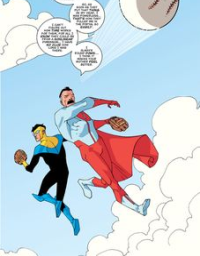
Back on Tau Day (which is also my retirement anniversary), I posted about a scene in the superhero comic Invincible that involves a baseball orbiting the Earth at a very close distance (roughly airplane height). Regardless of superhero strengths, I found the scene impossible on multiple counts.

At the time, I could only calculate the velocity of the ball given the circumference of the Earth and some guesses about the length of the presumed orbit. Suffice to say the answers sufficiently demonstrated the impossibility.

Here, I’ll use orbital mechanics for some hard data on putative baseball orbits.
Continue reading


Double Pi(e) Day

Be a Tauist!

I’ve found it extremely difficult to focus this past week. Most of the blame is on Substack Notes, a part of Substack that’s very similar to Twitter or a Facebook feed. I never had Twitter, dumped Facebook ages ago, and barely know what Instagram, Snapchat, et cetera are.

I have no immunity to a doomscrolling feed of interesting micro-posts. Reading them is bad enough. The urge to jump in join the fun is all but irresistible. But days are passing with little to show for them: no books read, no posts worked on, no software projects advanced.

Now it’s Tau Day, and I can’t let that pass postless.

Continue reading


The Universal Computer

Computing...

Computing…

I’ve written here before about chaos theory and how it prevents us from calculating certain physical models effectively. It’s not that these models don’t accurately reflect the physics involved; it’s that any attempt to use actual numbers introduces tiny errors into the process. These cause the result to drift more and more as the calculation extends into the future.

This is why tomorrow’s weather prediction is fairly accurate but a prediction for a year from now is entirely guesswork. (We could make a rough guess based on past seasons.) Yet the Earth itself is a computer — an analog computer — that tells us exactly what the weather is a year from now.

The thing is: it runs in real-time and takes a year to give us an answer!

Continue reading