Category Archives: Science
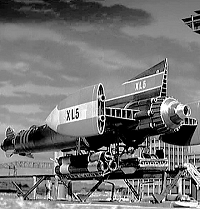 Last time we watched friend Em make a six light-year trip to planet Noether while friend Al stays home on Earth working on Theories. It turns out that Al ages 27 years while Em ages only 23 (point 8). This is not due to special diet, but to Special Relativity slowing Em’s clock on account of her fast motion through space.
We also saw that once Em stops at Noether, this breaks the symmetry of the two valid points of view regarding their motion (Em and ship are moving vs Al, Earth, and space, are moving).
Today we examine the trip before that point, while it is symmetrical.
Continue reading
5 Comments | tags: Albert Einstein, Emmy Noether, length contraction, light, light speed, light year, space-time, Special Relativity, time, time dilation, time-space diagram, Twins Paradox | posted in Physics
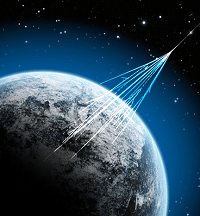 We’ve covered a great deal of ground in the last four weeks. (Writing a series of posts this long is a new experience for me! I hope you’re getting something out of it, too.) We’ve learned that motion, velocity, simultaneity, and length, are all relative to your frame of reference — motion changes your perception of these things. This week we’ll see that time is also relative — motion changes that, too!
So far, we only needed a (very imaginary) train to demonstrate the effects of Special Relativity. An Earthly frame of reference was enough to illustrate how motion affects velocity, simultaneity, and length.
But when it comes to time, we’re gonna need spaceships!
Continue reading
51 Comments | tags: Albert Einstein, cosmic rays, Emmy Noether, length contraction, light speed, light year, muon, space-time, Special Relativity, time, time dilation, time-space diagram, Twins Paradox | posted in Physics
 Last time I focused on how it was possible for Al to see — even enclose in a tunnel — a train that appears shorter to him due to its motion. It turns out that the train Al sees is a stack of time slices of the train at different moments. As we’ve seen, lots of things look different in a moving frame.
Today I want to say a little about Em’s point of view, run some numbers, and take you through a little math (just one equation, I promise). Then, because it’s Friday (when I try to write about light), I’ll introduce you to light cones.
They’re not actually necessary, but they’re kinda cool.
Continue reading
4 Comments | tags: 2D, 3D, gamma factor, gamma term, light, light cone, light speed, line of simultaneity, plane of simultaneity, simultaneity, simultaneous events, space-time, Special Relativity, surface of simultaneity, time-space diagram | posted in Physics
 Last time’s Too Long Train illustration demonstrates that length is relative. Observers moving at different rates measure the length of an object differently. The faster something moves in your frame of reference, the more its length contracts along the direction of motion.
In previous weeks we saw that motion, speed, and simultaneity, are relative; now we see that length is also relative. Next week I’ll talk about the relativity of time. Today I want to dig a little deeper into the length contraction part of Special Relativity.
It’ll be a factor when we get to the spaceships!
Continue reading
4 Comments | tags: length contraction, light speed, line of simultaneity, simultaneity, space-time, space-time event, Special Relativity, surface of simultaneity | posted in Physics
 The last two train examples (Lightning Strikes and Treaty Train) focused on how simultaneity is relative to motion. Our final train example focuses on how length is relative to motion. The faster something goes relative to you, the more it appears foreshortened along its direction of travel.
This example involves a train that, if it stopped halfway through, is too long for a tunnel — it would stick out both ends. But motion contracts length, so if the train goes fast enough, it becomes short enough to fit entirely inside the tunnel.
And it’s not an illusion; the train really does fit inside!
Continue reading
6 Comments | tags: foreshortening, length contraction, line of simultaneity, simultaneity, simultaneous events, Special Relativity, surface of simultaneity, trains, tunnels | posted in Physics
 Last time we explored the Simultaneous Lightning Strikes illustration of Special Relativity. In that scenario, on-the-ground observer Al sees simultaneous lightning strikes to a passing (very) high-speed train. On-the-train observer Em agrees both bolts hit the train (one front; one rear) but sees one happening first followed by the other.
The next scenario reverses the situation. This time traveler Em sees simultaneous events on the train and bystander Al sees them happening one after the other.
Today we explore: Peace Treaty (on a Train)!
Continue reading
6 Comments | tags: line of simultaneity, simultaneity, simultaneous events, space-time, space-time event, Special Relativity, time-space diagram, trains | posted in Physics
 For the last three weeks I’ve been laying a firm groundwork for the more interesting part of the series. Perhaps there was too much time and detail: I seem to have lost much of my audience (not that the lecture hall was packed in the first place).
I’ve long believed in the importance of basic knowledge — it’s stood me in good stead through life. But I know not everyone shares my appetite for details. For what it’s worth, the rest is the fun part, where all that groundwork goes into action.
This week, trains; next week, spaceships!
Continue reading
4 Comments | tags: relativistic speed, simultaneity, simultaneous events, space-time, Special Relativity, time-space diagram, trains | posted in Physics
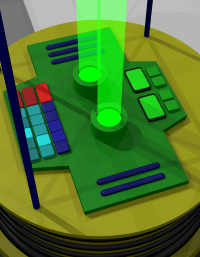 The main topic this week was how simultaneity is relative to your frame of reference. How there are (virtual) lines of simultaneity where all points on some line — at all distances from you — share the same moment in time. For any instant you pick, that instant — that snapshot — includes all points in your space.
A line of simultaneity freezes the relative positions of objects at a given moment — which enables distance measurements. Simple example: When their watches both read 12 noon, Al and Em were 30 miles apart. A more mathematical example uses x, y, & z (& t), but it amounts to the same thing: a coordinate system.
The gotcha is that simultaneity and coordinate systems are relative when motion is involved!
Continue reading
5 Comments | tags: 1D, 2D, 3D, Albert Einstein, Emmy Noether, frame of reference, Galilean invariance, light, light clock, light cone, light speed, line of simultaneity, simultaneity, simultaneous events, space-time, Special Relativity, surface of simultaneity, time-space | posted in Physics
 We started by exploring the idea that motion is relative. Now we see that the idea of simultaneity is relative! Events that Al sees as simultaneous in his frame of reference do not appear simultaneous to Em — she sees them happening one after another!
A frame of reference has lines of simultaneity that allow us to assign time coordinates to events in the reference frame. If Al and Em have different lines of simultaneity, then their coordinate systems differ— they assign different coordinates to an event!
Let’s explore that in a bit more detail…
Continue reading
Leave a comment | tags: simultaneity, simultaneous events, space-time, space-time event, Special Relativity, time-space diagram | posted in Physics
 Last time our friend Al used lasers and timers to create a regular grid-like map of the space and time near him. The map allowed him to assign space-time coordinates to events in his frame of reference (even if it takes time for him to see light from those events).
An important concept is the idea of simultaneity — of events in different locations happening at the same moment according to some observer (who has to wait for the event’s light to reach their eye).
So far the events weren’t moving relative to us. What if we — or the events, same thing — are moving (and moving fast)? It turns out, this changes the picture!
Continue reading
1 Comment | tags: frame of reference, line of simultaneity, simultaneity, simultaneous events, space-time, space-time event, Special Relativity, surface of simultaneity, time-space, time-space diagram | posted in Physics






 Logos con carne