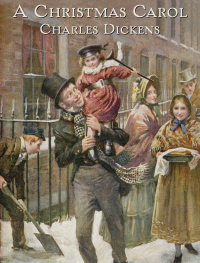
 I have written many times here about the wonderful Charles Dickens story, A Christmas Carol (1843). I wrote the first post back in December of 2012 when this blog was less than two years old. The most recent was ten years later, in December of 2022.
December, of course, because Christmas. Every year I watch as many adaptations as I can find (and I read the Dickens novella). It’s one of my favorite stories: it’s small and personal; it centers on a redemption arc; it has a classic happy ending; and it has ghosts.
This year I was struck by how it’s a powerful example of our cultural normative social values — something expressed throughout human literature.
Let me begin as Dickens began by quoting his Preface:
I HAVE endeavoured in this Ghostly little book, to raise the Ghost of an Idea, which shall not put my readers out of humour with themselves, with each other, with the season, or with me. May it haunt their houses pleasantly, and no one wish to lay it.
Their faithful Friend and Servant,
C. D.
December, 1843.
It brilliantly sets the tone as both whimsical and fantastical. Beyond the light tone, there is for modern readers a small unintended smile brought on by the juxtaposition between the old phrase “lay a ghost” and the 1970s slang “getting laid”. (With ghosts, one is laying them to rest.) Regardless, Dickens’ little Ghost of an Idea has captured our hearts ever since.
The humor (or humour) continues in the first two paragraphs:
Marley was dead: to begin with. There is no doubt whatever about that. The register of his burial was signed by the clergyman, the clerk, the undertaker, and the chief mourner. Scrooge signed it: and Scrooge’s name was good upon ’Change, for anything he chose to put his hand to. Old Marley was as dead as a door-nail.
Mind! I don’t mean to say that I know, of my own knowledge, what there is particularly dead about a door-nail. I might have been inclined, myself, to regard a coffin-nail as the deadest piece of ironmongery in the trade. But the wisdom of our ancestors is in the simile; and my unhallowed hands shall not disturb it, or the Country’s done for. You will therefore permit me to repeat, emphatically, that Marley was as dead as a door-nail.
Which never fails to make me grin. And to mentally salivate over the tasty meal that I’m about to enjoy.
The next two paragraphs start building a frame for the story:
Scrooge knew he was dead? Of course he did. How could it be otherwise? Scrooge and he were partners for I don’t know how many years. Scrooge was his sole executor, his sole administrator, his sole assign, his sole residuary legatee, his sole friend, and sole mourner. And even Scrooge was not so dreadfully cut up by the sad event, but that he was an excellent man of business on the very day of the funeral, and solemnised it with an undoubted bargain.
The mention of Marley’s funeral brings me back to the point I started from. There is no doubt that Marley was dead. This must be distinctly understood, or nothing wonderful can come of the story I am going to relate. If we were not perfectly convinced that Hamlet’s Father died before the play began, there would be nothing more remarkable in his taking a stroll at night, in an easterly wind, upon his own ramparts, than there would be in any other middle-aged gentleman rashly turning out after dark in a breezy spot—say Saint Paul’s Churchyard for instance—literally to astonish his son’s weak mind.
Dickens brings us much in four paragraphs. We already have some sense of Scrooge. In the next seven paragraphs, Dickens tells us more about him and his situation.
Then the nephew enters Scrooge’s place of business and the plot begins.
§
I have some notes about the four adaptations I watched this year along with some general observations about why A Christmas Carol shares an interesting trait with Sherlock Holmes, but first a few words about social values. Which is appropriate because we find them in Dickens.
And more to the point here, throughout our amassed body of literature.
Human recorded history goes back about 5,000 years. Over that time humanity has written many stories — true and fictional — about what it is like to be human. In particular, we produced parables, from bible stories to fairy tales to adult fictions, that describe cultural norms.
The book All I Really Need to Know I Learned in Kindergarten (1986), by Robert Fulgham, makes the point that we are given these moral lessons early and often by parents, schools, and (for many) churches. An important note: while individuals vary in their moral approaches, there is — especially over history — a heavily weighted average that forms a clear social moral compass.
This moral compass — this general historical human view of what it means to be moral — is probably the closest we can come to an absolute morality.
Humanity has learned many lessons over the eons. Among them lessons about right and wrong — not based on celestial edicts, but on the simple history of ‘A’ leading to ‘B’. Our accumulated social cause-and-effect. Our derived moral physics. As many have pointed out, it boils down to the Golden Rule.
Morality is essentially the recognition of the sovereignty and parity of others.
Science fiction writer Spider Robinson, as with many if not most writers, often has clear moral beats in his stories. I especially like this one:
“Kind is better than cruel — I’m sure of that. Loose is better than rigid. Love is better than indifference. So is hate. Laughing is the best. Not laughing will kill you. Alone is okay. Not alone is way better. That’s about it … ”
~Spider Robinson, Very Bad Deaths
And that is about it. Morality is trying very hard to not be an asshole.
Which brings me to the current sociopolitical situation and my point. Which is that you cannot align yourself with the current POTUS and call yourself a moral person. History contradicts you.
There is a meme that I think sums it correctly:
If you support this man, I won’t judge you for your choice of political parties. I will judge you for your lack of morals, ethics, and humanity.
So will others.
So will history.
The historical moral compass is clear in this case, whether based on traditional American values or traditional Christian values. The current administration is far abeam of either. It is by any moral standard a corrupt and amoral regime. It’s based on greed and grievance, bitterness and disgruntlement, selfishness and hatred.
As the meme above says, if you support this man, you are making a choice that speaks volumes about your character and morals. To be blunt, if you still support this man after all he’s said and done, I think there is something very wrong with you and want nothing to do with you.
§
As a segue back to A Christmas Carol, I was thinking about how, with its myriad adaptations, some close, some not, the story is like Sherlock Holmes in being diffuse and no longer well-defined.
Back in 2019 (in December), I wrote about how the Sherlock Holmes canon has superposed upon it all the adaptations ever made of it. Some are faithful to the source; some are jazz riffs or “loosely based on” or “inspired by” the Dickens text. In that post, I mentioned in passing A Christmas Carol because it, too, has myriad adaptations overlaying it.
That post was about the fuzzy image of Holmes, but it only recently occurred to me that it makes an interesting quantum analogy. Compare the vaguely defined Holmes with something like Mount Rushmore or the Statue of Liberty. These are well-defined and though you may have seen various replicas or images, chances are the mental images you have of these famous monuments is sharp and clear.
In contrast to the fuzzy, vague Holmes (or Scrooge or the ghosts in A Christmas Carol). My mental image of Sherlock combines Basil Rathbone, Benedict Cumberbatch, Jonny Lee Miller, Frank Langella, and many others (Wikipedia says Holmes has appeared onscreen 254 times — and many more times on stage or in radio plays — making him the world’s most portrayed fictional character.)
So, compare the sharp and clear image of Mount Rushmore or the Statue of Liberty with the fuzzy and vague image of Holmes or Scrooge or the ghosts. The former is an analog for the unambiguous classical physics world; the latter is an analog for the ambiguous “revealed only when looked at” quantum physics world.
Holmes and Scrooge have “wavefunctions” that have spread out and become indefinite, whereas Mount Rushmore and the Statue of Liberty are “collapsed” in our minds and definite.
Kind of a nice analogy, I thought.
§
Some notes on the four adaptations I watched this year:
Firstly, I found the story especially poignant this year in light of the social and political situation. We have, objectively speaking, wandered far from our traditional values as espoused in our major political documents, established laws and various professional ethics, and supposed Christian values (it is, after all, on our money). Or as espoused in stories such as this one.
Many have lost their moral compass of late, so it was almost overwhelming seeing a story based on core moral values we have followed for so long. The contrast between those values and our current lack of them was stark and dismaying.
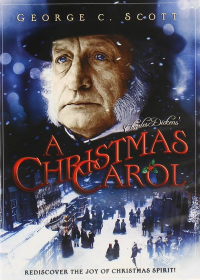 I started with the George C. Scott version (1984). I’ve long considered one of the better versions, but among those better versions it doesn’t rank all that high.
As I’ve said before, Scott makes a good grumpy Scrooge but somehow doesn’t quite pull off his redemption joy.
One of the small beats I look for (and generally don’t see in adaptations) is the view Marley shows Scrooge out his bedroom window:
The air was filled with phantoms, wandering hither and thither in restless haste, and moaning as they went. Every one of them wore chains like Marley’s Ghost; some few (they might be guilty governments) were linked together; none were free. Many had been personally known to Scrooge in their lives. He had been quite familiar with one old ghost, in a white waistcoat, with a monstrous iron safe attached to its ankle, who cried piteously at being unable to assist a wretched woman with an infant, whom it saw below, upon a door-step. The misery with them all was, clearly, that they sought to interfere, for good, in human matters, and had lost the power for ever.
On the other hand, it does have the bit with Old Joe (the fence) as well as what I see as a central bit, the children of Ignorance and Want. Many adaptations ignore one or both of these. The Scott adaptation has them both.
§
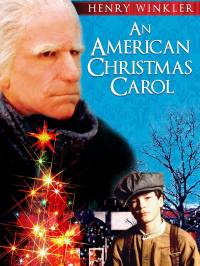 Then I watched the Henry Winkler version, An American Christmas Carol (1979). It’s about what you’d expect with The Fonz starring as Scrooge.
This adaptation plays fast and loose with the story — essentially creating a new story. Winkler plays Benedict Slade the over-the-top miserly businessman. His cowled assistant is Thatcher. The time is Christmas Eve, 1933, in New England.
Slade is out with an unwilling Thatcher reclaiming people’s possessions from unpaid loans (the whole town is struggling). Then there are spiritual repercussions.
One cute note: among the things he repossesses are a collection of rare old books — Slade takes them only because their leather bindings might return a few dollars. One of the choice items in that collection is a signed first edition of A Christmas Carol by Charles Dickens.
It plays like a Hallmark movie: simplistic and without nuance; heavy handed. Sometimes a story is said to have been “painted with a fine brush”. This was painted with a roller. By the end, I was waiting for it to be over.
§
 Next, I watched a colorized version of Scrooge (1935), with Seymour Hicks as Scrooge. Hicks also starred in a 1913 film version as well as touring with a stage version in the late 1800s and early 1900s.
He’s an experienced Scrooge and very good in the role. This is one of the better cinematic adaptations, though it suffers from poor image quality despite the restoration.
Marley’s ghost in this is invisible to us; only Scrooge sees him. Special effects at the time didn’t really exist. The Ghost of Christmas Present is an actor, and the other two are done with shadows and light effects. All-in-all a good lesson on why special effects can add to a story but can never comprise it.
One reason this is a favorite is that it is so faithful to the source text. Much of the dialog is from the book. This version also sharpens the social commentary by cutting between the Mayor of London’s sumptuous feast and the starving cold poor outside. In many ways, it’s the heart of Dickens’ tale.
§
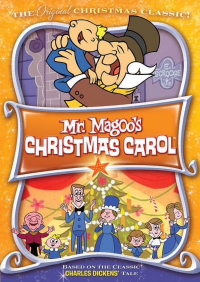 Lastly, the version that was my gateway to the story, the 1962 animated version, Mister Magoo’s Christmas Carol.
It’s framed as a play within a play. Mr. Magoo is an actor playing Scrooge in a stage production on Broadway in New York.
Long ago, as a child, this hour-long animated feature introduced me to the Dickens tale. My heart was captivated and captured. To this very day.
What with one thing and another, I started my annual A Christmas Carol marathon on Christmas Day this year feeling it was a bit pro forma. I’ve watched these all so many times and now there’s a vague sense of obligation — not a good frame of mind for seeing old friends.
Yet within moments I was swept away and had a wonderful evening.
The Magoo version is musical. There are at least six separate songs plus a few reprisals later. Even so, it manages to be one of the more accurate adaptations. Lot of the Dickens dialog straight from the book.
A worthy adaptation if a bit goofy in places. It has the Ghost of Christas Present show up first with the Ghost of Christmas Past coming second. Weird, but it works okay.
I bought it from Amazon a couple of years ago, so can watch it every year now. I used to have to try to find it on YouTube, so it usually had commercials and was soon deleted because copyright. Definitely a bit goofy, but with a lot of old-fashioned charm (and values).
§ §
“And so, as Tiny Tim observed, God bless Us, Every One!”
Stay Dickensian, my friends! Go forth and spread beauty and light.
∇






 Logos con carne
December 28th, 2025 at 5:46 pm
Another favorite bit:
“A small matter,” said the Ghost, “to make these silly folks so full of gratitude.”
“Small!” echoed Scrooge.
The Spirit signed to him to listen to the two apprentices, who were pouring out their hearts in praise of Fezziwig: and when he had done so, said,
“Why! Is it not? He has spent but a few pounds of your mortal money: three or four perhaps. Is that so much that he deserves this praise?”
“It isn’t that,” said Scrooge, heated by the remark, and speaking unconsciously like his former, not his latter, self. “It isn’t that, Spirit. He has the power to render us happy or unhappy; to make our service light or burdensome; a pleasure or a toil. Say that his power lies in words and looks; in things so slight and insignificant that it is impossible to add and count ’em up: what then? The happiness he gives, is quite as great as if it cost a fortune.”
December 29th, 2025 at 8:03 am
It’s been a long time since I read A Christmas Carol. I didn’t remember how much Dickens makes the narrator itself a character. Interesting. It reminds me how rigid many of our current literary forms can be today.
I’m pretty sure Dickens would have a field day with our current president and government. Imagine how many Oliver Twist type stories are playing out today, waiting for a modern day Dickens to dramatize.
December 29th, 2025 at 8:52 am
Heh, indeed. I imagine Dickens would be appalled by the arc of history the last four decades or so. Or maybe not, since when it comes to humans there isn’t much new under the Sun. I suppose his main emotion would be sorrow at our lack of progress and recent backsliding.
Yeah, the narrator (Dickens, I assume) opens the piece, ends the piece, and steps in at various times. I’m impressed by the writing every year when I read it. Sometimes I feel I’d like to write a whole series of posts dissecting the entire text bit by bit.
I think it’s easy to slide from “rules of thumb” to just plain iron-clad rules. Narration is “bad” because it tells rather than shows, so it becomes a rule to never narrate. But there are times when it not only works but works better than trying to show. Imagine that first Star Wars film without that opening crawl narrative.
December 29th, 2025 at 10:29 am
Dissecting the text of any Dickens novel would be an interesting series!
On the whole show-don’t-tell thing, yeah. Modern writing advice is you should construct the story like it’s a play or movie, with everything happening in discrete scenes as much as possible. But as you note, even movies don’t always stick to that.
And books are their own thing. Sometimes it helps to just have a narrative summary things if it’s all just routine stuff. Save the scenes for where there’s conflict, or at least something interesting to show.
BTW, started reading Alastair Reynold’s “Pushing Ice” which I’d somehow overlooked until now. I’m feeling that too much detail thing again, wishing he’d just give us summaries in places. But at least the premise is interesting.
December 29th, 2025 at 10:52 am
A lot of modern writing does read like a screenplay to me. We’ve touched on that with Asher, Banks, and Reynolds before. Sometimes it feels as if I can hear a future director yell “Cut!” at the end of those scenes.
Art is interesting to me because sometimes really good art comes from breaking the supposed rules, venturing outside the boundaries. OTOH, I found a lot of that experimental SF writing in the 1970s and 1980s unreadable. I think there are likely good reasons humanity settled on narrative forms. They work for us.
I’ve had Reynolds’s Blue Remembered Earth trilogy in my “Possibles” queue for a while but haven’t been inspired to check it out. I do have on hold at my library his new book, Halcyon Years. Wait is “Several Months”, though. I’ve had Asher’s Gridlinked on hold since last August — down to four weeks now. I decided not to read any more Cormac books until I read Gridlinked.
December 29th, 2025 at 12:56 pm
Definitely experimentation in storytelling is always risky. Although for alternatives to the current forms, there are plenty of examples in older fiction to show what does work. (An example is Dickens’ narrator with a personality, which Tolkien also uses in The Hobbit.) It doesn’t seem like someone trying these styles is taking nearly as big a risk as writing their whole book in second person, a narrow stream of consciousness, or reverse chronology.
I found the Blue Remembered Earth trilogy entertaining, particularly the second book, but it skips generations/centuries between the books, and the stories are only loosely related. And, assuming I’m not mixing up my stories, I think IIT (the theory of consciousness) is a minor plot point in the third book. I have Halcyon Years pre-ordered. He also has another one in the pipeline I’ll be interested to see, an expansion of his Merlin novellas. I only read one, but recall it being pretty good.
December 29th, 2025 at 6:08 pm
I suppose it’s true that all art is risky in a way that offering products or services isn’t. More dependent on public perception and taste. What works on one era falls flat in another. Plus, art is technically a luxury (though I don’t know how I’d survive without books).
If you have Halcyon Years on order, I assume it’s not out yet. That may account for the “Several Months” wait time even though I’m 13th in line for the single ebook copy the library ordered. In contrast, I put in a hold for Invincible, Compendium Three back in June, that’s been “Several Months” ever since, and I’m 65th in line (started 117th) with two copies in play. And now that I look closely, I see with the Reynolds book it says “You are 13th in line, 1 copy ordered. 1 person waiting,” compared to the text “2 copies in use” for the comic.
Your mention of IIT reminded me of an old short story that had it as a central plot point. Long before the term was coined, of course, but the basic idea about network complexity isn’t new. The SS was about the (old landline) telephone network coming to awareness due to its complexity. IIRC and, as you say, aren’t mixing up stories, the last line was something like, “Suddenly everywhere the phones began to ring.”
December 29th, 2025 at 7:04 pm
There are definitely some things from older books you can’t copy, but I think they’re mostly around cultural mores, such as gender roles and race attitudes. I think a lot of what makes a good tale still holds. But definitely you can’t control how people react.
Amazon lists Jan 27 for Halcyon Years. Which will be convenient since Iain Banks’ Excession comes out on Jan 20. (Unless they delay again.) And Feersum Endjinn on Feb 17. Stuff to look forward to.
I think I’d find 117th in line pretty discouraging. So it took six months to get down to 65, so likely a year overall? I guess I could live with that as long as there’s other stuff to read. And at least they have a queue.
IIT, if I remember right, isn’t mentioned in that book by name. Reynolds just uses a feature of it at a certain point in the story for a story element.
December 30th, 2025 at 9:07 am
Heh, yeah, true point. We might copy styles and forms, but social mores are a different matter. There are a number of early 20th century (or even late 19th century) British murder mystery authors I like (Agatha Christie foremost), but every once in while reading them I stumble over a jarring reference to the common prejudices of the time.
I wonder how fast my turn at Halcyon Years will come around after Jan 27. I’m not quite sure how to parse “13th in line” in the context of “1 person waiting”, especially given “1 copy ordered”. My guess is that I’m 13th in line with just one person after me? But I’m not sure why they’d tell me about how many are after me in line. I like the Libby library app, but it has its peculiarities.
I don’t really like the Invincible comic that much (and the Amazon adaptation even less), so I don’t care that much about the wait time. And as you suggest, I have plenty else to read. I liked Invincible at first, edgy and different, but I found it got old fast and, like so much else these days, is just too infantile for me. I finally got around to seeing the second reboot Star Trek movie, the one with Cumberbatch as Khan. I was struck by the infantilism of #notmykirk and #wtfspock (and the Spock/Uhura thing is beyond absurd). Our culture has become severely infantilized.
On the flip side, really loathed the adaptation of Resident Alien but the comic turned out to be excellent.
I’m sure you’ve seen me say before that IIT seems like part of the picture, but I’m not persuaded it’s the whole story.
December 30th, 2025 at 2:08 pm
Your point about old murder mysteries reminds me of the books I read off of Gutenberg. For copyright reasons, these are usually the original edition books, not the later ones you might have picked up in a bookstore, revised for modern sensibilities. “Jarring” is the right word.
Have to admit I don’t know much about Invincible. Never watched the show. The description sounds like a superhero thing, which I’m surprised you’re interested in. (I’ll watch superhero movies myself, but can’t generate any enthusiasm for the source material anymore.)
Yeah, the J.J. Abrams Star Trek movies. I enjoyed the first one well enough. The second was ok as popcorn entertainment, although I thought bringing back Kahn was lame. And Abrams’ entire schtick seemed to be having the characters do what they never would have in the original series. Really for the best that that film series is dead.
Never even knew there was a Resident Evil comic. Hmmm.
On IIT, right. I have very little credence in it myself.
December 30th, 2025 at 4:09 pm
I’m more tolerant of animated superhero shows than live-action ones, but you’re right I don’t have much interest in the usual fare (in any medium). I’ve long had, and still have, a taste for the unusual ones. The Umbrella Academy is a good example, and odd for me because I like the live-action Netflix adaptation better than the graphic novel.
Invincible seemed like another usual take, and it is to some extent, but it’s a path that’s well-trodden now. I doubt it began with Stormwatch and The Authority, but that’s where I first experienced comics about what superheroes — assuming human emotions — would really be like. How would you behave if no one could stop you? The movie Hancock played that theme. I bailed only a couple of episodes into The Boys, but it’s along the same vector. Invincible turned out to be disappointing. I posted about it back in 2021 — it didn’t earn enough space for its own post.
I’m sure you’re right about Abrams. He never was a Trek fan growing up.
I checked Wikipedia and wasn’t at all surprised to see there are indeed Resident Evil comic books. (I would have bet money there must be.) I meant the Resident Alien comic book series and its live-action adaptation (which stars Alan Tudyk). I posted about it in 2024.
The Resident Evil movies have been a guilty pleasure since the first one came out. Especially the ones with Ali Larter; she’s caught my eye since Heroes (which wasn’t bad; another unusual take on superheros).
December 30th, 2025 at 6:38 pm
Ah, Resident Alien. Thanks. Wasn’t paying attention. I think I might have seen part of one episode of that show. Obviously it didn’t draw me in. Not my thing. The fact that it was on SyFy at the time probably didn’t help. I had no idea it was based on a comic.
Doesn’t surprise me a bit that they massively changed the source material. I remember the James SA Corey team admitting they had to defend that The Expanse would only work in space. Apparently there was a push to cheapen to an Earth based show.
The Resident Evil movies were pretty good popcorn entertainment. It did feel like they could have been developed into something better but they were always okay for what the were. The music and choreography were always excellent. I haven’t seen the reboot one. I’m guessing since there’s another reboot coming out, the first one wasn’t good. Not that any of these movies did great with critics.
December 31st, 2025 at 9:51 am
I like Alan Tudyk, so I gave it a shot. Per my shit-covered raisin theory (SCRT?) these were especially shitty raisins, especially once I read the comic. I checked last night, and the third season is on Netflix now, and I’m torn on whether to watch it. I recall having almost no interest in the show by the end of the second season. OTOH, I have that nagging “clean plate” ethic that makes me want to finish what I start. (The older I get the more I’m able to fight that off, but it’s still a motivating force for me. A really irritating one sometimes.)
As I think you know, when it comes to adaptations that identify with their source, especially if the time span between source and adaptation is small, that on my three axes of adaptation (changes, deletions, additions) it’s the additions that I usually have the worst time with. To me they often indicate a narcissism by the adaptor, a presumption they can tell a better story (while stealing someone else’s). From I’ve seen (and granted I have a high bar), most of them are wrong in this presumption. Some egregiously so.
But The Expanse … on Earth? That boggles the mind even for Hollywood these days. (And yet, on some level, it doesn’t surprise me at all. But, OMG!)
The Resident Evil franchise is apparently a big one, but I’ve only ever been interested in the Paul W.S. Anderson films with Milla Jovovich (and often Ali Larter). As you say, popcorn movies, even guilty pleasures in that they’re basically “kickass chicks with guns” movies. But of their kind, they’re finestkind, and I’ve always enjoyed them. The first one is probably the most interesting, the next few are okay, but they start to get a bit silly in the last couple. The last one with Jovovich pretty much filled my quota.