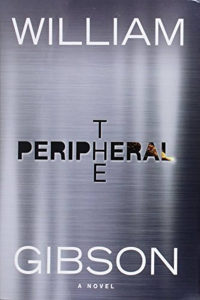
 I have a great deal of respect for science fiction author William Gibson and what he contributed to the art but can’t honestly say I love his writing. Gibson and Bruce Sterling are widely viewed as the fathers of cyberpunk (hence the respect), but I find their writing sometimes opaque and challenging (though maybe that’s on me).
In recent years I’ve been revisiting both authors — rereading the few stories I have read and checking out many I never did. It hasn’t moved the needle that much for me, though. Still don’t find them highly engaging.
Which brings us to The Peripheral and its Amazon Prime adaptation.
The novel, Gibson’s second-most recent full-length work, was published in 2014. It’s the first of a trilogy. The second novel, Agency, was published six years later, in 2020 (and is his most recent full-length work). The six-year span suggests the third one, Jackpot, will come out in 2026.
Amazon video released their adaptation late in 2021. It was renewed for a second season, but the 2023 actors’ and writers’ strikes cancelled it.
I’m 77% through the novel according to the Libby app, and I’m four episodes into the adaptation — exactly halfway through the eight-episode first season.
I’m enjoying the novel though, as usual, don’t find Gibson as engaging as I’d hope for. Can’t put my finger on it; something about his writing (more so Sterling’s — see Sterling: The Caryatids). As a contrasting example, I’ve read some Neal Asher lately and found it thoroughly enjoyable.
If I’m honest this probably is more me being a shallow reader seeking escape, and good characters — enjoyment — rather than someone interested in the literary value or authorial skill. I see a tension between style and what my high school English teacher called transparency.
I’ll take transparency every time.

The Peripheral (2022; season one; eight episodes)
That said, when I am in the mood for a chewier read, Gibson does deliver (my jury is still out on Sterling, but my sense is he’s a bit too erudite and eclectic for shallow me). I wrote back in 2021 about how much I enjoyed re-reading Neuromancer (1984) and — for the first time — reading its sequels.
Make no mistake, The Peripheral is good. It is rightly praised as a return to Gibson’s older more science fiction-y style of writing. I won’t describe it here. In part because spoilers, in part because the novel’s Wiki page gives you as much of the plot as you care to read. Plus, I haven’t finished the novel or adaptation yet.
Very briefly, the plot involves a near future interacting with a more distant future. Not by time travel but by exchanging data. The story follows Flynne Fisher (Chloë Grace Moretz in the adaptation) in the near future and Wilf Netherton (Gary Carr) in the far future. (“Far” in this case being 70 years.)
In the far future, a peripheral is a biological body driven by a remote mind. They’re used as telepresence devices and run on Ai when not occupied. Flynne uses one to visit her apparent future.
While I’m enjoying the novel, the Amazon Video adaptation much less so. For the usual reasons: lame writing and, in this case, a complete reconstruction of the plot. Gibson’s original plot is nowhere in sight. The characters and general setup are taken from the novel but applied to a different story. Even some characters have been altered. A key one is missing completely.

Flynne Fisher (Chloë Grace Moretz) wearing the future-tech headset that links her to her peripheral in the future. In the story, “builder” technology (3D printing) is advanced. Her headset is built based on plans sent from the future.
It’s not a good sign when I’m driven to start taking notes in the first episode.
It is quickly apparent Gibson’s story is replaced with the usual bland content — bland despite plenty of conflict, fighting, and action because we’ve seen it all before. Over and over. Not just bland, but simplistic cliched pop pap for mass consumption.
One good example is Corbell Pickett (Louis Herthum), the over-the-top Bad Guy Boss in the near future. Seriously over the top. The kind of cartoon BGB who verbally, and sometimes physically, abuses his inexplicably loyal (but incredibly dumb and incompetent) minions. He’s a cliche that’s beyond tired and worn out; he’s absurd.
[And, yes, I’m aware our POTUS is probably just as cartoonishly bad, but it’s another example of how real life doesn’t always make believable fiction. Comedians despair because how can you satirize something that’s such a self-parody of humanity?]
Flynne’s brother, Burton (Jack Reynor), suffers from brain trauma caused by cybernetic implants from his time with the U.S. Marines. In the novel, it sounds somewhat akin to a palsy or physical Tourette’s — uncontrolled body movements. In the adaptation, we see one scene of somewhat picturesque silent pain inadvertently seen by Flynne and used to restore the sympathy she lost in a previous scene. Not really a part of the character; just a plot device.
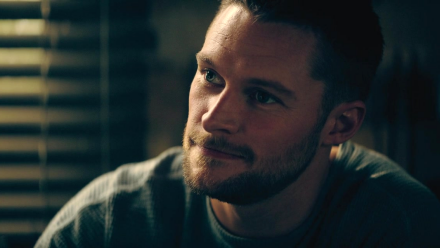
Flynne’s brother Burton Fisher (Jack Reynor), a former elite squad U.S. Marine. He suffers brain trauma from the “haptics” cybernetics unit installed to make him a highly specialized soldier.
While Burton’s affliction is prettified for TV, there is considerable brutalism and threat. Plenty of double-dealing, conflict, gun fights, and nasty baddies. It all seems so simple-minded. Infantile, even.
The dialog, oh, dear, the dialog. Clunky, especially during exposition dumps (some of which were excruciating). It’s an interesting contrast to Gibson’s way with dialog. His characters speak like people speak. We don’t provide exposition in known contexts and neither do Gibson’s characters. Which is part of what can make him a challenge to read.
Science fiction has always played the game of keeping the reader in the dark until later. It builds a reality in our minds with holes to be filled in later. A bit like building a jigsaw puzzle.
But modern screenwriting — intentionally I’m given to understand — exposits in big fat chunks because so many put TV in the background and don’t pay much attention. So, everything needs to be spelled out. Sometimes repeatedly.
That thing with the eye surgery was horrific. Why did Flynne need to be in the peripheral and endure it? Aelita West (Charlotte Riley) says it’s important, but it’s never explained why. It’s merely body horror for the viewers. More importantly, given the technology of the “far” future, why was it even necessary? Given that same technology, why a retina scanner that is so easily fooled? The plot point makes no sense — it’s purely a visual “icon” (a cliche or trope).
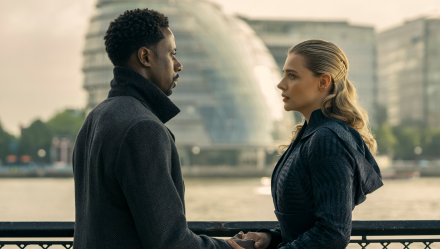
Flynne, inhabiting her peripheral, having a “face-to-face” conversation with Wilf Netherton (Gary Carr) in the far future. He visits her in his past using a more conventional telepresence device.
Quickly edited closeups in fight scenes because none of the actors has the background or training. But we need fight scenes.
It makes the gun fights rather dumb. John Wick this ain’t. There’s no sense of the geography of what’s happening. Just quick shots of people shooting or running around. Good gun fights are well choreographed. Another cliche: the last-minute save by Connor Penske (Eli Goree).
In the novel, Flynne first inhabits a drone to visit the future. Later a peripheral is found for her. They’re expensive and not common (people rent them for telecommuting). In the adaptation, Flynne first appears in a life-like robot and later in a custom-built peripheral that looks exactly like her (in the book, they find one that sort of resembles her). Early on, Flynne — at this point still thinking she’s only inhabiting a sophisticated new simulation she and Burton have been hired to test — discovers she’s in a robot’s body only when a violent fight rips the skin from her hand revealing the underlying mechanism.
Which surprises her because why bother to simulate a robot under a human appearance? It’s a sim, so why not just simulate the human? It’s an early clue that more is going on. But the point is, if they can provide such an accurate robot body, what’s the point of the peripheral? It provides Flynne with more physical feedback, but she seemed fine operating the robot. We’re not shown it making any real difference.
My point is that it’s dumb, and as with most departures from Gibson’s story, it didn’t need to be like that. I’ve said many times that, among the three aspects of adapting something — removing, changing, adding — it’s the last one that usually bothers me most. Given the necessity of removing text, I’ve never understood adding new material. Which, from what I’ve seen, almost always departs for the original intent.
The whole point of an adaptation, one would think, is that it’s a chance to see the author’s text brought to life. But if the adaptation is such a major revision of that text, why bother associating it with the original? Seems like a setup for failure — disappointment from those who loved the text — presumably the very ones an adaptation is trying to attract.
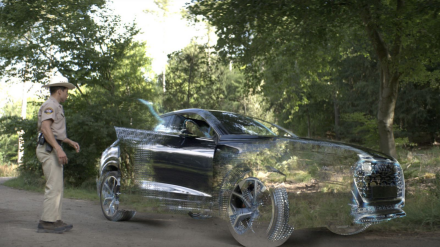
Sherrif Tommy Constantine (Alex Hernandez) confronting cloaking technology sent from the far future to aid the killers after the Fishers. There’s a bit of an attraction thing between Tommy and Flynne.
We need a better approach to adaptations. We need to be able to say Inspired By or even Loosely Inspired By and be okay with that. Too many adaptations have been disappointing. Few bring anything of value to their originals.
Burying all those bodies so close to the house. Ugh. They have all that land, so why do it right outside? Because it made a cool camera shot from inside the kitchen. Dumb.
Another cliche. Flynne wakes to hear noise in the kitchen. She carefully sneaks in there, but it’s just mom. The medicine sent from the future has cured her tumor, she can see again, and she was so hungry the first thing she decided to do with her amazing new health was make a sandwich. In the dark.
I knew what was going on the moment Flynne woke up. She’d given mom the medicine the day before and was unhappy it wasn’t an instant miracle cure. Then she learned from the future people that it might not even work. But it obviously has to, so it’s just waiting for the shoe to drop.
Yet another cliche: the fast-typing hacker. A visual icon we see over and over and over (saw it a lot on NCIS, to name one, but it’s everywhere). Because it looks cool on film.

While they can apparently make life-like robots, the general “servant” bots look like this. The face has display capabilities that allow it to show projected faces if representing someone.
In the novel, Gibson makes it clear the dystopic far future is due to humanity wrecking their environment. In the adaptation, our downfall is blamed on having the grid hacked, a pandemic, the failure of antibiotics, and domestic terrorism. Mostly not us, as such, though.
I’m not thrilled with Moretz’s Flynne though I not sure exactly why. She’s a bit of a downer and a nag, but I think it’s more a dissonance between her can-do competent side and her weirdly vulnerable helpless side. It seems more plot-driven than character-driven to me. I don’t get a good sense of who any of the characters are other than the writer’s puppets.
Bottom line, I’ll keep watching, but with a lot of headshaking. I find the adaptation a disappointment overall but not so awful as to be unwatchable (like the Cowboy Bebop adaptation). Many far worse adaptations exist (see Awful Adaptations). Better ones, too, though.
Too early to rate Gibson’s novel (let alone the trilogy), but I lean towards a weak Ah! rating. A cut above the usual SF fare. I might bump that once I read it all.
If the first half of the adaptation is indicative, the show gets a low Eh! rating and flirts with a Meh! rating. Depends on the second half. So far, I’m underwhelmed.
Novelist/screenwriter Scott Smith is behind the adaptation. He’s famous for A Simple Plan (1993), which director Sam Raimi adapted in a same-named movie in 1998. The movie was a critical and audience hit that won many awards and many more nominations. It’s a good, albeit dark movie; something of a classic for cinephiles. Apparently, the novel is darker.
That darkness is apparent in his adaptation of The Peripheral. Indeed, it’s part of what puts me off. Gibson’s version is different in tone (and very different in plot). The novel is well worth reading (obviously, if you enjoy SF), but you’re on your own with the adaptation. I neither recommend nor advise against.
A final note: The story (and adaptation) makes use of an idea about time travel from theoretical physics (so it’s scientific). Generally, travel into the past is seen as impossible because it would break causality in two related ways.
The first, well known, is the grandfather paradox where you travel into the past and kill an ancestor before they have your parent. This sets up a contradiction. No parent, so you can’t exist, so can’t have traveled to the past. But then … well, you get the picture.
In the second scenario, you come from the future to give yourself plans for a time machine. Present self has to promise it will bring the plans back when the time comes. The paradox is where the plans came from. Seemingly nowhere.
One theory resolves these paradoxes. (Well, two do, the second being that time travel to the past is impossible.) In traveling to the past, you create a branch point where the timeline splits off into an alternate world. If you kill your grandparent there, future you in that timeline never gets born, but your timeline is unchanged. Likewise, if you have plans for a time machine and take them into the past prior to their existing, you just create a branch where that happened.
That’s how it works in The Peripheral. The moment someone in the far future opened a communication portal to the past (not explained so far, just given), the past branches into a new timeline — what they refer to as a stub.
Neither the book nor the adaptation go into it in any detail (so far, anyway) — it’s just mentioned it in passing — but Gibson does base his plot on that theory.
§ §
Stay peripheral, my friends! Go forth and spread beauty and light.
∇







 Logos con carne
August 28th, 2025 at 9:31 pm
It’s too bad this adaptation isn’t up to the book’s standards. At least there’s still the original for you to go back to. But it is disappointing, because seeing a really good adaptation would be fun. It’s very satisfying to see your favorite parts brought to life. And nothing’s wrong with fun! Like you, I also like the meaty stuff but am always up for a really engrossing, page-turning, fun read, as well!😀
August 29th, 2025 at 11:22 am
Yeah, it’s a pity. It’s so rare that modern adaptations honor their source the way they used to. It makes for a stark contrast when watching older film adaptations of novels. Somewhere along the way we seem to have decided that adaptations need to change things — part of the modern “disruption” ethic, perhaps? A consequence of a decades of a deconstructivist point of view?
Some adaptations are particularly egregious offenders. (Still in the lead is the atrocious and disgusting adaptation of Agatha Christie’s The ABC Murders. Revolting on a jaw-dropping level. See A Big Crapfest.) While this adaptation of The Peripheral isn’t quite that bad, after watching episodes five and six last night (with only two more to go), it’s clear that Gibson’s story was ignored almost completely, major characters have been dropped, and others have been kept but altered. It’s another one of those adaptations that makes me wonder why they didn’t just do an original story — what was the point of calling this an adaptation of Gibson’s book?
Because you’re so right about the delight of seeing a loved (or even liked) book brought to life in a way that honors the text. Jackson’s Lord of the Rings was a real winner in that category for me. And many others. I’m not alone in thinking the movie came almost astonishingly close to my decades-long visualizations of those books.
With so many examples and counterexamples, how does Hollywood not get this?
August 29th, 2025 at 1:40 pm
I LOVED Peter Jackson’s LOTR! Except for one thing. My personal favorite part (“The Scouring of the Shire”) wasn’t included at the end. For me as a reader, everything in the story builds toward that final showdown. Without the Scouring, what is even the point of this whole epic story? The Scouring is THE answer to the question: Why should hobbits go outside their front doors and step onto the road (“a dangerous business, Frodo”) to engage with the outside world? Don’t get me started lol
But other than that (egregious!!!!) omission, I agree, Peter Jackson’s Lord of the Rings was brilliant. I’m so glad the third film swept the Oscars!
August 30th, 2025 at 5:58 pm
That would come under removals. Usually changes bother me more and additions even more, but when an adaptation cuts out a favorite part, that stings. (As I recall, an otherwise outstanding adaptation — Contact, based on the same-named Carl Sagan novel — elided the bit about information buried in pi and other transcendental numbers — the Creator of the Universe’s signature. My favorite part of a very good book. Definitely stings.)
August 30th, 2025 at 6:03 pm
This all makes me think: A couple of years ago I posted Awful Adaptations. I should post a contrasting Wonderful Adaptations. There certainly are some good ones.
October 7th, 2025 at 2:51 pm
[…] year the only post so far was about the Amazon Prime adaptation of the William Gibson 2014 novel, The Peripheral. I hadn’t seen the whole thing when I wrote […]
December 9th, 2025 at 12:20 pm
[…] with the adaptation of William Gibson’s The Peripheral, this is another example where the original story — save for the major players — is […]