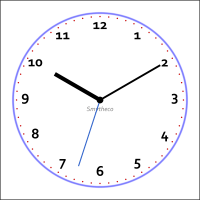
 Long ago (in the first year of this blog), I posted Sideband #34: The North Star, which was about how sighting on the North Star (Polaris) gives you your latitude. Simply put, the elevation of the star is your latitude. My Twin Cities are at 45° north, so Polaris is 45° above my northern horizon. Simple!
In this Sideband, I’ll explain how you can use your wristwatch as a compass. Assuming your watch is an analog one with hands. And assuming you can see the Sun (so this doesn’t work at night).
But, unlike North Star navigation, this one does work in the southern hemisphere.
The basic idea is pretty simple, but there are some caveats and some things to know. I’ve already mentioned the biggest caveats: this requires an analog watch with hands, and you must be able to see the Sun.
Given those, what you do is hold your watch horizontally and point the hour hand at the Sun. Now imagine an angle halfway between the hour hand and 12:00 noon on the watch face.
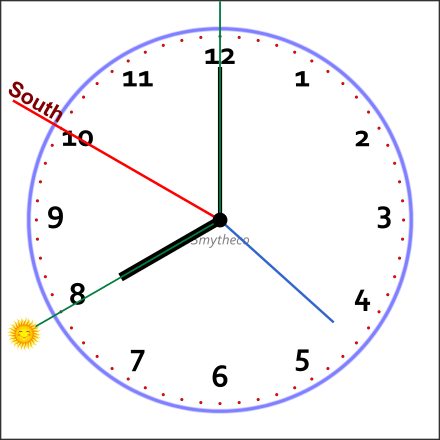
Figure 1. It’s 8:00 AM, so 10:00 points south.
Figure 1 shows an example. The (horizontally oriented) watch has the hour hand, which is pointing to 8:00, pointing at the Sun. Halfway between the hour hand and 12:00 is 10:00, and that will also be (roughly) pointing south.
And, of course, once you know where south is, the opposite direction is north, and (facing south) east is to your left, and west to your right.
§
To see how this works, try to imagine it’s 8:00 in the morning, the Sun has recently risen and is somewhere to the east. So, if the hour hand on your watch is pointing east at the Sun, then some angle to the right is south. Specifically, the angle that is halfway between 8:00 and 12:00.
Why halfway? Because (most) watches are 12-hour clocks that go around twice in every 24-hour period. The watch is therefore twice as fast as the Earth’s rotation, so we divide the motion of the hour hand in half to compensate.
It may help to consider the simplest possible case, when it’s high noon. Then the Sun is directly south. It being 12:00, the hour hand is pointing to 12:00:

Figure 2. It’s 12:12, and everything is pointing south.
And since the angle between the hour hand and 12:00 is zero, halfway between them is also just 12:00. Indeed, if your hour hand is pointing at the Sun, which is directly south at noon, then obviously it’s all pointing directly south.
One caveat: this doesn’t respect daylight saving time. So, if it’s summer, you might want to temporarily set your watch back an hour.
[For clarity, I’m no longer showing the seconds hand. In fact, we don’t even need the minutes hand, but the watch face looks too weird without it.]
§
A bigger caveat involves whether it is before or after noon. When it’s before noon, you bisect the angle between the hour hand and 12:00 going clockwise (as shown in Figure 1). When it’s after, go counterclockwise. This is especially important to remember when, for instance, it’s 6:00 AM versus 6:00 PM.
In the first case, it’s before 12:00 noon, so go clockwise:

Figure 3. It’s 6:00 AM, so go clockwise to 9:00 (halfway) for south.
In the second case, it’s after 12:00 noon, so go counterclockwise:

Figure 4. It’s 6:00 PM, so go counterclockwise to 3:00 for south.
These examples might also be helpful in understanding how this works. At 6:00 AM the Sun is just above the horizon and, generally speaking, directly east. Which means south is 90° to the right of the eastern Sun. But at 6:00 PM, the Sun is setting and more or less directly west. Which means south is 90° to the left of the western Sun.
Keeping in mind whether to go clockwise or counterclockwise is especially important for the very early and very late hours. For example, 5:00 AM might tempt you to go “the short way” counterclockwise to 12:00, or 8:00 PM might tempt you to again take the shorter direction clockwise. Resist that temptation! (If it’s 8:00 PM, south is at 4:00.)
§
In the southern hemisphere, everything is the same with one exception: the halfway angle points north, not south.
§
If you find yourself in the woods or partly cloudy conditions that make it hard to zero in on the Sun, try using a straight stick or pen held vertically (just let it dangle straight down from your fingers in a light grip). The shadow cast by the stick or pen will help you align your watch’s hour hand.
§
This trick obviously had greater value when pretty much everyone had an analog watch, but GPS wasn’t yet a thing that came with our cell phones. I suppose, if your phone battery died and you had an analog watch and you were alone and you needed to know where south is, it might have some utility.
But quite honestly, if you know the time and can see the Sun, it’s pretty easy to orient yourself. Assuming you have any navigational sense at all (which not everyone does). And, I suppose, if you needed to get a strong sense of south in the mid-morning or mid-afternoon when it’s harder to be exactly sure where in the sky the Sun is relative to south, this might have some value.
[Long ago, when I lived in Los Angeles, I was gassing my car when a woman at the next pump walked over and asked me which direction was west. I pointed to the clearly visible setting Sun and simply said, “It’s that way.”]
§ §
I’ve been reading a bunch of Dick Francis novels lately, and he’s had his characters use this watch-as-compass trick in more than one. I recall hearing about it long ago (probably back when I was a Boy Scout) but couldn’t remember the details.
So, I did a bit of research to relearn it, and now I’ve passed it on to you.
Stay southbound, my friends! Go forth and spread beauty and light.
∇







 Logos con carne
August 29th, 2023 at 5:06 pm
WordPress is funny sometimes. As soon as I posted this, I got this notification from WP:
(See this Wikipedia entry if puzzled about the joke.)
August 29th, 2023 at 5:11 pm
For the curious, I wrote a Python program to draw the watch faces. It has parameters that control the time displayed and the green and red lines. The whole thing is CGI.
August 29th, 2023 at 5:24 pm
Very cool! But yeah, almost superfluous. I have been lost in the woods, and the wilderness. With and without maps and yet … knowing compass direction was of no help.
Here’s one: standing on the beach, looking west as the sun sets, each finger between the sun and the ocean represents an hour in time. I think? Or is it 20 minutes?
Now that’s useful. Know that one?
August 29th, 2023 at 7:27 pm
Yeah, I suppose if one has no idea where one is, then knowing the compass directions probably isn’t super helpful. It would help avoid the problem of going in circles. You’d at least be able to pick a direction and stay on that heading. (In dense forest, one trick is to drag a long thin tree truck behind you. The surrounding trees tend to force you into a straight path because the pole you’re dragging doesn’t bend around them.)
I wouldn’t think sunset or beaches would make much difference. The ocean horizon just gives you a fixed reference point. (Would also be true of the rising Sun in the Atlantic.) The Sun circles the Earth (or appears to) every 24 hours, so it’s just a matter of 360° ÷ 24 hours = 15°/hour regardless of where it is in the sky. As you may know, both the Sun and the Moon have a visual angle to us of roughly 0.5° (which the same distance as the Sun moves in two minutes — in 20 minutes it would move 5°).
The width of your index fingernail held at arm’s length is about 1° visually, and the width of your thumb joint is about 2° visually. So, the Sun moves an index fingernail’s distance in four minutes and a thumb joint’s distance in eight. The width across your four fingers is roughly 6° visually, which would be 24 minutes.
August 31st, 2023 at 3:11 pm
Cool trick! I’d never heard of it before. Not that I have much use for a compass out here, but who knows.
September 4th, 2023 at 9:20 am
Not to most useful trick in the book, I have to admit, but kind of a cute one. But who even wears any kind of watch these days, let alone an analog one? (I have a buddy who wears one. Kind of a gimmick watch in that it only has an hour hand.)
September 5th, 2023 at 11:30 am
I did up until very recently, but when the battery died I gave it up along with watch wearing altogether.
September 5th, 2023 at 5:35 pm
Seems sort of pointless if one carries one’s phone everywhere. Unless as a fashion accessory, I guess.
May 16th, 2025 at 3:05 pm
[…] despite knowing the 4:20 thing for ages, until I happened to create an analog clock image (for this post) capable of displaying any time desired, I hadn’t realized how the hands line […]