 We’re about to enter a new phase of Friday Notes. I’ve cleared most of the primary pile of notes for blog posts. What remains are notes that still might lead to posts if I find the motivation. There is also a thick sheaf of much older more ambitious notes, most of which are probably past their Use-By date by now.
The destiny of that thick sheaf remains to be seen, but I recently dug out an even older set of notes. Two old spiral-bound half-sized notebooks… from the late 1970s and early 1980s! One contains thoughts and ideas, the other fragments of song lyrics.
I haven’t looked at this stuff in years. Going through it, I decided to record some of the more interesting in blog posts before I toss those notebooks.
I’ll start that below, but first a couple of weather-related pictures and some more notes from the infamous pile.
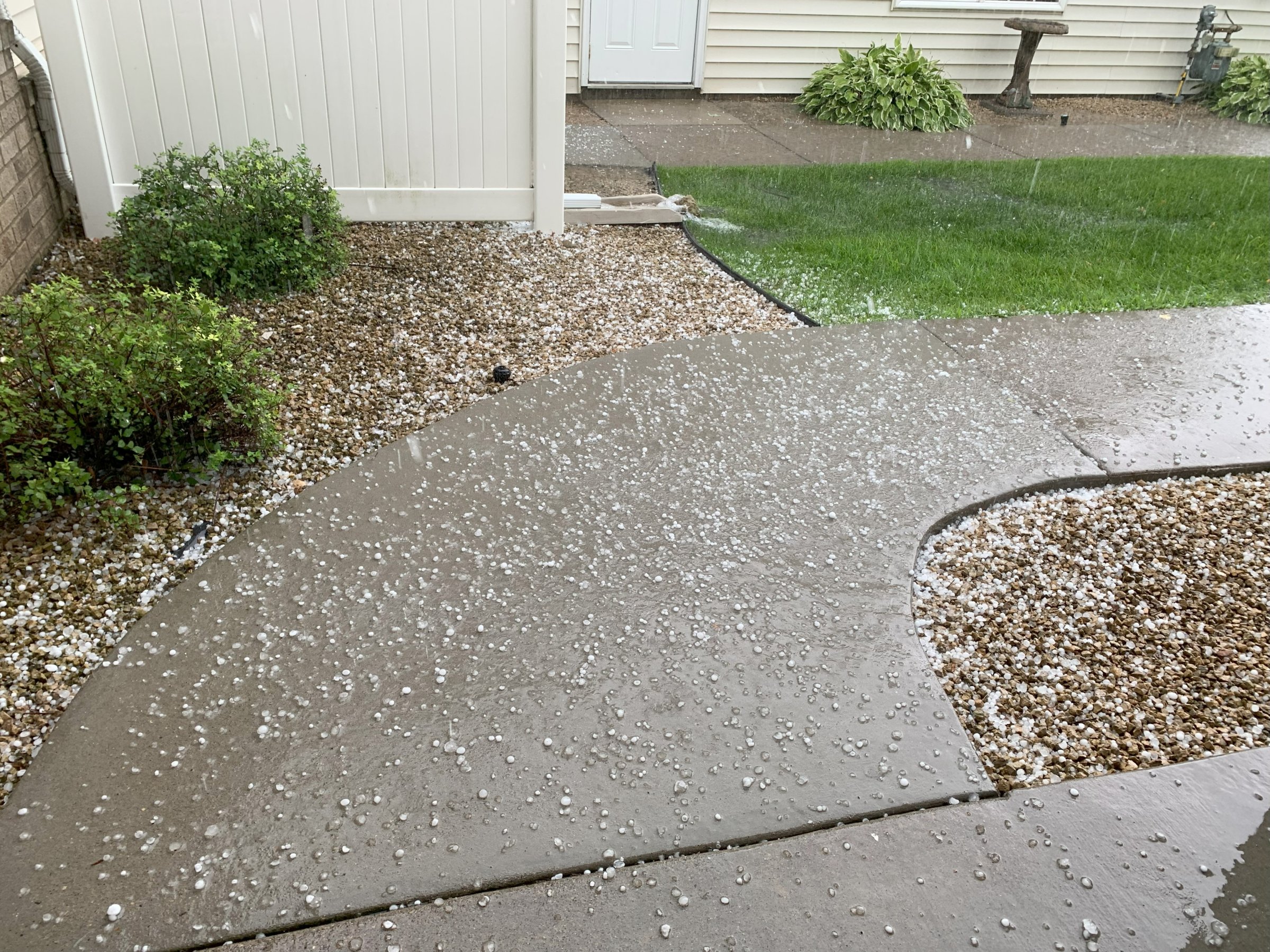
Hail, hail (rock and roll)! We haven’t had a lot of stormy weather this summer (so far), but a decent storm passed by last week. Fortunately for property owners, the hail wasn’t too big. A few stones were dime-sized, but most were gravel-sized. [click for big]
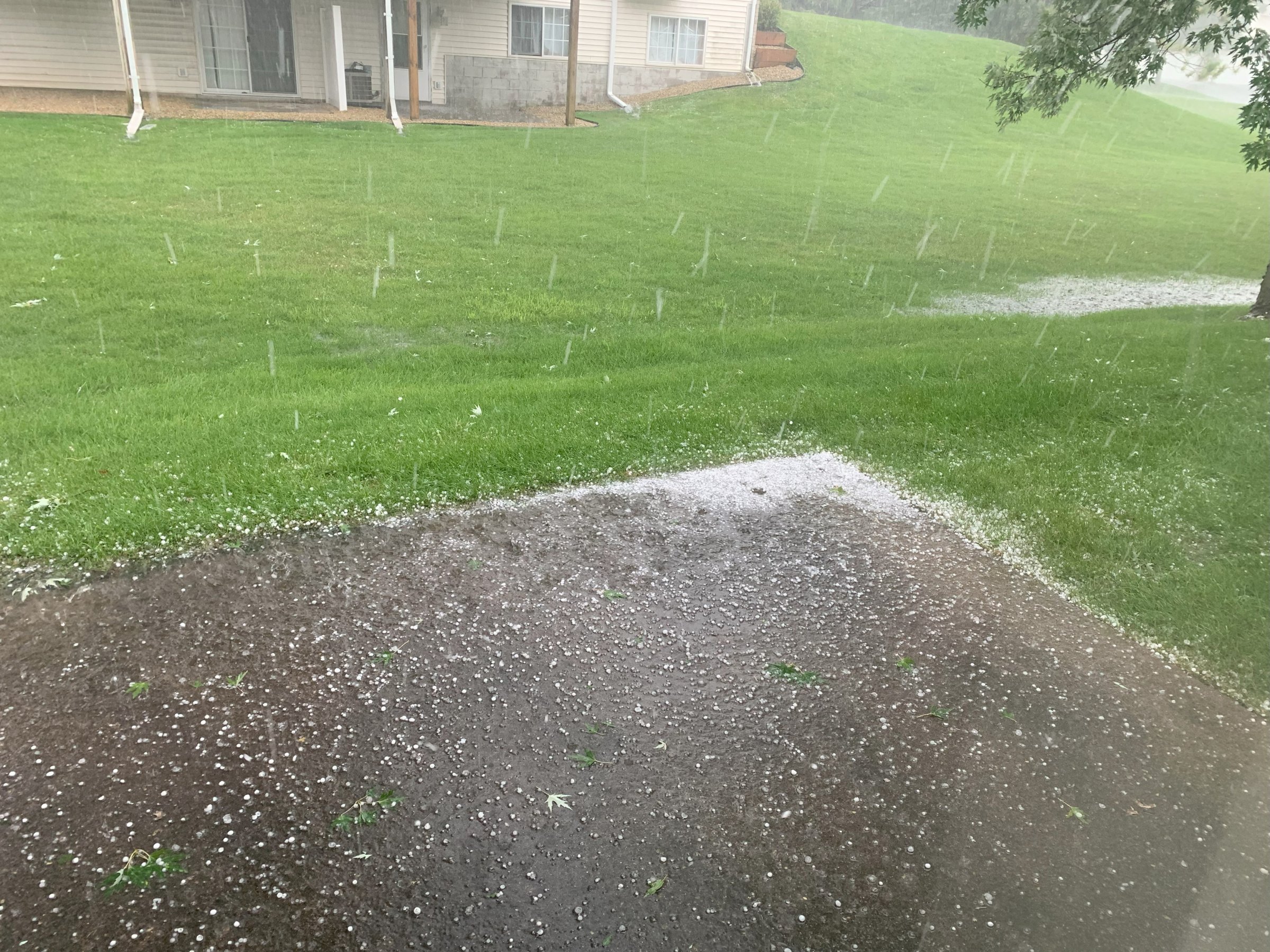
The previous picture was out my front door, this is looking out back. I like how the falling hail stones show up against the grass. [click for big]
§ §
Is it just me, or do the first episodes of TV series seasons sometimes not measure up to the rest of the season? Is it foolish to think the first episode of a season should be especially good? Because the first (or last) seems important to me, plus, with the premiere, they’ve had so much time to prepare.
It’s just that I’ve been very disappointed in season premieres a number of times over the years watching NCIS. (Some other shows, too.) Seems like they’re trying too hard sometimes. NCIS veers away from their usual crime-solving format, and it rarely works for me. (The season cliffhangers eventually resolved by those first season episodes often have the same issue.)
Letterkenny [see TV Tuesday 6/6/23] seems almost deliberately to subvert this. Cliffhangers from the previous season are usually casually and easily dismissed in the first episode of the new season. (And I’ve had no complaints about first season episodes there. The notion may just be my imagination based on a few data points from NCIS.)
§
The landscape of art includes books, poems, music, sculpture, dance, painting, photography, stage plays, TV shows, movies, flash mobs, metalwork, glass blowing, weaving, and a great deal more. There is a spectrum among these that varies in, firstly, the degree of narrative, and secondly, in the degree of detail in that narrative.
All art has some narrative, even if it’s just this-is-a-vase-I-made. Its existence tells a (perhaps minimal) story. But some art has an explicit story. Books, TV shows, and movies are good examples of story art. Poems and songs may tell stories but may also be more about mood and experience. The stories they tell usually don’t have the detail of narratives in, say, books (which are typically the most detailed).
The point is the degree to which narrative art “collapses” the “wavefunction” of imagination. And what effect that has on experiencing the narrative repeatedly.
It seems the less detail involved, the more often one can enjoy something. (The time involved to read or watch a detailed narrative is likely also a factor.) Poems and songs are so vague we can enjoy them endlessly. How many times have you listened to a favorite song or read a favorite poem? Does it compare at all with how often you’ve read your favorite books or watched your favorite TV shows or movies?
All campfires look basically the same. So do most ocean coasts. Or clouds. But we never tire of watching them. Too much detail can be boring.
§
We’ve experienced a lot of unusually bad air quality here this summer. Mostly from forest fires up in Canada, but also some local dust. One day I noticed this on the air quality map:

Air quality of 109 (!!) in the Twin Cities due to wildfire smoke.
The wildfire smoke seems to be making a beeline for the Twin Cities. Ouch!
§
I watched a video about defining “harm” in the context of AI. In general, the concept is tricky. When you get a vaccine, the injection arguably does you a tiny bit of harm. But this is balanced by the greater good from the vaccine.
[Got my follow-up shingles shot a couple of weeks ago, and it kind of kicked my ass for a day. Flu-like symptoms for about 24 hours. But after that, nothing. Arm was hardly even sore.]
So, what if an AI had a plan that made life much better for most of humanity but much, much worse for some small fraction? Where’s the threshold between “good of humanity” and “crime against humanity”? The question applies far beyond the context of AI.
Which is a whole other topic I’m not exploring here. What this triggered was thinking about the difficulty of defining foundation concepts. For example, trying to exhaustively and exclusively define love. Or justice. Or happiness. Or art. Or pornography. Or harm.
Some concepts defy definition. They’re too big and diffuse to be clearly defined. They’re typically basic building-block concepts we use to define more involved concepts. Generally, we can only describe foundation concepts with examples.
These descriptions train our neural nets to recognize instances of the concepts they describe. Given enough trusted examples, our ability to distinguish these things from other things improves.
In fact, this is exactly how current AI models are trained. The better the training data, the better the model can guess what new input is. In both cases, it’s a matter of concept resolution in the mindspace.
This would apply to virtue ethics. Deontology is mindless, and consequentialism is tricky to predict. A mind trained on good examples would likely do well with virtue ethics or be greatly helped in predicting consequences.
It’s again a matter of training the (natural) neural net to discriminate ethical actions. Experience matters (the 10,000 hours). While I lean strongly in favor of virtue ethics, I have to acknowledge that it requires thoughtfulness and education.
§
I’ve been watching these videos about different languages. It got me thinking about how all languages have a fixed alphabet, only so many characters. Yet these suffice for everything and anything that has or ever will be said.
This isn’t quite the same with numbers. In any given number system, there is a fixed set of “digits” — the characters of number systems — but actual numbers are infinite, sometimes in more than one direction. Number systems are just ways of expressing those numeric values.
DNA is similar. Only four “characters” in that alphabet, but it suffices for every human ever. All the animals, too. Granted, some can be very similar, but the text written by those four characters is long enough for a huge amount of variation.
And that’s the thing. With a finite number of characters, there are only so many combinations. There may be so many as to defy description and amount to infinite, but the number is not truly infinite. (At this point, it’s almost obligatory to mention The Library of Babel, the short story by Jorge Luis Borges. It imagines a library containing every book possible — every combination of letters in all possible finite lengths. Most of them are gibberish, of course.)
It’s an intriguing property of reality that simple building blocks, plus some simple rules on using them, given energy and time turn into something extremely complex. The Mandelbrot and Conway’s Game of Life are good demonstrations of this property. For that matter, so are we.
And the brain, likewise, is a finite tool for dealing with the vast variation of the world. (The world is also finite but so much larger than brains that the possibilities, relativity speaking, are essentially infinite.)
§
Peter Gabriel has been releasing singles from his new album in a unique way. Every full moon he releases the “Bright-Side” mix of a new cut, and every new moon he releases the “Dark-Side” mix of the same cut. (Except last month, when he reversed the protocol. No idea why.)
My hearing is so bad that I can’t tell much difference between the mixes. There’s also an “In-Side” mix that comes out during the lunar month. It’s mixed for Dolby™ Atmos™ (which is a whole other can of audio worms).
Apropos to the previous note, the tune from last month, “So Much”, is about both sides of the title phrase. There’s so much to be done, but only so much that can be done. Nice hook.
Gabriel has released eight cuts off the album with three to go. I’ve got tickets in October for the concert tour he’s on now promoting the album. Looking forward to it!
§
Long ago at work I had a screensaver that imitated the dripping green text from The Matrix (and sequels).

One time one of the salesmen stopped in and asked me if it was real, a part of the programming work I did. Ah, the power of movies to misinform. Just about everything said about computers or, especially, hacking in movies and TV shows is laughably hysterically wrong.
I’m especially amused by the way-too-common trope that a sufficiently powerful (or clever) [chip/program/computer] can not only hack into any system but make that system do anything it wants.
§ §
Now a blast from my past, some bits from one of my old notebooks.
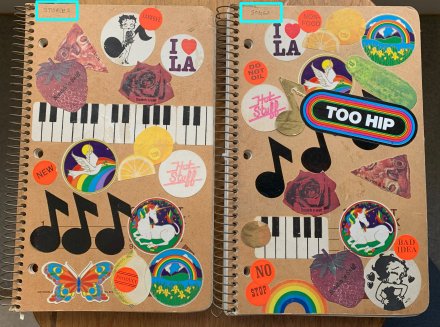
It’s not easy to read, but the two cyan outline boxes (upper left and upper center) highlight the notebook labels: Stories and Songs (left-to-right). And what can I say. We didn’t have stickers when I was growing up, so I enjoyed that childhood late. (Many of them are scratch-n-sniff!)
These come from a time when I still thought of myself, at least somewhat, as a filmmaker and musician. But as the song lyric goes, “The child is grown; The dream is gone.” I was hired in 1980 by The Company during this era and was shifting my view of self. (And, as it turned out, 34 years at TC set me up to enjoy a pretty easy retirement.)
§
Like it or not, we live in a high-tech society. And the tech is getting higher. There must be, for many, the feeling that all these wonderful things work by magic. We have ovens that cook in seconds using deadly invisible rays. (And we know they’re deadly. We’ve all heard the story about that lady and the poodle she wanted to dry off quickly.)
[This was the opening to an introduction to “The Common Man’s Realistic Guide to Technology” — I saw myself as a science communicator at an early age. I’ve long wanted to let people in on why this stuff is so cool.]
§
I have a highly efficient filing system. The secret is to file immediately. The minute I finish with something, I immediately set it down somewhere and immediately that spot becomes the file location for that object. Until the object is needed again, or the file is cleaned. I mean cleared.
[This bit of silly is the last note in one section of the notebook and actually has a date at the bottom: 11/2/82. Which means the other notes are earlier.]
§
[Story Idea] Dog’s Life: Written in dog’s POV from puppy to old dog.
[Story Points] Wonders how water facet works (magic). Learns a few words. Dinner and treats. The Gods grow old, too! And move away. Things change. Outdoors and seasons. Strife between Gods at home? Old age.
[The idea was to conceal that Dog is a dog as much as possible. Ideally, the story should work without the reading picking up on that fact.]
§
[Story Idea] Stoptime: a drug that slows perception of time for the user by speeding up the brain. The body is still limited by how fast it can move, but speed and reflexes are seriously increased. Too much nearly stops time and usually drives the user insane. They are “frozen” for what seem like weeks.
[A nice idea at the time, but between science fiction and superheroes, pretty much well-covered by now.]
§
There is a view which has it that we are only mentalities, and that we create the reality around us to suit us. The “world” is the collective idea of billions of these mentalities. Another “person” coming up with an idea or teaching us something demonstrates the existence of other mentalities. [This is not solipsism.]
So, science is really these mentalities inventing a more and more complex “world” as time goes on.
[I’ve mentioned that I flirted a bit with philosophical idealism when I was younger and more credulous. This is a last whiff of that.]
§
Some people regard it as the removal of man from his art. But others see it as an extension of man into new realms. After all, it is the world of music which has changed (grown!), and man (the musician) is still the same.
[I think I was talking about musical synthesizers, which at the time some were questioned as corrupting music. Maybe we should have stuck with the harpsichord. Seriously, if Mozart and those guys would have had synthesizers or electric instruments, they would have loved them!]
§
[Lastly] This is not for everybody. It is primarily oriented towards members of the human race. [Such snark!]
§ §
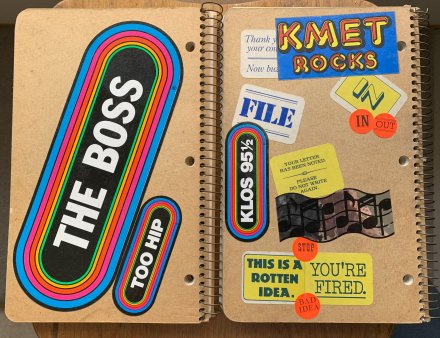
The back of the notebooks and the end of the post!
Stay in The Matrix, my friends! Go forth and spread beauty and light.
∇






 Logos con carne
August 18th, 2023 at 9:30 am
Damn WP Developers. Damn them to hell. I forget to apply my <P> tag fix to this post and, sure enough, that damned piece of shit, the $*#@$ WP Reader, merged all my paragraphs. And, unlike on previous occasions, fixing the post after posting didn’t fix the error.
Previous experience suggests the problem may resolve itself eventually but damn the WP Developers and their $*#@$ WP Reader to hell forever. This bug has existed now for years.
It’s making me hate the WP organization (because WTF) and want to just walk away from this bullshit. They refuse to address long-standing bugs but they keep making “improvements” which, from my point of view, not only don’t improve a damn thing but make the platform worse and worse.
Damn it!
August 19th, 2023 at 11:15 am
WP did eventually catch up to itself and realize the post had paragraphs. Hard to see if it was my fix or the secondary process they’ve hinted at that comes around and fixes posts. What I don’t understand is why they’d need a secondary process. What does it see that the primary process doesn’t? Weird.
August 18th, 2023 at 3:46 pm
I’ve always felt the premiere of a series was the worst, so much so that I usually give the show another episode or two before I decide whether to go on (unless it’s so bad I can tell even vast improvements won’t make it something I’d enjoy watching). I wonder if it’s because the cast and crew and writers are still getting to know each other and haven’t figured out the group dynamic? I really have no idea. But you’re right, it’s usually far worse and it’s often because they’re trying too hard.
August 19th, 2023 at 11:23 am
Oh, yes, very true. Series premieres frequently don’t represent the show. And, as you said, even if the writing is on point (perhaps because the series has a well-wore nature), the production rarely is. For exactly the reason you suggested, I imagine. Everyone has to get used to working together, and often the actors haven’t really settled into their characters.
A very good example for me was Star Trek: The Next Generation. I’d been a huge fan of Star Trek as a kid, and a new show was like manna from Heaven. But I called my (fellow Trek fan) buddy during the first commercial break and the moment he answered said, “I hate it!!” And that premiere episode was a stinker. Notably bad among the seven seasons the series ran. Bad on all sorts of levels.
What I can’t figure out is why first episodes of new seasons of an established show are sometimes so bad. Or so I’ve gotten the impression. (I have to admit that the only instances that stand out are a number of new season first episodes from NCIS. There may be some selection bias going on there.)
August 19th, 2023 at 12:50 pm
Hm. I haven’t noticed the first episodes in new seasons problem, but if that’s the case, I imagine it’s a “trying too hard” kind of thing. Or maybe changes in people working behind the scenes. I’ve noticed variance in the quality of writing—the funniness, to be more specific—in a show called “Monk,” but it’s an older show and I’m not sure binge-watching was a thing back then, so maybe people didn’t notice the changes quite so much.
August 19th, 2023 at 9:49 pm
Good point about crews changing. I have wondered if they don’t view the time between seasons so much as all the time to make a good first episode as time to do a lot of other stuff. Maybe they come back cold and kind of have to scramble to crank out that first episode. And yet they want it to be special, so pressure and too little time and new people onboard? I guess I can see it.
I think one had to be a dedicated TV watcher to notice stuff like that back in the day. It’s a lot easier to see when you binge. Kinda funny sometimes to watch the show evolve.
August 18th, 2023 at 8:05 pm
On Filing: https://drive.google.com/file/d/1ot2tpLTHYoV4_RHdkQSgZEeBroG-ifAj/view?usp=sharing
On society’s ills and thresholds for spectrum-like attributes:
I’m of the mind that intelligently designed rule/laws should automatically adjust to compensate for changes. Take minimum wage: this value should be based on the average monthly single bedroom rent for a region. Employers don’t want to pay such a high minimum wage — induce the reduction of rent. The two are linked and reflect a natural dynamic. Do this for all systems. What do you pay teachers? Cops? Surgeons? All can be based on metrics. What speed to you allow on a highway? All based on metrics (accident rate, fuel costs, road-repair costs…)
August 19th, 2023 at 11:28 am
Ha, that’s good! (I noticed a hidden decision point in the “Delay This” task.)
Your task, should you choose to accept it, is to convince people to live in a rational well-managed world… [Good luck with that!]
I’ve thought for a while that technology has reached the point where that kind of social flexibility and responsiveness you’re talking about was possible. I doubt it would have worked in the past, societies move slowly with a huge number of inputs all attempting to steer it. But it sure seems like we have the tools for it now. I’ve read any number of SF books that describe realities along those lines. The trick is getting society to move in that direction.
August 18th, 2023 at 8:20 pm
I think I’m different from you, and of course, that’s what makes the world go round. Although I definitely love songs, etc., it’s favorite books and movies that I’ll return to again and again. Far more than I’d probably return to a favorite song. I wonder why?
Switching topics, did you go back and fix all of your paragraphs? Because I’m able to see everything in your post as paragraphs in my own WP Reader.
August 19th, 2023 at 11:36 am
Interesting! And part of why I put things like that out there. To get back reflections of people who think differently. I totally agree it helps make the world go round. (Or, at least, stay round, as gravity made it round ages ago. 😁)
So, you read books over many times, but don’t listen to the same songs often or re-read poems? Well, you have a doctorate in English, so maybe that makes sense. Or maybe you drifted that way in the first place because of your inclinations?
That said, there are books (or series of books) that I’ve re-read time and again. Terry Pratchett’s Discworld books, are a good example. I used to read that whole series every other year or so. And I used to read Dune every few years or so. There are a few others like that. Books I love so much I do re-visit them. (I don’t know if novellas count, but I read The Christmas Carol every Christmas.)
But I couldn’t even begin to count how many times I listened to the songs I enjoy. Hundreds of times, maybe thousands in some cases. In a few cases, so often that I had to stop listening to that artist or album for a while!
August 19th, 2023 at 11:39 am
p.s. Yes, WP did catch up with itself. I fixed the paragraphs in the post right after I posted, but (different from previous times) there was no immediate effect. I was busy yesterday, so I don’t know how long it took, but I saw today that the post displays as it should.