 I started the Friday Notes series in March of 2021. (I would have mentioned the five-year anniversary in last month’s edition had I noticed it.) Since then (61 posts), I have managed to whittle down long-standing, and in some cases ancient, piles of notes.
The piles aren’t all vanquished; likely they never will be. New notes spring up like mushrooms, so it seems there will always be fodder for future posts.
Or at least endless editions of Friday Notes.
Very recently I burned through a trilogy — the Owner universe — by Neal Asher, a science fiction author whose work I very much enjoy (so far, no disappointments).
The trilogy comprises The Departure (2011), Zero Point (2012), and Jupiter War (2013). I read all three in the span of five days. It was, as they say, one rippin’ good yarn.
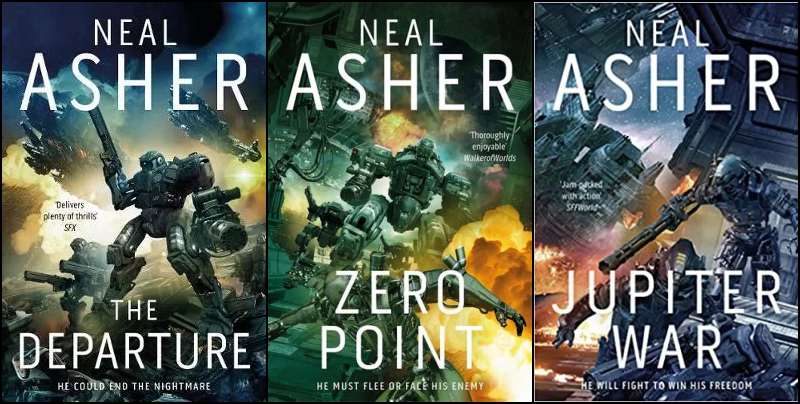
The trilogy is (no pun intended) a departure from his books about the Polity — humanity’s distant future. This series takes place in a fascist dystopic near future where Earth is ruled by the Committee and its vast resource-hogging bureaucracy. Beyond the rulers, the many tens of billions populating Earth are divided into the ZAs (zero assets) and SAs (special assets). The former live near the starvation level. The latter, a much smaller group, are a bit better off (because they’re considered useful).
The story centers on Alan Saul, who decides to take down the Committee. I won’t say more about the books, but there are a few bits from them I want to mention.
Asher’s work sees consciousness as computational. His far future Polity is ruled by highly advanced Ai, and there are fully conscious machines as well as human-computer hybrids. Many humans have “memory crystals” that backup their mind in the event of fatal catastrophe to the body, and those crystals can be transferred to robot bodies or even clones. (In this trilogy there is “comlife” — computer life.)
In one of the books, Asher ruminates on our history of recording self. He points out it began with cave paintings. Then there were books. Now there are vlogs and blogs. (I’ve mentioned how this blog is, in part, my way of recording self — my scrawl on the internet wall.) Asher’s memory backups are the end result of that progression: perfect recordings of every moment of one’s life.
So, humanity has been recording ourselves for a long time. (I wonder sometimes what future archeologists will make of the wealth of data the modern era provides. Each age of humanity increases the amount produced.)
Asher’s Polity books begin chapters with text from a supposed future works. Many are from How It Is by Gordon. Other quotes come from weapons lectures by E.B.S. Heinlein. In the Owner books, the opening bits are unsourced and seem to come from the author (or some omniscient voice).
Two of them caught my eye:
Back in the twenty-first century, a technological singularity did not just seem possible, it seemed inevitable; but those booting up their computer models of human technological development neglected one critical force: the power of human stupidity. For technology to develop so fast that it goes beyond the ability of humans to model it, the underlying bedrock of science must be rigorous and stable. Yet, even in that century, science was becoming unduly influenced by political thought and execrable creations like post-normal science. Science itself began to break down when Karl Popper’s dictum of falsifiability was abandoned in favour of faith, and when funding for it became wholly controlled by political expediency. Scientific thought stagnated when scientists themselves became frightened to pursue lines of research that led them away from whatever consensus happened to be the love child of the politicians who controlled the funding. They became merely puppets producing the results required of them, distorting their research to fit, taking their thirty pieces of silver and crying in their laboratories; dwarfs scuttling away from the shadows of giants like Feyn-man and Dyson.
Which is sadly on point for how things seem to be going now. That said, I’ve been watching some videos by Curt Jaimungal that counter the perception theoretical physics is moribund. Even so, too much theoretical work, to my mind, strays too far from Popper.
The quote serves a minor purpose of reminding me of something I see in e-books. Either due to optical scanning or to embedded “hard” hyphens in the text, there are hyphens where they don’t belong (as in Feynman’s name). On the other hand, the kinds of optical scanning errors, that for instance see “turn” as “tum”, seem less common. (I have an older Kindle book by Roger Penrose that’s unreadable due to the multiple optical scan errors on every page.)
Here’s the other chapter-open that caught my eye:
The importance of politicians is something that can never be under-estimated, for over the centuries so many of them have strutted on the world stage, prattling their party political and ideological jargon and produced little of real value. The number of them who have had a real effect on the human lot pales in comparison to the number of scientists and engineers who have produced something worthwhile. Who did more for women’s rights than the inventors of the washing machine, the vacuum cleaner and the contraceptive pill? Has righteous nannying improved human health more than Lister, Pasteur, Fleming, or any number of a huge list of pioneering biologists? Who gave us more freedom than Henry Ford, or more freedom of speech than the inventors of the Internet, or more to eat than Jethro Tull or John Froehlich? It was Edison who shone real light into our lives, not some dogma. However, let us not presume politicians are ineffectual, for whenever the bombs and napalm are falling, the mines taking off legs and the bullets punching holes in human flesh, they are always behind the firing line, deciding who should die.
(Not that Jethro Tull, of course. Nor that Fleming.)
I very much agree that science and scientists deserve more respect, and I wouldn’t be opposed to a scientific meritocracy. Let’s have scientists run things for a while; they can’t possibly be worse than politicians.
§
I doubt this comes anywhere near to an original thought: The aurora borealis is Mother Earth’s necklace.
And the aurora australis are the diamonds on the soles of her shoes.
§
I watched (half of) a review about the Project Hail Mary movie that spent that half going on (and on) about how Grace put two test tubes next to each other in the centrifuge. Which makes it off-balance, an error no Real Scientist™ would commit.
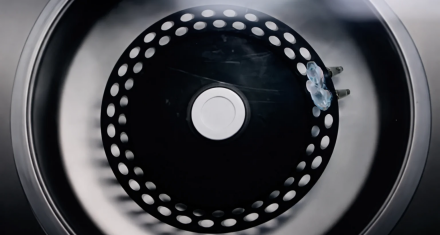
Firstly, movies are dreams, not real life. They’re not documentaries. They’re visual, and maybe the directors thought it looked better having the two tubes side-by-side. Secondly, why would Grace, a science teacher, necessarily know better? A biologist, sure, but who can really say what Grace’s background is.
More to the point, perhaps the centrifuge is self-adjusting. My washing machine is. Perhaps they included more robust equipment on the Hail Mary exactly because of the unknows to be faced.
I can see a biologist mentioning it in passing, but to rant about it for five minutes was a bit much for me, so I clicked out. Based on the Google hits I got looking for the above image, apparently a number of scientists are going on about it.
§
Something I hadn’t realized about gravitons, the supposed mediator of gravity, is that individual gravitons are, even in principle, impossible to detect because their energy level is so low that Heisenberg uncertainty washes them out.
(The video should start at the relevant point: 1:30:00 but is worth watching in its entirety.)
And at the other extreme, with high gravity the energy levels become so high that black holes would form and prevent us from seeing anything. (Our ability to probe the universe is limited on a low end by uncertainty and on the high end by black hole horizons.)
My hope is that gravity turns out to not be a force but, as in General Relativity, just the warping of spacetime. Under GR, the equivalence principle equates gravity from mass/energy with the force felt as acceleration. I can maybe see how mass/energy might produce gravitons, but how does acceleration do it?
Gravity waves (which we’ve proved exist) are said to be proof of gravitons — equating the gravity waves with electromagnetic waves — but what about sound and water waves? These are disturbances in a medium, so why aren’t gravity waves disturbances in the medium of spacetime (as indeed they appear to be)?
Maybe the real reason we’ll never detect gravitons is that they don’t exist.
Something else to consider about gravity versus the three forces of the standard model (electromagnetism, weak, strong). Gravity is the only one with an equivalence principle. It’s also vastly weaker than those three (which leads to the hierarchy problem).
All of which suggest to me that gravity isn’t a particle-mediated force.
§
The enshittification of large tech companies (and large companies in general) is an oft-observed modern phenomenon. My canonical example is how Apple’s free iTunes app used to be a great way to curate one’s digital music library but over time the good went away and what remains serves mainly to promote Apple sales.
I realized recently this isn’t a new thing. I’ve noticed all my adult life that restaurants sometimes decline after a heyday of popularity and goodness. My theory has been that the originators responsible for the Goodness sold the business and moved on to new things. As creative people are wont to do.
The new owners typically see the business as a wealth source and forget why it became popular in the first place. Quality declines, business drops, and the place closes.
The problem with huge companies of any stripe is they don’t much care if former quality-loving customers dry up so long as there are enough others who prefer cheapness to quality. It’s hard to punish companies like that, so they survive.
I wonder if this is another inevitable consequence of how big humanity has gotten. I think many of our problems come from that. Each of us has less than one-eight-billionth of a share in humanity. Not much leverage there.
§
It has long struck me as interesting that just about every English-speaking person understand exactly what “F! U!” means even though the second letter is phonetic. It’s even a joke in the Neil Simon play The Odd Couple (when Felix Unger leaves a note to roommate Oscar Madison signed “F.U.”).
Everyone gets it; no one ever seems to question it.
§
And now, here’s the weather. (These weather reports have become such a staple of these Friday Notes posts that I may have to start a Weather Notes series. Weather is a long-abiding interest that I’d like to know more about at the technical level. I’d like to better understand high pressure ridges, for instance.)
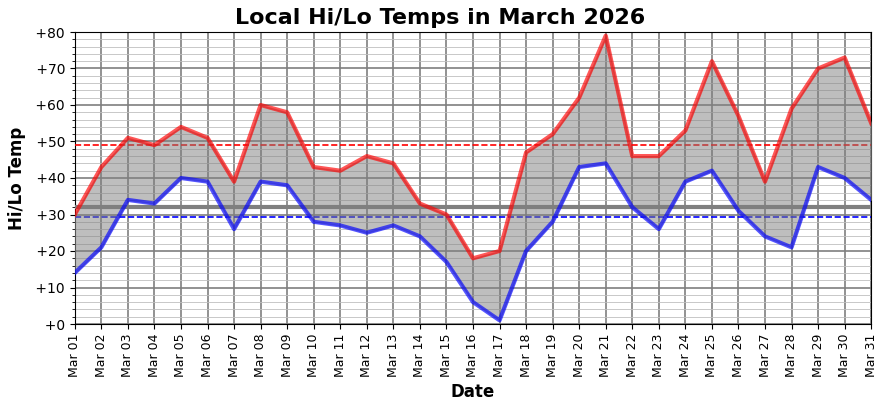
The large temperature variation we saw in January and February (see previous FN post) got even more extreme in March. Two days with highs around +20 (the 16th and 17th) and only four days later a high of +80.
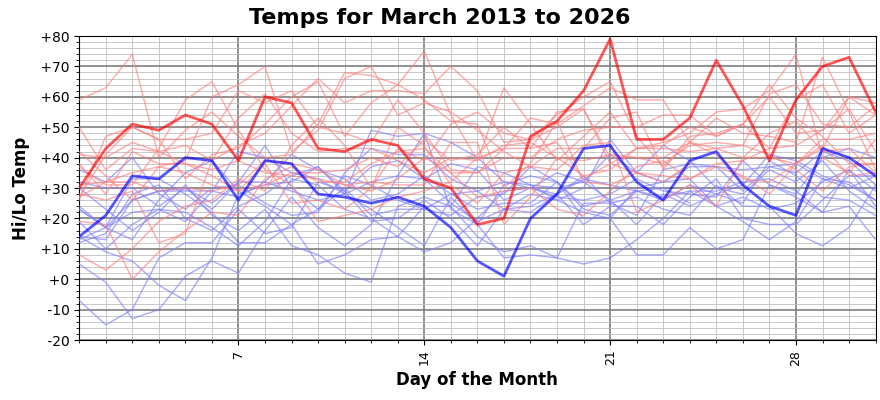
As you see, that high on the 21st broke high-temp records going back to 2013. That low temp of zero on the 17th was also a recent-record breaker. We are ever at the mercy of the jet stream here, but the extremes keep us on our toes.
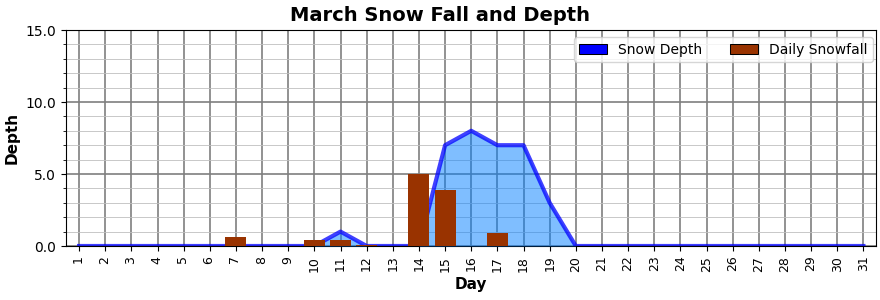
We had a winter storm blow through on the 14th and 15th and dump about nine inches of snow:

New snow is always so pretty. No matter what lies beneath, a fresh blanket of it makes the world bright and clean.

The warm temps that followed melted it all pretty quickly:

The first two pictures are from the 16th. This and the one below are from the 21st, just five days later.

At this point, though we’ve had some chilly temps lately, I’m wondering if it’s time to put away the shovels. Some rain is forecast in the week ahead, but my guess is we’ll get no more snow. (Now watch the jet stream prove me wrong!)
I added a “days below +20” band to my first attempt to quantize winter pain:
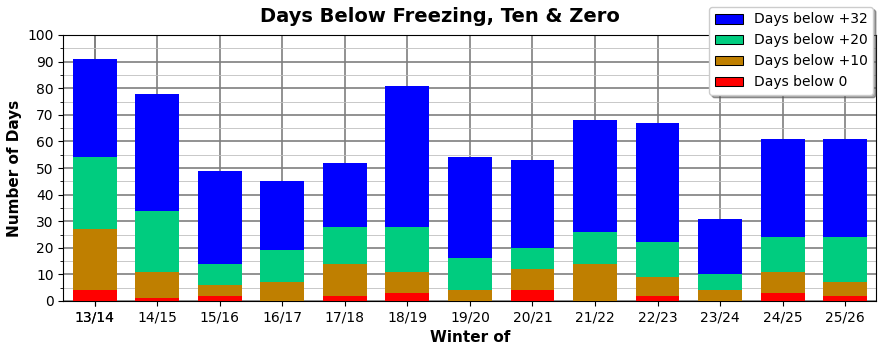
But I don’t think this chart says as much as I’d like. It would be interesting to compare these modern winters against much older ones. I’d like to try something that charts consecutive days of cold and warm temps. Winter gets painful when there is a week or more of -20 temps.
I created this chart:
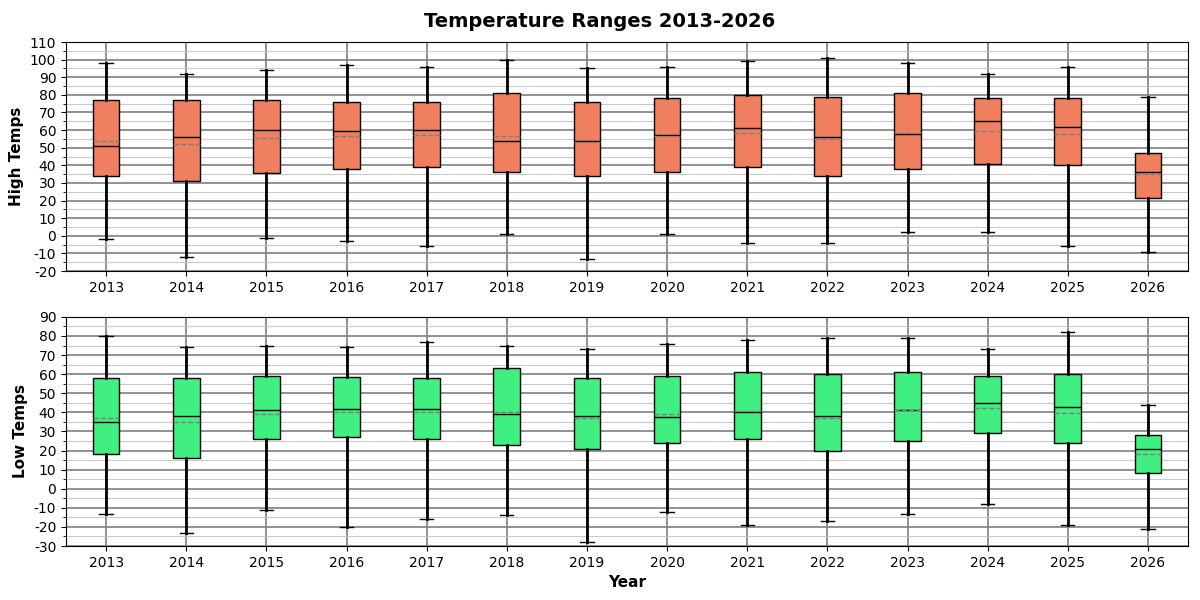
Which includes high and low temps for the whole year (which is why this year’s data is noticeably different). But I think the real problem in comparing winters is twofold. Firstly, this data set (2013-present) is just too modern; I need data going back much further (which I have but there are several pain points associated with processing it).
Secondly, I don’t think temperatures are enough. At the least, I need something taking spans of days but also including wind chill and amount of snowfall. Including cloudy versus sunny days might be interesting, too. A sunny day just feels better.
§ §
As always, plenty more notes, but that’s enough words for now.
Stay balanced, my friends! Go forth and spread beauty and light.
∇








 Logos con carne
April 10th, 2026 at 9:20 am
Good news (or bad news, depending on your perspective): I was doing a major bit of Spring Cleaning and stumbled on a bunch of really old notes…