 All my life I never noticed that, when February has 28 days (non-leap years), the dates in March line up exactly with the dates in February. It took writing this TV Tuesday post for March 24 and realizing last month’s edition was also on the 24th to notice it.
Seventy revolutions around the local star, yet I can still find new things lurking in what is by now a vast pile of ordinary. It’s a double-dip pleasure: firstly, the delight of the new thing; secondly, the delight of still being delighted by delightful things (and wordy whimsy).
More to the point, I’ve been delighted by some things I’ve been watching lately, including actually going to the movies this past Sunday.
There are a number of reasons why — despite the AMC Theater complex just over a mile away — I hardly ever go to the movies anymore. This is a TV Tuesday post, so movie theaters are off topic (and these posts typically run long, so I won’t spend words on it here). Suffice to say the bar is very high. Very few movies make the cut (I didn’t even go see Avatar 3 with the gang).
After reading the book and getting a whole new take on Andy Weir, I was chomping at the bit to go to the movies to see Project Hail Mary. I had my usual anxiety over whether Hollywood could produce an adaptation that honored the book. I recently read and very much enjoyed the book, which gave my anxiety an extra piquancy.

I’m overjoyed to report that Phil Lord and Christopher Miller do not disappoint. To put it mildly. To put it more accurately, they (along with help from Weir and some Actual Physicists™) pretty much blow the doors off. I think I haven’t enjoyed a science fiction film this much since Arrival (2016). And for similar reasons.
But we are gathered here today for television, not movies, so I’ll save this for another time. [FWIW, see this recent review of the book.]
§
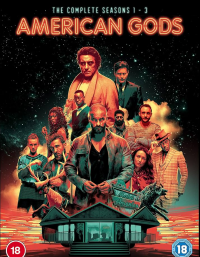 As a segue from SF books to TV shows, Amazon Prime had the first season of American Gods (2017-2021; three seasons). It’s based on the same-named 2001 novel by Neil Gaiman (who, say what you will, has done some memorable work; I’ve long been a fan of his Sandman series — and this novel).
The TV adaptation features Ian McShane (playing Odin), who I’ve liked since his days playing Lovejoy (not to mention Deadwood or his role in the John Wick movies).
The story is about a war between the old Gods humanity has held in their minds for ages versus their new gods such as television and money. It’s an excellent book, my favorite Gaiman novel after Good Omens (which he co-authored with my all-time favorite author, Sir Terry Pratchett).
I’ve seen the first season before and hadn’t found it a great adaptation. I watched that season again, forewarned and forearmed, and it went down easier. I wouldn’t mind seeing the other two seasons, but they aren’t worth paying for. I have a memory of hearing the later seasons didn’t hold up.
§
I finished working through the four seasons of Cheers (1982-1993; eleven seasons) on Hulu. I wonder whether these partial offerings (Cheers had eleven seasons) are due to some licensing issue or meant solely as bait.
[Amazon Prime Books has become so enshittified that I don’t even bother checking whether they’re offering anything interesting to read anymore. They used to, but now it’s just obscure stuff they can’t sell and first novels of (usually also obscure) long-running series (which apparently is what most writers are churning out these days).]
I’m still working through Bewitched (1964-1972; eight seasons). I’m only into the second season. Still in black & white; they jump to color in season three.
Speaking of shows that made that transition, The Man from U.N.C.L.E. (1964-1968; four seasons), one of my favorite childhood shows, was more of a TV landmark than many may realize. (That might be worth a post someday.)
Bewitched can be hard to watch sometimes, in part because the received mores of the time — specifically the subservient wife — grate on modern sensibilities. (By “modern” I mean 20th century mores, not the exaggerated Far Left mores of today.) But even worse is Darrin — most of the time, he is such a shallow asshat that it’s hard to watch. (I don’t get his attitude. Being married to a witch would be awesome. Think of the vacations you could take.)
Being so smitten with Samantha as a kid, until now I hadn’t realized her not infrequent missteps, usually in making unilateral moves and then lying to Darrin about it. Which, to me, is the greater offense. It’s genuinely amazing how many TV episode plots involve people who supposedly care about each other deceiving those same people in the name of “protecting” them (in fact, usually to protect themselves from consequences).
As someone who reveres honesty, that’s my least favorite — no, my most despised — plot point. That old show Three’s Company (1977-1984; eight seasons) used it in almost every episode.
I have to admit that sometimes I question whether my childhood crush on Sam is quite up to watching the whole of Bewitched (the seasons were long in those days, too; 30+ per season). I’ll see how it goes.
[The episode counts in the eight seasons of Bewitched almost seem to say something about American television then (and now). The counts, in season order: 36, 38, 33, 33, 30, 30, 28, 26. Now days we’re lucky to get as many as ten.]
§
Some time ago, the title caught my eye. Seeing that it was a comedy about modern-day vampire roommates intrigued me. What finally determined me to watch it was hearing it used the film crew mockumentary style made popular by The Office (British version: 2001-2003; American version: 2005-2013).
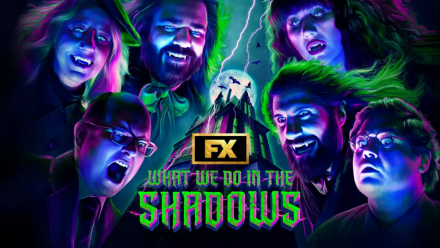
I’m speaking, of course, of What We Do in the Shadows (2019-2024; six seasons). Most of the promotional artwork for the series makes it look at least a little bit horror genre, and it sometimes tries for that, but the premise, characters, and writing are just too goofy to really pull it off.
This one took a while to grow on me. I didn’t take to it much at first, but by the end of the final season, I was a little sad it was over. Part of the problem involved a clash of tone between the mockumentary style involving a clearly present film crew filming these three vampires (and their vampire friends) murder people.
One of the four roommates, Collin Robinson (Mark Proksch), is an energy vampire. He doesn’t suck blood; he tells long depressing personal stories that suck energy (to exhaustion if not death). He’s exactly the sort of soul-draining utterly interminable person you sometimes meet, so it took a long time for me to embrace him as a character (not sure I got all the way there).
Nandor the Relentless (Kayvan Novak), the self-styled head vampire of the household (based on his age), has a familiar, Guillermo de la Cruz (Harvey Guillén), who turns out to be a direct blood descendent of Van Helsing and very good, when necessary, at killing vampires.
Of note, Matt Berry as Leslie “Laszlo” Cravensworth, another roommate. The role was apparently crafted with him in mind. I thought he was a stitch as the boss in The IT Crowd (2006-2013; four seasons). That show, by the way, is well worth checking out if you work with computers (or even if you don’t). Berry’s character there reminded me a bit of the character Stephen Root played in NewsRadio (1995-1999).
[Could the Steves of the world get together and for once and for all decide whether you are Stevens or Stephens? It’s confusing.]
§
Recently, I was thinking about “The 10 Most Intriguing Shows (of All Time)”, specifically with regard to whether Japanese storytelling rather thoroughly trounces American storytelling.
After consideration, I think “trounces” goes too far. It wasn’t hard to come up with a good list of very intriguing (and well-done) American shows. I just mentioned The Office. Other entries on my list: HBO’s Westworld (the first season, anyway; it inspired all these posts); The Good Place; 30 Rock; Atlanta; Community; Northern Exposure; South Park; Letterkenny; Lucifer; Archer; Black Mirror; Love, Death & Robots… the list goes on, and most people probably have their own list of intriguing American/British/European TV shows.
In contrast, it seems as if every Japanese anime I watch intrigues and surprises me. Thinking about that is what got me to thinking about “The 10 Most Intriguing etc.” Some Japanese anime is among the best of anything I’ve seen. Not best of breed, but best of show. Stories such as Cowboy Bebop, Ghost in the Shell, Akira, Grave of the Fireflies, and many others. Others just a notch below, not quite classics but beloved to me: Assassination Classroom [see this post], Gate [see this post], the Ghost in the Shell spin-offs, Space Dandy, and again many more.
I think it boils down to storytellers being the same everywhere, but in western countries unfettered greed has become too prominent in how we produce all forms of entertainment (leading to the awful cacophony of advertising). That industrialized take’m-for-everything-fuck-the-art approach has corrupted too much American storytelling.
The Japanese seem to still understand and embrace ars gratia artis.

Which brings me to That Time I Got Reincarnated as a Slime (2018-present; three seasons). Sadly, Hulu only offers the first two. I’m hoping the third shows up eventually.
That Time … a Slime is an isekai tale — a story involving someone (or sometimes multiple someones) transported to another realm — typically a magical one. (Westerners write these, too; The Wizard of Oz is an obvious example). In this one, Satoru Mikami, a 37-year-old Japanese office worker with a perfectly ordinary — even happily mundane — life. After a brief introduction to the character, he is knifed by a random assailant on a Tokyo street and dies.
And wakes up reincarnated as a slime monster in a magical Medieval realm populated with humans and “monsters” of all stripes. The first friend he makes is a powerful dragon. The next is a group of goblins.
This could have been a basic fantasy story — good guys versus bad guys — but what elevates this is how the slime monster — who takes the name Rimuru Tempest — firstly, turns (nearly) every enemy he meets into a friend and ally, and secondly, founds a nation of monsters where all can be free and respected.

Kind of strange promotional artwork because it features Rimuru in his assumable human form as well as in his natural slime form.
There are the usual battle sequences, but a surprising amount of screen time is devoted to Rimuru’s nation-building and strategizing. There is a strong in-game feeling to what the characters experience. They can acquire new skills, for instance, and healing potions can do all but bring characters back from the dead (and even that happens at one point).
Overall, it’s constructive, upbeat, positive, life-affirming, and joyful, so it’s a delight to watch. Rimuru is fully oriented towards building a free nation and has no urge to power (despite becoming one of the most powerful beings around).
It isn’t a comedy, but it’s tongue-in-cheek and light-hearted. Rimuru can both absorb and create things, so one of his little bribes is to create copies of recent manga issues for other former humans transported to the same magic land (and are dying to know how their favorite storylines have evolved).

Speaking of manga, as is so often the case with anime series, this was first a light novel and manga series.
I’ve had this in my Hulu watch list for a long time and only got around to (binge) watching it because Hulu said it was going to expire it Thursday. In the past, sometimes the date got pushed back, sometimes the expire warning went away entirely, and sometimes the show went away but came back a week or so later.
So, for all I know, it could go away and come back with its third season, but I figured it was now or never. Watch now or forever hold your peas. I’m glad I did. Turned out to be yet another delight from Japanese storytellers.
§
In the lower orbits of just plain really good storytelling, the Rurouni Kenshin anime on Netflix (2003-present; two seasons). It is, of course, based on a manga series.

The main character, originally called Hitokiri Battōsai, was a much-feared political assassin in late 17th century Japan: an unbeatable swordsman despite his youth. As the Meiji era begins, he becomes Himura Kenshin, a wandering swordsman devoted to justice and helping the weak against the preying strong. With a long list of dead behind him, he forsakes murder and carries a sakabatō (with the edge on the inside) rather than a normal sword.
And he’s still unbeatable (or near enough).
Rurouni, by the way, is a term coined by Nobuhiro Watsuki, author of the manga series. He says it’s similar to rōnin. It means a wandering swordsman who has embraced a peaceful lifestyle.

As with That Time … a Slime, this series is also upbeat and positive, though it can get a little dark. Kenshin’s past is one source of that as are some of his enemies. It’s fairly standard fare as Japanese sword stories go. A meal that doesn’t surprise, but which is perfectly enjoyable. Netflix has announced a season three.
Darker, and based on the manga, are five live-action movies:
- Rurouni Kenshin Part 1 (2012)
- Rurouni Kenshin Part II: Kyoto Inferno (2014)
- Rurouni Kenshin: The Legend Ends (2014)
- Rurouni Kenshin: The Final (2021)
- Rurouni Kenshin: The Beginning (2021)
All are available on Netflix. I watched them as they became available (or as I noticed them), but now that they’re all available, I’m thinking of binge watching them (one per night; I’m not insane). A question is whether to watch the origin one (#5) first or last.
They are a bit darker (as I recall), but I think some of that is in virtue of being live action rather than animation (rather than manga (rather than text)). There is a hierarchy of verisimilitude and immersion with live action at the top — at least until TruVR™ becomes a reality. I think this is, in part, why some anime doesn’t translate well to live action.
§ §
As usual, over my word ceiling, so that’s enough for this time. Baseball season is about to start, and that will cut seriously into my show-viewing time.
Stay anime-ted, my friends! Go forth and spread beauty and light.
∇









 Logos con carne
March 25th, 2026 at 3:58 pm
Good to hear Hail Mary turned out well. There’s certainly been a lot of discussion about it online. Most people seem to have loved it. Although a few people had issues. I’m predicting I’ll enjoy it when I finally see it.
I watched the first half season one of American Gods years ago. In one sense I was into it, but in another it wasn’t working for me. Neil Gaiman’s fantasy is a little too dreamlike for me.
I haven’t seen any of those anime, or much of any anime lately. Something maybe to look up, although I tend to gravitate toward the darker stuff. I’ve also been meaning to dig up some of the light novels and see if there’s anything there I could get into, just to see if they do storytelling any different from American young adult novels.
March 26th, 2026 at 10:15 am
I think you’ll enjoy Project Hail Mary. It does the book justice, although much of the science and sciencing is skipped. Those familiar with the book will see a lot of it in the background, though. Put it this way: you know how picky I am about adaptations, especially when I really like the original text, and I loved it. On a first viewing, no complaints.
Gaiman’s work is certainly distinctive. His Sandman series, being about the King of Dreams, is explicitly dreamlike. And maybe for that reason doesn’t translate very well to live action. The Netflix adaptation of it was dreadful and soon cancelled. The American Gods adaptation (done on Starz, IIRC) wasn’t as dreadful, but the first season wasn’t great, and my understanding is that it got worse in the later seasons. Pity. It is a good book, though obviously taste pertains.
You might like the Rurouni Kenshin anime (or live-action movies) more than the Slime one. The former is historical Japan whereas the latter is magical fantasy realm. If you’re not watching much anime lately, you’ve probably not seen Sakamoto Days, which I have queued up for next. I’ve heard it’s something of a cross between the John Wick movies (which I love) and Donnie Yen’s Enter the Fat Dragon (which was very cute). So, about a deadly (but currently married and retired) assassin, but with some comedy.
March 26th, 2026 at 5:41 pm
Looking forward to Project Hail Mary. Not sure if I’ll go to the theater to see it, so it may be a few months.
Rurouni Kenshin does sound pretty interesting. I think I might have watched some of the Slime one, although it was several years ago on the old Funimation, but got distracted from it and never swung back around. I recall it being okay, but obviously it wasn’t enough to draw me back.
That does remind me that I do have a few series on Crunchyroll I was watching and need to get back to: Legends of the Galactic Heroes, which was pretty good, one called NieR:Automata which is weird, dark, and interesting, and Gachiakuta, which has been getting a lot of attention.
March 26th, 2026 at 7:30 pm
If you have a nice big TV, Project Hail Mary should look pretty good. It’s visually beautiful, so you might consider seeing it on a really big screen. I’m thinking of seeing it again in IMAX.
I’ve never heard of NieR:Automata or Gachiakuta. I do sometimes think I should subscribe to Crunchyroll or similar. Maybe once I’ve explored the anime on Netflix and Hulu and Prime. 🤷🏼♂️
March 26th, 2026 at 5:59 pm
Just got an email from Netflix that a new season of Dorohedoro is coming out. That just went to the top of my anime watch list!
March 26th, 2026 at 7:31 pm
Never heard of Dorohedoro, either. Looking at the Wiki entry, yeah, maybe might check it out someday. I’ll keep it in mind, anyway.
March 26th, 2026 at 8:43 pm
Given how much you watch anime, you might find Crunchyroll worth it. The service was rough right after the merger with Funimation, but they’ve improved a lot, at least with the Roku version.
Dorohedoro is just nuts, dark as hell, yet funny. I was blown away by the first season, but had pretty much given up ever seeing any additional seasons. It’s been six damn years. I sure hope that doesn’t give the American TV producers any ideas.
March 27th, 2026 at 8:20 am
You mentioned Roku, which reminded me there may be no available Crunchyroll app for my LG TV. It’s old enough that some services aren’t bothering to produce apps for it> No MLB app, for instance, which means to watch baseball on my TV I have to connect an old laptop to it with HDMI. Bit of a pain. The OLED screen turned out to be a mistake — the organic LEDs degrade. There are major splotches of red pixels in the center of the screen with very low output, so the colors aren’t true. It’s worst with yellows; the lack of red turns them greenish.
I have considered getting a Roku box, but what I really need is a new TV. Planning on getting one soon, so maybe I’ll have access to better apps (such as Crunchyroll).
Six years, wow. Do you know what was behind the delay?
March 27th, 2026 at 11:25 am
I’ve had a pretty good experience with Roku over the years. They used to have the widest selection of apps, but not sure if that’s still true. And they’ve been playing with changes to the UI that if they ever implement, will likely cause me to take a hard look at the alternatives.
The good thing about the consoles is they’re cheap. So even though my TV is ancient (a c. 2010 Sony), I’m on my third upgrade of Roku.
On Dorohedoro, I just checked on Google. Apparently it’s the same production company that made Attack on Titan, and they were swamped getting the last season of that out. Which fits with what I remember about Japanese companies. They’re less prone to expand or contract as the demand shifts. But six years. Sheesh!
March 27th, 2026 at 11:53 am
I’ve thought about getting a Roku box. Or even a new DVD player with apps. (I gave the one I had to a friend who didn’t have a smart TV and then just bought a dumb DVD player cheap.) I am planning on a new TV very soon, so next steps will depend on what it has. (These days, I assume it’ll have a lot.)
Interesting about the anime company. It does seem a lot of manga comes from small outfits with the primary author(s) driving it all. I’d assume anime requires a larger crew, but perhaps they don’t treat it all with the assembly line attitude we do.
April 4th, 2026 at 11:17 am
[…] Project Hail Mary (the 2021 book by Andy Weir) back in February [see this post]. Last month I wrote a few paragraphs about the movie (written by Drew Goddard and directed by Phil Lord and Christopher […]